Nordkette Cable Car
Innsbruck, Austria
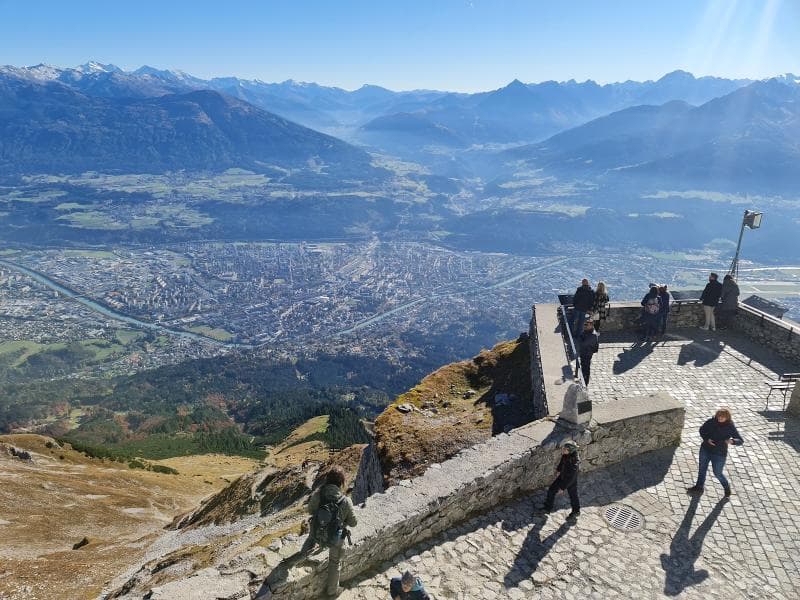
Ascend Innsbruck's Nordkette Cable Car for breathtaking alpine views and architectural marvels by Zaha Hadid. Experience Austria's majestic Karwendel mountains from city to summit.
Overview
The Nordkette Cable Car, often referred to as the 'Jewel of the Austrian Alps', offers a remarkable journey from the bustling city center of Innsbruck directly into the high alpine world of the Karwendel Nature Park. This unique experience allows visitors to ascend from an urban environment to over 2,000 meters above sea level in just minutes, providing breathtaking panoramic views of both the capital of the Alps and Tyrol's most extensive conservation area.
Comprising a series of interconnected lifts, the Nordkette Cable Car system provides effortless access to a stunning natural landscape, making it a gateway for hikers, skiers, nature enthusiasts, and those simply seeking unparalleled vistas. Its seamless connection between city life and rugged mountain scenery is a defining characteristic of Innsbruck.
History & Cultural Background
The vision for a cable car connecting Innsbruck to its northern mountain range emerged in the early 1900s. The first significant step was the construction of the original Hungerburgbahn funicular, which opened on September 12, 1906.
This initial funicular was an engineering marvel for its time, featuring a bridge spanning the Inn river. It quickly became a beloved recreational link for the people of Innsbruck to the Hungerburg area.
Further expansion in 1927 saw the construction of the Seegrubenbahn and Hafelekarbahn, planned by architect Karl Innerebner, extending the reach further into the Nordkette. These sections went into operation after just a year of construction in 1928, creating the full Nordkette connection.
In the early 21st century, a major renewal project transformed the lower section of the Nordkette system. The old Hungerburgbahn was replaced and re-routed, opening in December 2007.
This modern iteration features spectacular station buildings designed by the renowned Iraqi-British architect Zaha Hadid. Her design for the stations—Congress, Löwenhaus, Alpenzoo, and Hungerburg—brought international attention and acclaim for their futuristic and organically shaped structures. While the upper sections (Seegrube to Hafelekar) retained their original Franz Baumann-designed station buildings, they underwent significant technical upgrades.
What Makes It Special
The Nordkette Cable Car stands out for its extraordinary juxtaposition of urban and alpine environments. One can depart from a station nestled near Innsbruck's historic old town and, in approximately 20 minutes, be immersed in a high-alpine landscape at over 2,200 meters.
A primary draw is the groundbreaking architecture of the Hungerburgbahn stations. Zaha Hadid's designs, characterized by their fluid, glacier-like forms and extensive use of double-curved glass, are considered masterpieces of modern architecture. These stations integrate seamlessly into their diverse surroundings, from the urban setting of the Congress station to the natural backdrop of Hungerburg.
The journey itself offers a continually evolving panorama. As the cable car ascends through distinct climatic zones, passengers witness a dramatic shift in scenery, from the Inn Valley to the rugged peaks of the Karwendel. From the summit at Hafelekar, a complete 360-degree view unfolds, showcasing the sprawling city of Innsbruck on one side and the untouched wilderness of Austria's largest nature park on the other.
Stories, Fun Facts & Local Details
The construction of the original Nordkettenbahn in the 1920s involved immense human effort. For example, before an auxiliary cable car was built, ten porters transported materials up to the Seegrube, making the journey twice daily with an average load of 70 kg each.
Zaha Hadid's architectural vision for the Hungerburgbahn stations was inspired by natural phenomena such as glacial moraines and ice movements. She aimed to create structures that evoke the fluid language of natural ice formations, like a frozen stream on a mountainside, achieving this through innovative materials and manufacturing techniques.
The Hungerburgbahn serves not only as a tourist attraction but also plays a vital role in daily life, functioning as public transport for the residents of the Hungerburg district.
An interesting stop along the way is the Alpenzoo, Europe's highest-lying zoo, making the Nordkette journey appealing for families.
The new Hungerburgbahn, opened in 2007, was shortlisted for the prestigious Stirling Prize by the Royal Institute of British Architects in 2008, a testament to its architectural significance.
Visitor Perspective
The journey to the 'Top of Innsbruck' unfolds in several stages, each offering a distinct experience. It typically begins at the Congress station in the city center, where the Hungerburgbahn funicular transports visitors uphill. This segment passes through stops like Löwenhaus and Alpenzoo before reaching the Hungerburg station.
From Hungerburg, a short walk leads to the Seegrubenbahn cable car, which ascends to the Seegrube station at 1,905 meters. This area is perfect for enjoying culinary delights at the Seegrube Restaurant, taking in views, or starting various hiking trails.
The final ascent is via the Hafelekarbahn cable car to the Hafelekar station, which sits at an impressive 2,269 meters. Here, visitors are greeted with the most spectacular viewing platform, offering expansive views and an undeniable sense of being on top of the world.
The entire round trip to Hafelekar, including time for enjoying the views and perhaps a meal, is recommended to take at least three hours, with the actual travel time for the lifts being approximately 70-80 minutes for a round trip.
The Nordkette Cable Car system is designed to be accessible, with elevators and ramps available at various points, and the Seegrube restaurant and station restrooms are also wheelchair-friendly.
Coordinates: 11.3986, 47.2691
View on Google Maps💬 How Travelers Describe This Place
Based on community votes
Photogenic
791Interesting
457Unique
252Must See
147Beautiful
19
Traveler Stories
Discover memorable experiences shared by travelers who have visited this place.
No traveler stories yet.
Be the first traveler to share what made this place memorable.
Things to see at Nordkette Cable Car



Tour
By
Spot
Discover amazing places around the world. Your journey starts here.
Explore
© 2026 TourBySpot. All rights reserved.