Knez Mihailova Street
Belgrade, Serbia
Discover Knez Mihailova Street, Belgrade, Serbia's iconic pedestrian zone. Explore rich history, stunning architecture, and vibrant culture.
Overview
Knez Mihailova Street, known formally as Ulica Kneza Mihaila, stands as the vibrant pedestrian and shopping heart of Belgrade, Serbia. This iconic thoroughfare, stretching for approximately one kilometer, connects the historic Kalemegdan Fortress and park at one end with the bustling Republic Square at the other. More than just a street, Knez Mihailova is a legally protected spatial cultural-historical unit, recognized as one of the city's most ancient and valuable landmarks. It was officially named after Prince Mihailo Obrenović III, a significant Serbian ruler from the 19th century. Today, it serves as a central meeting point, a cultural artery, and a lively promenade that encapsulates the spirit of Belgrade, drawing both locals and international visitors into its historical embrace.
History & Cultural Background
The story of Knez Mihailova Street is deeply interwoven with Belgrade's multifaceted past, tracing its origins back to ancient times. Archaeological evidence suggests that the street follows the central grid layout of Roman Singidunum, the ancient settlement that later became Belgrade. During the Roman era, it functioned as a main access road, or 'via cardo', to the city. In the subsequent Ottoman period, the area was characterized by bustling trade routes, gardens, fountains, and mosques.
The street as we largely know it today began to take shape in the 19th century, undergoing a significant transformation into a sophisticated boulevard. This shift was largely influenced by the first Serbian urban plan for Belgrade, drafted by Emilijan Josimović in 1867. His vision was instrumental in reshaping the city from its oriental appearance towards a more European urban design. In 1870, two years after the assassination of Prince Mihailo Obrenović, the city authorities officially named the street in his honor. Many of the elegant buildings lining the street were constructed during the late 1870s, showcasing the architectural styles favored by the city's wealthiest families. Its historical and cultural value led to its protection as a spatial cultural-historical unit in 1964, a status later elevated in 1979 by the Republic of Serbia.
What Makes It Special
Knez Mihailova Street is special for its remarkable blend of historical depth and vibrant contemporary life. Its architecture is a visual feast, featuring a harmonious mix of neoclassical, Art Nouveau, Baroque, and even some Austro-Hungarian influences. Visitors are captivated by the beautifully preserved 19th-century facades, often adorned with intricate details, ornate balconies, and corner domes, which speak volumes of Belgrade's past prosperity and European aspirations.
Beyond its aesthetic appeal, the street is Belgrade's buzzing social and cultural epicenter. It is a dynamic pedestrian zone, free from vehicular traffic since 1987, creating a welcoming space for strolls and gatherings. Knez Mihailova hosts numerous cultural institutions, including the prestigious Serbian Academy of Sciences and Arts (SANU), Instituto Cervantes, Goethe-Institut, and Institut français de Serbie, solidifying its role as a hub for intellectual and artistic exchange. Its lively atmosphere is further enhanced by an array of shops, from international brands to local boutiques, alongside outstanding cafes and traditional restaurants, making it a prime destination for shopping, dining, and people-watching.
Stories, Fun Facts & Local Details
- Knez Mihailova holds the distinction of being one of the first streets in Belgrade to be officially named in 1870, reflecting its early importance in the city's urban development.
- Beneath its modern pavement lie echoes of Roman Singidunum. During reconstruction, remains of a Roman castrum have been discovered, offering glimpses into Belgrade's deep historical layers.
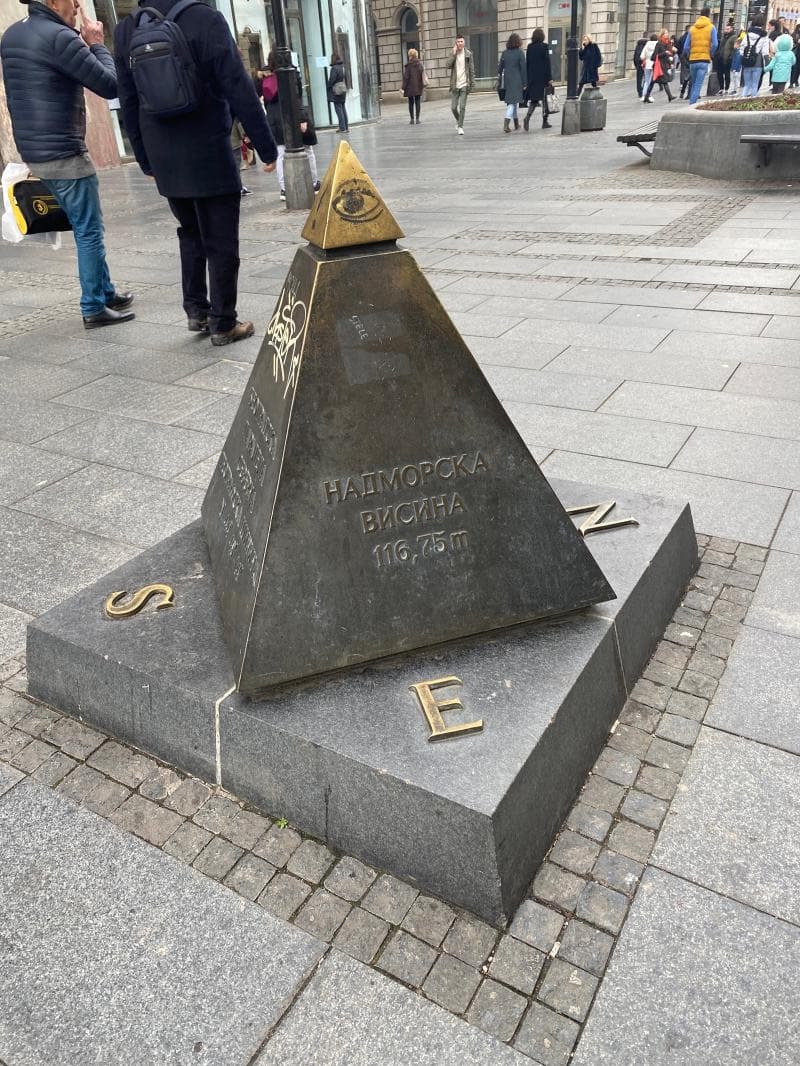
- One intriguing detail is the pyramid located in front of the Serbian Academy of Sciences and Arts building. Officially, it is a monument dedicated to science, displaying geographical coordinates of Belgrade; unofficially, it has sparked local legends and associations with Freemasonry.
- In the late 19th and early 20th centuries, the 'Hajduk Veljko' kafana (tavern) on the street was reportedly the first location where Belgraders could hear a phonograph in 1896, and it later became the city's first cinema in 1906.
- Many of the grand buildings that now house shops and cultural centers were once private residences belonging to Belgrade's wealthiest families until the mid-20th century.
Visitor Perspective
For any traveler exploring Belgrade, a visit to Knez Mihailova Street is an indispensable experience. It's often described as the city's lively heart, pulsating with energy from early morning until late evening. During the day, it's perfect for browsing shops, enjoying coffee at an outdoor cafe, and soaking in the architectural beauty. As evening descends, the street transforms, with buildings beautifully illuminated and a magical ambiance filling the air, complemented by live street music and performers.
Walking along Knez Mihailova offers a safe and engaging way to experience Belgrade's urban pulse. Visitors frequently praise its vibrant energy, friendly atmosphere, and the sheer joy of people-watching. Due to its central location, it is easily accessible and connects effortlessly to other major attractions like the Republic Square, National Museum, National Theatre, and the Kalemegdan Fortress. Comfortable shoes are recommended to fully enjoy a leisurely stroll along its kilometer-long expanse, taking in every detail from the elaborate facades to the diverse array of street artists and vendors. Whether you seek history, culture, or simply the vibrant rhythm of local life, Knez Mihailova offers an unforgettable glimpse into the soul of Belgrade.
Coordinates: 20.4569, 44.8178
View on Google Maps💬 How Travelers Describe This Place
Based on community votes
Beautiful
1.0kPhotogenic
563Must See
309Unique
100Interesting
63
Traveler Stories
Discover memorable experiences shared by travelers who have visited this place.
No traveler stories yet.
Be the first traveler to share what made this place memorable.
Things to see at Knez Mihailova Street



Tour
By
Spot
Discover amazing places around the world. Your journey starts here.
Explore
© 2026 TourBySpot. All rights reserved.