Bayterek Tower
Astana, Kazakhstan
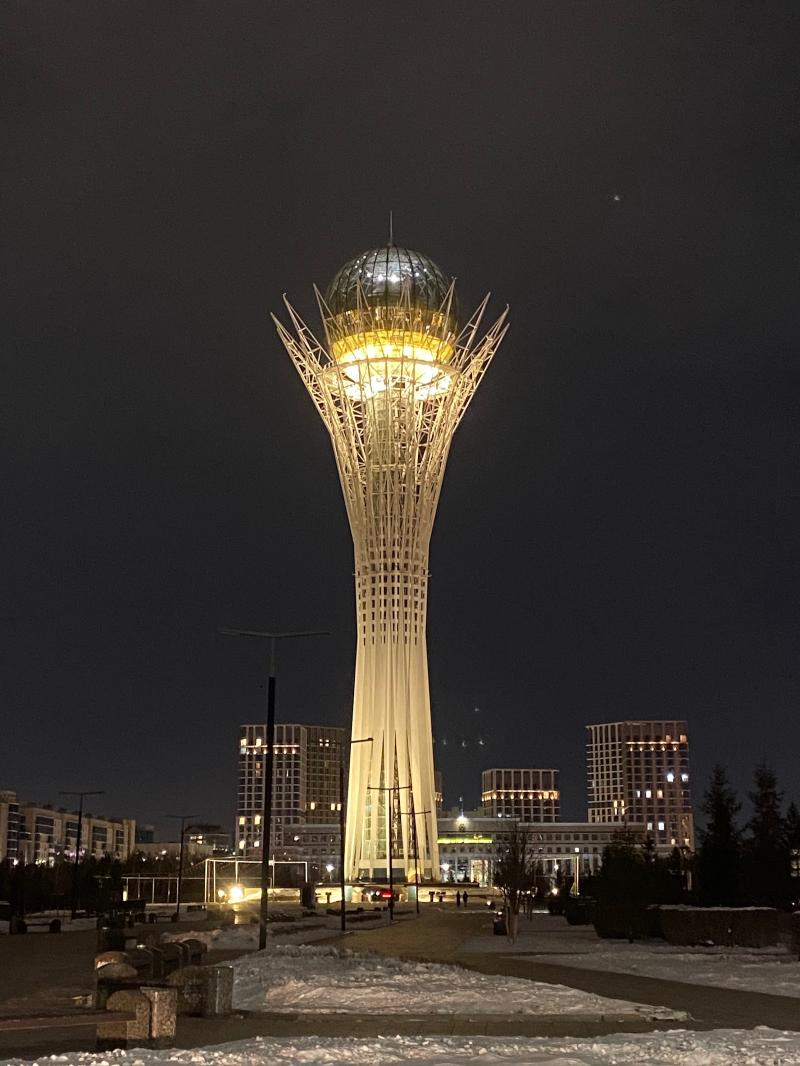
Discover the Bayterek Tower in Astana, Kazakhstan, an iconic monument embodying a Kazakh legend of a mythical bird and a golden egg, offering panoramic city views.
Overview
The Bayterek Tower stands as a radiant symbol of modern Kazakhstan, gracing the skyline of its capital, Astana. This iconic monument, often described as a 'tree of life' holding a golden egg, captures the imagination with its unique design and profound cultural significance. Rising to a total height of 105 meters, with its observation deck famously situated at 97 meters, the tower offers a striking blend of architectural innovation and ancient folklore. Since its opening in 2002, the Bayterek has become a must-visit destination, embodying the aspirations and vibrant spirit of a young nation on the global stage.
History & Cultural Background
The very name 'Bayterek' holds deep meaning, translating from Kazakh as 'tall poplar tree' or 'tree of life'. This monument is a physical manifestation of a revered Kazakh folktale involving the mythical Samruk bird, a creature believed to lay a golden egg in the highest branches of the sacred Tree of Life. In this legend, the egg symbolizes the sun, life, and the promise of a bright future, while the Tree of Life itself connects the underworld, the earthly realm, and the heavens. The tower's design directly reflects this ancient narrative, with its robust metal structure representing the World Tree and the massive golden sphere at its apex embodying the miraculous golden egg.
The concept for the Bayterek Tower originated from Nursultan Nazarbayev, the first President of independent Kazakhstan. Construction began in 1996, and the tower officially opened to the public in 2002. Its creation was not merely an architectural feat but a profound statement marking a pivotal moment in Kazakhstan's history: the relocation of its capital from Almaty to Astana in 1997. This historical year is commemorated by the observation deck's height, precisely 97 meters above ground, a powerful nod to the nation's new beginnings and ambitious vision.
What Makes It Special
What truly sets the Bayterek Tower apart is its seamless fusion of cutting-edge design with rich spiritual symbolism, bridging ancient traditions with modern national identity. The most captivating feature for many visitors is the spherical observation deck, encased in a shimmering golden sphere. From here, panoramic glass elevators transport guests skyward, revealing breathtaking 360-degree views of Astana's evolving cityscape.
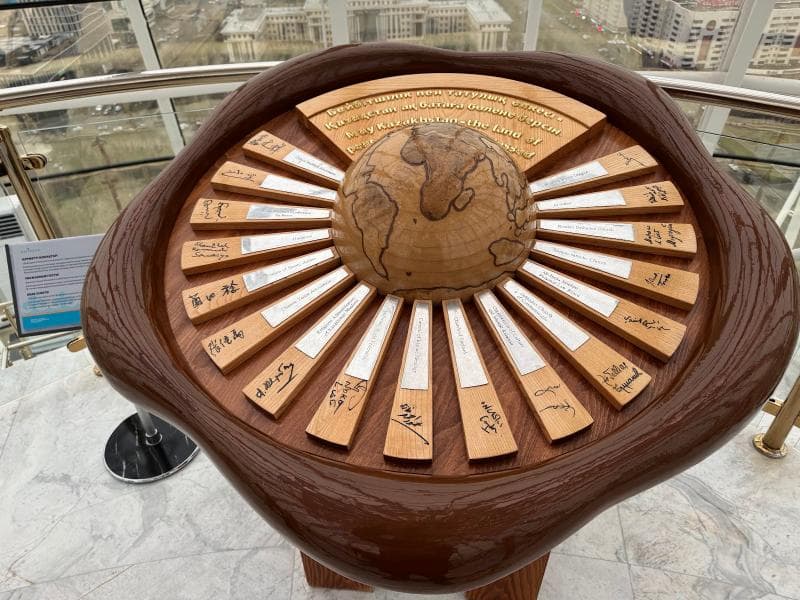
Inside this golden 'egg,' a unique ritual awaits: visitors can place their hand into a gilded imprint of the right hand of President Nazarbayev. It's a tradition believed to grant wishes, and a chime sounds upon contact, adding a touch of magic to the experience. Also within the sphere is a striking wooden globe sculpture, its 17 petals signed by representatives of different world religions. This installation serves as a powerful testament to Kazakhstan's commitment to peace, unity, and interfaith harmony. The sphere itself is crafted from 'chameleon' glass, a material designed to change color with the shifting sunlight, making it a dynamic and living architectural element.
Stories, Fun Facts & Local Details
Beyond its grand symbolism, the Bayterek Tower holds several fascinating stories and details that bring it to life. One popular anecdote recounts that President Nazarbayev first sketched the tower's design on a napkin during a state dinner, an origin story that adds a charming, personal touch to this national landmark. Locally, some citizens affectionately refer to the tower as a 'Chupa Chups,' a playful comparison to the well-known lollipop, highlighting its distinct and recognizable silhouette.
The tower's significance is also etched into the nation's daily life; it is proudly featured on the 10,000 Kazakhstani Tenge banknote. As mentioned, the precise height of the observation deck at 97 meters is not arbitrary but a deliberate tribute to the year 1997, when Astana officially became the capital of Kazakhstan, marking a new chapter for the country. The monument's overall structure is also interpreted as representing the three realms of existence from ancient nomadic mythology: the subterranean roots, the earthly trunk, and the celestial crown, each level offering a different perspective on the world.
Visitor Perspective
A visit to the Bayterek Tower is an immersive journey. From the ground level, where exhibition spaces, cafes, and even an aquarium can be found, you ascend through the tower's core. The panoramic elevators offer a sense of anticipation as they smoothly carry you upwards. Upon reaching the observation deck, the vast expanse of Astana unfolds below, a testament to rapid urban development against the backdrop of the Kazakh steppe. You can clearly discern the city's meticulous planning, with its wide avenues and monumental buildings.
For the best experience, consider timing your visit for late afternoon to witness the city bathed in golden sunlight, transitioning into a mesmerizing display of illuminated architecture as night falls. The tower itself glows spectacularly after dark, adding to the city's enchanting ambiance. Strategically located on Nurzhol Boulevard, a grand pedestrian walkway, the Bayterek is not just a standalone attraction but a central point from which to explore Astana's modern governmental and cultural district, making it an essential part of any itinerary in the Kazakh capital.
Coordinates: 71.4305, 51.1283
View on Google Maps💬 How Travelers Describe This Place
Based on community votes
Unique
540Must See
470Beautiful
410Photogenic
147Interesting
114
Traveler Stories
Discover memorable experiences shared by travelers who have visited this place.
No traveler stories yet.
Be the first traveler to share what made this place memorable.
Things to see at Bayterek Tower





Tour
By
Spot
Discover amazing places around the world. Your journey starts here.
Explore
© 2026 TourBySpot. All rights reserved.