Wat Arun
Bangkok, Thailand
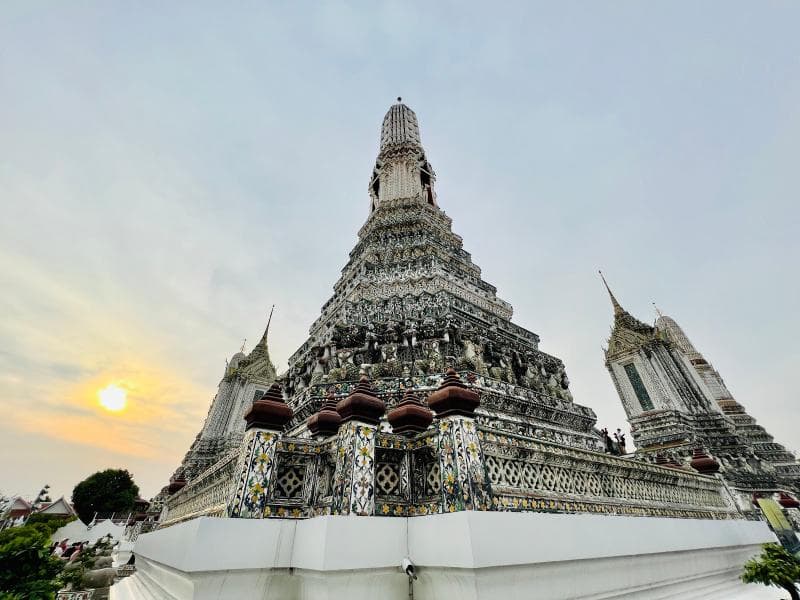

Discover Wat Arun, Bangkok's iconic Temple of Dawn. Explore its stunning prangs adorned with porcelain, rich history, and spiritual significance in Thailand.
Overview
Perched majestically on the west bank of the Chao Phraya River, Wat Arun, often affectionately known as the 'Temple of Dawn', stands as an iconic landmark of Bangkok, Thailand. Its distinctive central spire, or prang, soaring into the sky, is instantly recognizable and a testament to Thailand's rich artistic and cultural heritage. Adorned with intricate patterns of colorful porcelain and seashells, this Buddhist temple offers a visual spectacle that changes with the light, from the soft hues of sunrise to the golden glow of sunset. It is not merely a beautiful structure but a profound symbol, deeply embedded in the nation's history and spiritual landscape.
History & Cultural Background
The origins of Wat Arun trace back to the Ayutthaya period, when it was a more modest temple known as Wat Makok, meaning 'Olive Temple', named after the wild olives growing in the area. Its transformation began in 1768 when King Taksin, after the fall of Ayutthaya, arrived at the temple as dawn broke, selecting it for his new capital in Thonburi. He renamed it Wat Chaeng, or 'Temple of Dawn', signifying a new beginning for the kingdom. For a significant period between 1779 and 1784, Wat Arun held Thailand's most revered artifact, the Emerald Buddha, before it was moved across the river to Wat Phra Kaew in the Grand Palace.
The temple we admire today was largely developed during the early 19th century under the reigns of King Rama II and King Rama III of the Chakri Dynasty. King Rama II initiated the enlargement of the central prang, a vision completed by King Rama III, transforming it into the towering structure seen today. Its full ceremonial name is Wat Arun Ratchawararam Ratchawaramahawihan, reflecting its royal connection and status as a cultural icon of the Rattanakosin Kingdom.
What Makes It Special
What truly sets Wat Arun apart is its breathtaking architecture, particularly its towering central prang and the surrounding four smaller satellite prangs. Rising between 70 and 86 meters, the central prang is a magnificent representation of Mount Meru, the cosmic center of the universe in both Hindu and Buddhist cosmology.
The intricate decoration is another hallmark of its uniqueness. Thousands of pieces of colorful porcelain, often salvaged from the ballast of Chinese trading ships, along with seashells, are meticulously embedded into the prangs. This creates a spectacular mosaic that glimmers under the sunlight, giving the temple its radiant quality. The architectural style harmoniously blends traditional Khmer and Thai influences, showcasing a rich cultural exchange that shaped the region's artistic expression.
The sight of Wat Arun from across the Chao Phraya River, especially at sunrise or sunset, is an unforgettable experience. The play of light on its ornate surfaces highlights its beauty, creating a serene yet grand spectacle that captivates all who witness it.
Stories, Fun Facts & Local Details
The name 'Wat Arun' itself is steeped in symbolism, deriving from Aruna, the Hindu god personified as the reddish glow of the rising sun. This connection beautifully explains its popular moniker, 'Temple of Dawn'. A captivating detail about its construction is the use of discarded Chinese porcelain. Instead of using precious metals, artisans creatively repurposed broken ceramic pieces, often from trading ship ballast, to create the temple's distinctive sparkling facade. This not only speaks to ingenuity but also to the historical trade links between Siam and China.
Within the temple complex, the ordination hall houses a significant Buddha image. This image was personally designed by King Rama II, and its base enshrines his royal ashes, offering a poignant connection to the monarch who profoundly influenced the temple's form. Furthermore, the central prang features four Buddha images depicting key moments in the Buddha's life, including his birth, first sermon, enlightenment, and nirvana.
Currently, Wat Arun is recognized on the UNESCO Tentative List for World Heritage Sites, a significant step acknowledging its 'outstanding universal value' and cultural importance on a global scale, though it is not yet a full World Heritage Site.
Visitor Perspective
Visiting Wat Arun is an immersive experience. Situated conveniently on the west bank of the Chao Phraya River, it is best accessed by a scenic cross-river ferry from the Tha Tien Pier, which provides magnificent views as you approach. The temple is open daily from 8:00 AM to 6:00 PM, with the last entry typically around 5:30 PM. For foreign visitors, there is an entrance fee of 200 Thai Baht, payable in cash at the gate.
To show respect for this active place of worship, visitors are required to dress modestly. This means ensuring your shoulders and knees are covered. For those who may not be dressed appropriately, sarongs are often available for rent. The best times to visit are early morning, right after opening, or late afternoon. These times offer cooler temperatures, fewer crowds, and the most enchanting light for photography. While you can admire its beauty from the ground, climbing the steep steps of the central prang offers breathtaking panoramic views of the winding Chao Phraya River, the Grand Palace, and Wat Pho on the opposite bank, creating an unforgettable perspective of Bangkok's historic heart.
Coordinates: 100.48889, 13.74361
View on Google Maps💬 How Travelers Describe This Place
Based on community votes
Photogenic
826Unique
800Must See
589Interesting
387Beautiful
90
Traveler Stories
Discover memorable experiences shared by travelers who have visited this place.
No traveler stories yet.
Be the first traveler to share what made this place memorable.
Things to see at Wat Arun



Tour
By
Spot
Discover amazing places around the world. Your journey starts here.
Explore
© 2026 TourBySpot. All rights reserved.