Stone Bridge
Skopje, North Macedonia
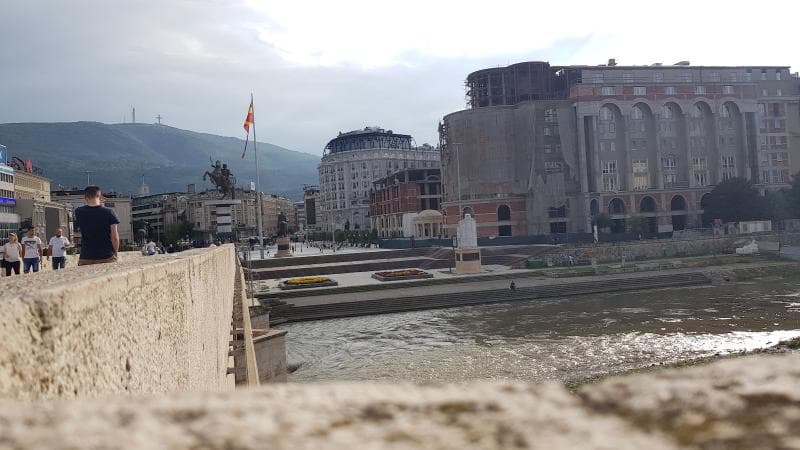
Discover Skopje's iconic Stone Bridge, a historic landmark connecting Macedonia Square to the Old Bazaar. Explore its rich history and cultural significance in North Macedonia.
Overview
The Stone Bridge, locally known as 'Kamen Most', stands as an enduring symbol of Skopje, North Macedonia. This historic masonry bridge gracefully spans the Vardar River, forming a crucial pedestrian link between the city's bustling Macedonia Square on the south bank and the ancient charm of the Old Bazaar on the north. More than just a crossing, it is one of Skopje's most recognizable landmarks, deeply ingrained in the city's identity, even featuring prominently on its coat of arms and flag. Visitors traversing its solid stone surface are offered a unique perspective of Skopje, connecting the contrasting modern and historical facets of the capital.
Constructed from robust stone blocks and featuring twelve elegant semicircular arches, the bridge is approximately 214 meters long and 6 meters wide. It offers picturesque views of the Vardar River, the surrounding embankments, and the distant Kale Fortress perched on a hill. Whether bathed in the golden light of sunset or illuminated against the night sky, the Stone Bridge provides a captivating backdrop and a central point for exploring Skopje's rich heritage.
History & Cultural Background
The origins of the Stone Bridge are steeped in a history that stretches back centuries, with some historical accounts and archaeological findings suggesting its initial construction or foundations date to the 6th century, following the devastating earthquake of 518 AD during the reign of Byzantine Emperor Justinian I. However, the bridge in its current, magnificent form primarily hails from the Ottoman period. It was meticulously rebuilt or constructed under the patronage of Sultan Mehmed II the Conqueror between 1451 and 1469.
Throughout its long existence, the Stone Bridge has silently witnessed pivotal moments in Skopje's history. It suffered damage during the powerful earthquake of 1555 but was swiftly repaired, a testament to its enduring importance. The bridge also played a somber role, serving as the site for historical executions, most notably that of the rebel leader Karposh in 1689. Remarkably, it narrowly escaped destruction at the end of World War II when retreating German forces were persuaded by local officials not to demolish it. More recently, the bridge underwent extensive reconstruction beginning in 1994, a process that spanned seven years, ensuring its preservation for future generations.
What Makes It Special
The Stone Bridge is special not only for its architectural grandeur but for its profound symbolic significance. It is a powerful emblem of Skopje's resilience and its complex cultural tapestry. The bridge embodies the connection between different eras and civilizations that have shaped the city: from ancient Roman foundations to Byzantine influences, then flourishing under Ottoman rule, and finally adapting to modern Skopje. It literally and figuratively bridges the divide between the historical Ottoman-era Old Bazaar and the more contemporary, often grand, architecture of Macedonia Square.
Its robust construction, featuring finely chiseled travertine blocks and clever engineering elements like spurs on its piers to mitigate flood damage, speaks to the advanced building techniques of its time. The presence of a reconstructed guardhouse further adds to its historical authenticity and aesthetic appeal. The bridge's role as a vibrant pedestrian thoroughfare means it remains a living part of the city, constantly abuzz with locals and visitors, facilitating daily life and cultural exchange.
Stories, Fun Facts & Local Details
One interesting detail about the Stone Bridge is the minor debate surrounding the exact number of its arches; while many sources cite twelve, some also refer to thirteen. Regardless, each arch contributes to its majestic appearance and structural integrity. Local legend and history whisper tales of its ancient past, reflecting the city's deep roots and continuous inhabitation. The fact that it stands on older Roman foundations suggests a continuity of urban life and a strategic crossing point over the Vardar for nearly two millennia.
For several years, the bridge hosted a unique local event called 'Breakfast on the Bridge,' where, once a year, on a Sunday morning, a collective breakfast was held right on its surface. This initiative, though no longer active, highlighted the bridge's role as a community gathering space and a cherished part of Skopje's social fabric. The bridge is also sometimes referred to as the Dušan Bridge, paying homage to Serbian King Stefan Dušan, who was crowned in Skopje in 1345. This nod to various historical figures underscores the rich tapestry of narratives woven into its stone.
Visitor Perspective
Walking across the Stone Bridge is an essential experience for any visitor to Skopje. It's a journey not just over a river, but through time, connecting distinct urban landscapes and cultural atmospheres. Starting from Macedonia Square, you can stroll across, observing the Vardar River flowing beneath, and then emerge directly into the captivating labyrinth of the Old Bazaar.
The bridge offers fantastic photographic opportunities, especially during the golden hour of sunset when the stonework glows, or in the evening when the bridge is beautifully illuminated. Early mornings provide a quieter, more reflective experience, perfect for those seeking solitude and an unobstructed view. From the bridge, one can gaze up at the historical Kale Fortress, observe the city's monuments, and truly appreciate Skopje's unique blend of old and new. The Stone Bridge is not merely a path; it is an invitation to engage with Skopje's soul, a place where history, culture, and everyday life converge.
Coordinates: 21.433071, 41.996992
View on Google Maps💬 How Travelers Describe This Place
Based on community votes
Beautiful
915Interesting
873Photogenic
422Must See
123Unique
53
Traveler Stories
Discover memorable experiences shared by travelers who have visited this place.
No traveler stories yet.
Be the first traveler to share what made this place memorable.
Things to see at Stone Bridge



Tour
By
Spot
Discover amazing places around the world. Your journey starts here.
Explore
© 2026 TourBySpot. All rights reserved.