St. Nicholas's Cathedral
Ljubljana, Slovenia
Explore St. Nicholas's Cathedral in Ljubljana, Slovenia: a stunning Baroque masterpiece with rich history, intricate frescoes, and iconic bronze doors.
Overview
St. Nicholas's Cathedral, Ljubljana's striking Baroque masterpiece, stands proudly in the city's historical heart. Officially known as Stolnica svetega Nikolaja, this venerable cathedral is an unmistakable landmark, easily recognized by its distinctive green dome and two towering bell towers that pierce the Ljubljana skyline. As the seat of the Archbishop of Ljubljana, it serves as the spiritual epicenter of the city and a testament to centuries of rich religious and cultural heritage in Slovenia. Its prime location on Cyril and Methodius Square, adjacent to the Central Market, makes it a focal point for both locals and curious travelers exploring the charming Old Town.
History & Cultural Background
The history of St. Nicholas's Cathedral is deeply intertwined with Ljubljana's own narrative, tracing its origins back to a Romanesque basilica first mentioned in 1262. This early church faced repeated trials, enduring significant fires in 1361 and 1469, the latter reportedly started by Turks. Each reconstruction brought changes, with a Gothic style emerging after the first fire. A pivotal moment arrived in 1461 when Ljubljana became a diocesan seat, elevating the church's status and necessitating further renovations. The current Baroque edifice, a grand vision, began construction in 1701, guided by the renowned Jesuit architect Andrea Pozzo. Pozzo's design transformed the site into a magnificent Latin cross layout with elegant side chapels, and by 1706, the main construction was complete, marking a new era of splendor. For a century, the cathedral featured a painted illusion of a dome, until a true green dome was finally built in 1841, dramatically altering Ljubljana's silhouette. Later in the 20th century, particularly in 1996, the cathedral received its iconic bronze doors, commissioned to commemorate 1250 years of Christianity in Slovenia and a visit by Pope John Paul II.
What Makes It Special
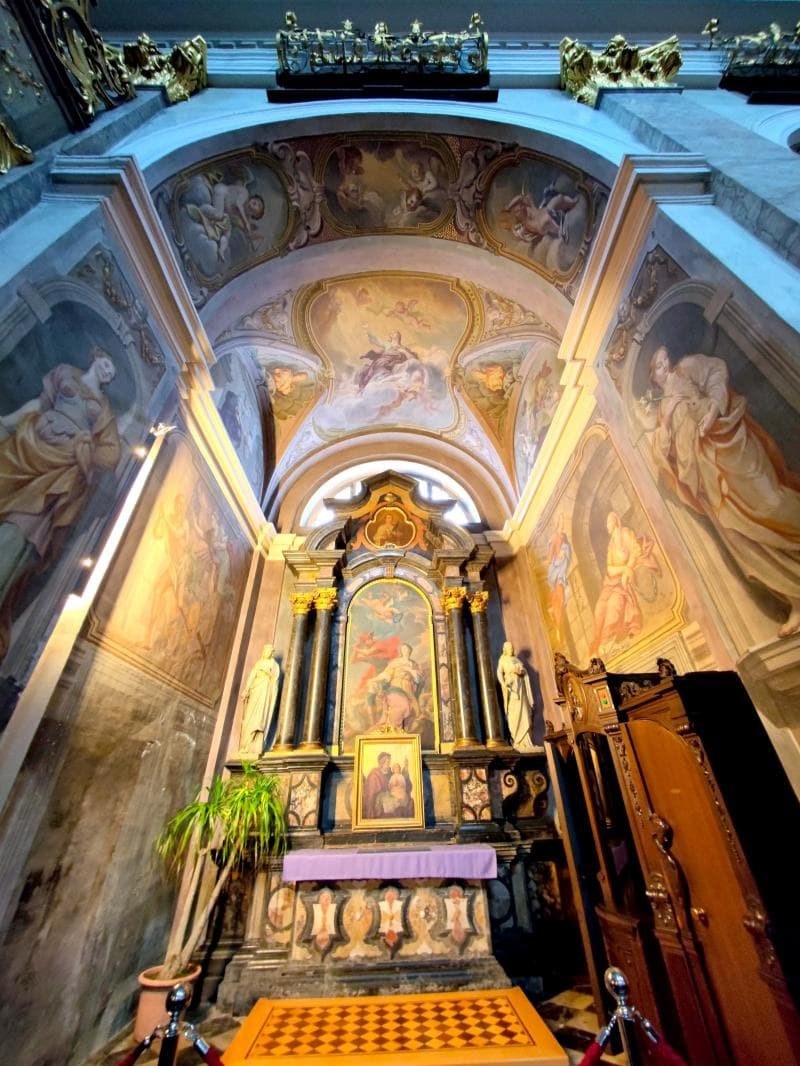
The interior of St. Nicholas's Cathedral is a Baroque marvel, captivating visitors with its opulent decoration and artistic grandeur. Every surface seems to tell a story, adorned with intricate frescoes, sculptures, and gilded details. The ceilings and walls are famously covered by the illusionistic frescoes of Giulio Quaglio, painted between 1703-1706 and again in 1721-1723, which create a breathtaking sense of depth and heavenly expanse. Later, Matevž Langus contributed to the dome's frescoes in 1844, further enriching the visual tapestry with vibrant angels and religious scenes. Notable sculptures include the altar angels by Francesco Robba and the brothers Paolo and Giuseppe Groppelli, adding to the cathedral's artistic treasury. The cathedral's layout, a Latin cross with spacious side chapels, reflects classical Baroque design, creating a harmonious and awe-inspiring space for worship and contemplation. The striking main bronze doors by Tone Demšar, and the side doors by Mirsad Begić, are modern masterpieces that narrate Slovenia's Christian history and honor its bishops, providing a powerful and unique entry point into this sacred space.
Stories, Fun Facts & Local Details
Beyond its architectural splendor, St. Nicholas's Cathedral holds many intriguing details. The dramatic bronze doors are not merely entrances but storytelling portals. The main door depicts 1250 years of Christianity in Slovenia, featuring scenes like the baptism of converts and the nation's struggle through the 20th century, culminating with an image of Pope John Paul II. Interestingly, these doors lack traditional handles; worshippers gain entry by touching parts of the sculpted figures, which have become burnished gold over decades from countless hands. A much older detail is the ancient sundial located on one of the outer walls, dating from 1826, bearing Roman numerals and a Latin motto that translates to, 'You don't know the date or the hour,' a subtle reminder of life's transience. It's also said that to strengthen the mortar during construction, lime was mixed with wine, an old technique believed to improve binding properties. The bells in the cathedral's tower ring out hourly with a unique melody, a tradition maintained for over 300 years, adding an audible layer to the cathedral's timeless charm.
Visitor Perspective
Visiting St. Nicholas's Cathedral offers a profound journey through history, art, and spirituality. The cathedral is generally open daily, usually from early morning until evening, and admission is typically free, making it accessible to all. However, as it remains an active place of worship, visitors are kindly requested to dress modestly, covering shoulders and knees, and to maintain a respectful demeanor, especially during Mass times when access may be limited. For a quieter and more contemplative experience, it is advisable to visit before 9:30 AM or after 4:00 PM on weekdays, thereby avoiding peak tour group hours. Its central location in Ljubljana's Old Town, just a short walk from other major attractions like the Triple Bridge and Dragon Bridge, means it easily fits into any walking tour of the city, offering a peaceful sanctuary amidst the bustling streets. The cathedral stands as a living monument, inviting curious travelers to step inside and immerse themselves in its rich legacy.
Coordinates: 14.50778, 46.05056
View on Google Maps💬 How Travelers Describe This Place
Based on community votes
Beautiful
551Must See
547Photogenic
421Unique
298Interesting
212
Traveler Stories
Discover memorable experiences shared by travelers who have visited this place.
No traveler stories yet.
Be the first traveler to share what made this place memorable.
Things to see at St. Nicholas's Cathedral



Tour
By
Spot
Discover amazing places around the world. Your journey starts here.
Explore
© 2026 TourBySpot. All rights reserved.