St. Joseph's Cathedral
Hanoi, Vietnam
Discover St. Joseph's Cathedral in Hanoi, Vietnam – the city's oldest church with stunning Neo-Gothic architecture resembling Notre-Dame de Paris.
Overview
St. Joseph's Cathedral, known locally as Nha Tho Lon (Grand Cathedral or Big Church), stands as a magnificent and enduring landmark in the heart of Hanoi, Vietnam. This iconic structure, an exemplary work of Neo-Gothic architecture, is situated on Nha Chung Street within the bustling Hoan Kiem District, a short distance from the picturesque Hoan Kiem Lake. Measuring 64.5 meters in length, 20.5 meters in width, and featuring twin bell towers soaring to 31.5 meters, its design intentionally echoes that of the famous Notre-Dame Cathedral in Paris. As the oldest church in Hanoi and the seat of the Roman Catholic Archdiocese, it holds profound historical, architectural, and cultural significance, gracefully blending Western influences with subtle Vietnamese touches.
History & Cultural Background
The history of St. Joseph's Cathedral is deeply intertwined with Hanoi's colonial past. Construction began in 1884 under the French colonial administration, with the cathedral being consecrated on Christmas Day in 1886 and completed by 1888. It was built under the guidance of French missionary and apostolic vicar Paul-François Puginier. Remarkably, the cathedral occupies the former site of the ancient Bao Thien Pagoda, a significant Buddhist temple dating back to the 11th-century Ly Dynasty. The decision to erect a prominent Catholic church on this sacred ground symbolized the spread of Catholicism and French colonial power in Indochina. Throughout the French colonial period, it became the central hub for Catholicism in Northern Vietnam, hosting daily and weekly religious ceremonies. Following the French withdrawal in 1954, the cathedral was closed, only to reopen for services on Christmas Eve of 1990. Having weathered two fierce wars and numerous political shifts, the cathedral stands as a testament to resilience, witnessing countless ups and downs in Hanoi's history.
What Makes It Special
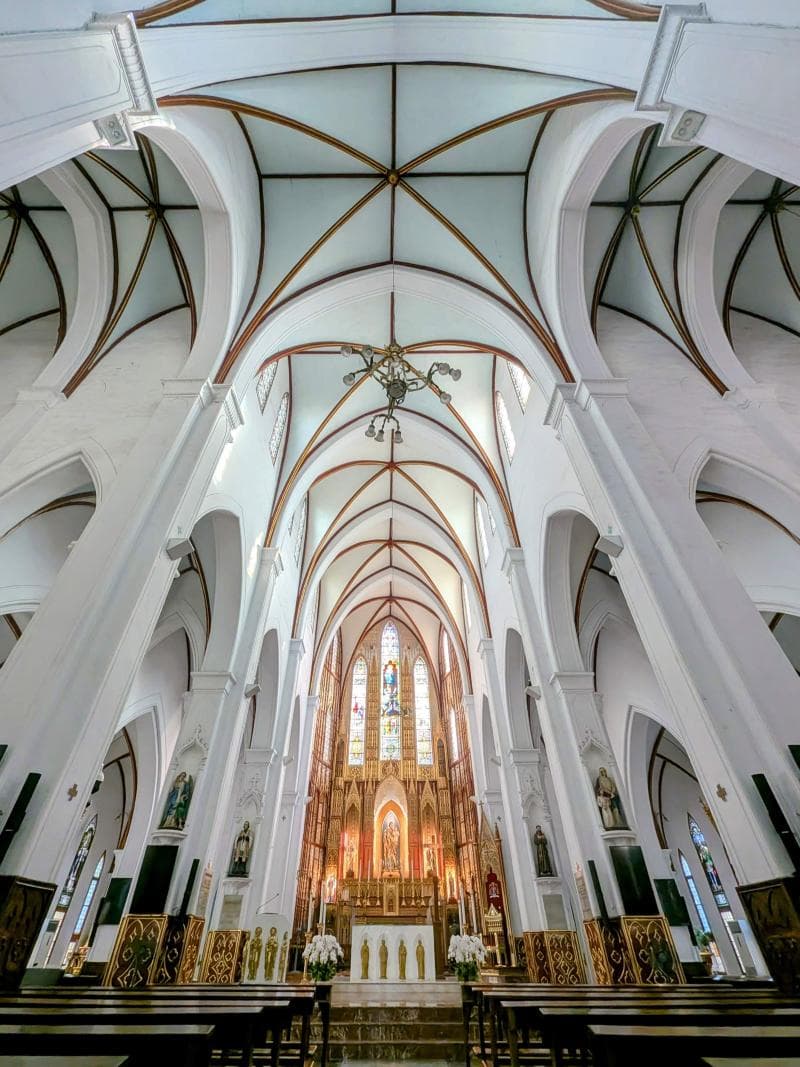
What truly sets St. Joseph's Cathedral apart is its captivating architectural style, a harmonious blend of European Gothic Revival and Vietnamese elements. Its striking exterior features pointed arches, rib-vaulted ceilings, tall stained-glass windows depicting biblical scenes, and twin bell towers that make it a recognizable landmark. The resemblance to Notre-Dame de Paris is undeniable, often earning it the moniker 'Notre-Dame of Hanoi.' Yet, a closer look reveals unique Vietnamese characteristics in its construction. The building's frame is made from baked clay bricks and red tiles, with pasteboard walls, and the altars inside are adorned with red and golden gilded wood, reflecting traditional Vietnamese temple aesthetics. This synthesis of Western and Eastern design gives the cathedral a distinctive charm not commonly found elsewhere. Its enduring presence, having survived over a century of change and conflict, further highlights its special place in Hanoi's urban landscape.
Stories, Fun Facts & Local Details
Beyond its architectural grandeur, St. Joseph's Cathedral is a vibrant part of contemporary Hanoi life, woven into the city's daily rhythm. Locals affectionately call it 'Nha Tho Lon,' meaning 'Big Church.' The square in front of the cathedral, adorned with a copper statue of Mother Maria (Queen of Peace), transforms into a lively social hub, especially in the evenings. This area is famous for its 'lemon tea culture' (trà chanh), where young people gather on low stools to chat and enjoy refreshments, creating a buzzing atmosphere that beautifully contrasts with the cathedral's ancient stone facade. During major holidays like Christmas and Easter, the cathedral becomes the epicenter of celebrations, decorated elaborately and drawing large crowds for special services, creating a truly festive ambiance. Sunday evening masses are particularly popular, with so many worshippers that the crowds often spill out onto the surrounding streets, listening to hymns and prayers broadcast from inside. Early mornings, roughly between 7:00 AM and 8:30 AM, offer the best light for photography and a more peaceful experience before the city fully awakens.
Visitor Perspective
Visiting St. Joseph's Cathedral offers a rich cultural and historical experience for any traveler to Hanoi. The exterior and its surrounding square are freely accessible 24/7, allowing for exterior viewing and photography at any time. For those wishing to explore the interior, access is generally permitted during non-mass hours, typically from 8:00 AM to 11:00 AM and 2:00 PM to 5:00 PM on weekdays, though Sunday hours may vary around mass schedules. When entering the cathedral, visitors are respectfully asked to dress modestly, ensuring shoulders and knees are covered, and to maintain a quiet demeanor. The cathedral's prime location in the Old Quarter means it is just a short 5- to 10-minute walk from Hoan Kiem Lake, making it an easy addition to any Hanoi itinerary. The surrounding streets, including Ly Quoc Su and Nha Chung, are lined with charming cafes, traditional Vietnamese restaurants, and boutiques, offering ample opportunities to enjoy local cuisine and soak in the vibrant street life after a visit.
Coordinates: 105.84889, 21.02861
View on Google Maps💬 How Travelers Describe This Place
Based on community votes
Unique
685Photogenic
472Beautiful
446Interesting
399Must See
33
Traveler Stories
Discover memorable experiences shared by travelers who have visited this place.
No traveler stories yet.
Be the first traveler to share what made this place memorable.
Things to see at St. Joseph's Cathedral



Tour
By
Spot
Discover amazing places around the world. Your journey starts here.
Explore
© 2026 TourBySpot. All rights reserved.