Pyramid Of Tirana
Tirana, Albania
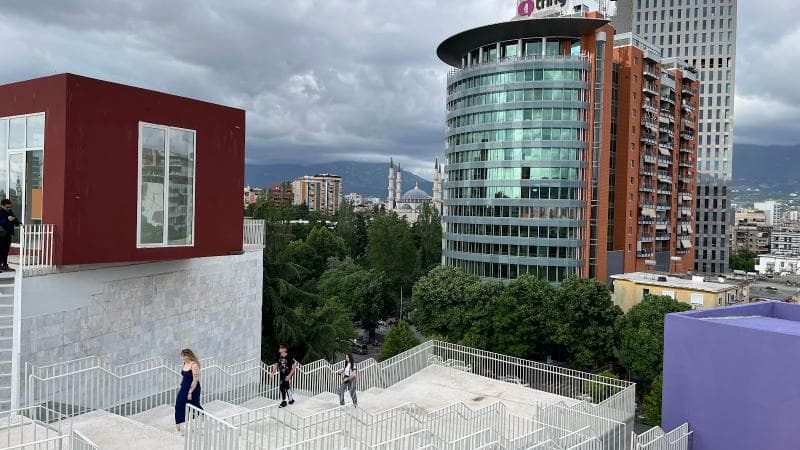
Explore the Pyramid of Tirana, Albania's iconic landmark transformed from a communist monument into a vibrant youth technology and cultural hub.
Overview
The Pyramid of Tirana, known locally as Piramida e Tiranës, stands as a profoundly symbolic and iconic landmark in the heart of Tirana, Albania. Once a monument to a past regime, this striking Brutalist structure has undergone a remarkable transformation, evolving into a vibrant hub for innovation, education, and cultural exchange. Its prominent location on Dëshmorët e Kombit Boulevard makes it easily accessible and a focal point for both residents and visitors eager to witness Albania's journey from a complex past to a dynamic future. Today, it invites exploration, reflection, and engagement, serving as a testament to the country's resilience and forward-looking spirit.
History & Cultural Background
The history of the Pyramid of Tirana is deeply intertwined with Albania's tumultuous political landscape. Inaugurated on October 14, 1988, the building was originally conceived as a museum dedicated to Enver Hoxha, the long-time communist leader who had died three years prior. It was an ambitious and costly project, co-designed by Hoxha's daughter, Pranvera Hoxha, and her husband Klement Kolaneci, alongside architects Pirro Vaso and Vladimir Bregu. The pyramid-shaped structure, intended to glorify Hoxha's legacy, was initially known as the Enver Hoxha Museum.
However, with the collapse of communism in Albania in 1991, the Pyramid's purpose shifted dramatically. Stripped of its original exhibits, it was repurposed as a conference center and exhibition venue, and later became known as the International Cultural Center. Its functions varied widely over the years; it briefly housed a nightclub, served as a base for NATO and humanitarian organizations during the 1999 Kosovo War, and even became home to Albanian media outlets like Top Channel and Top Albania Radio.
For decades, the Pyramid remained a controversial symbol. Debates raged over its fate, with some advocating for its demolition as a painful reminder of the communist dictatorship, while others argued for its preservation due to its unique architecture and historical significance. Despite periods of neglect, vandalism, and dilapidation, the structure persisted, a silent witness to Albania's ongoing transformation.
What Makes It Special
What makes the Pyramid of Tirana truly special is not just its striking Brutalist architecture, but its incredible journey of reinvention. Designed with a distinct pyramidal form, which some interpret as resembling an eagle from above, the building's design incorporated elements like an amphitheater-like interior with superimposed galleries and zenithal lighting. Initially clad in white marble, the building stood as an imposing structure.
The most recent and transformative chapter began with a major reconstruction completed in 2023, guided by the renowned Dutch architectural firm MVRDV. Rather than demolishing the structure, the renovation aimed to preserve its concrete shell while opening it up to the public. Steps were integrated along its sloping facades, inviting people to literally walk to the top. The interior and surrounding park now house colorful modular boxes, creating a dynamic village of cafes, studios, workshops, and classrooms. This bold transformation has converted the former monument into a contemporary cultural and educational hub, primarily serving as the TUMO Center Tirana, a free technology education center for youth.
Stories, Fun Facts & Local Details
The Pyramid has always had a fascinating, unofficial life alongside its formal uses. For many years, before its official renovation, young Albanians and tourists alike embraced the challenge of climbing its steep, slippery slopes. It became a rite of passage, a casual act of defiance, and a place where people would gather at the top for panoramic views of Tirana, sometimes even sliding down its marble tiles. This informal appropriation by the public directly inspired the architects of the recent renovation to incorporate accessible stairs into the design, solidifying its role as a truly public space.
The building's varied past also includes a period where parts were looted for their marble, and it offered shelter to homeless people, adding layers to its complex narrative. Located in front of the Pyramid, visitors can also find the Peace Bell, cast from expended shell casings from Albania's 1997 civil unrest, offering another poignant layer of history nearby.
Today, it stands as a powerful metaphor for Albania itself – a country that has transformed a painful past into a hopeful future, where citizens now literally 'walk all over' the symbol of a bygone dictatorship.
Visitor Perspective
Visiting the renovated Pyramid of Tirana offers a unique and engaging experience. There is no entrance fee to explore the exterior and its public areas, inviting everyone to interact with the structure. You can ascend the newly installed steps to the apex, where 360-degree views of Tirana unfold, providing an excellent vantage point to appreciate the city's blend of old and new.
The interior, now home to the TUMO Center, pulses with the energy of youth engaged in creative technologies, from computer programming to robotics. While specific opening hours for workshops may vary, the general public can often peek inside and feel the dynamic atmosphere of this educational hub. The surrounding park is also part of the experience, featuring cafes and spaces for relaxation. A typical visit to explore the architecture and public spaces might take an hour or two, but many find themselves lingering longer, captivated by the story and the vibrant new life of this once-controversial landmark.
Coordinates: 19.82138, 41.323131
View on Google Maps💬 How Travelers Describe This Place
Based on community votes
Beautiful
799Interesting
424Photogenic
234Must See
181Unique
30
Traveler Stories
Discover memorable experiences shared by travelers who have visited this place.
No traveler stories yet.
Be the first traveler to share what made this place memorable.
Things to see at Pyramid Of Tirana



Tour
By
Spot
Discover amazing places around the world. Your journey starts here.
Explore
© 2026 TourBySpot. All rights reserved.