Cultural Events
Tirana, Albania
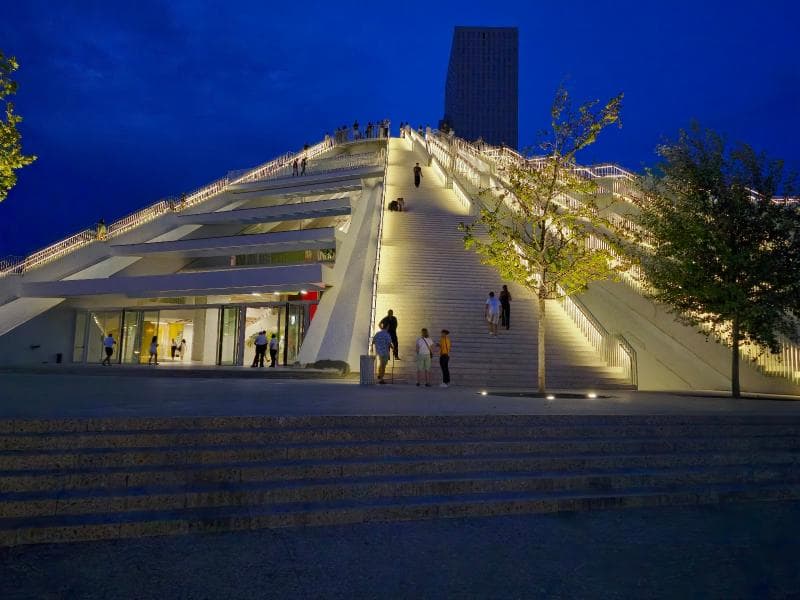
Discover cultural events at Tirana's Pyramid. This transformed landmark in Albania is now a vibrant hub for arts, tech education, and community gatherings.
Overview
The Pyramid of Tirana, located in the heart of Albania's bustling capital, stands as a powerful symbol of transformation. Once a monument shrouded in a controversial past, it has been dramatically reimagined as a vibrant cultural and educational hub, reflecting Albania's forward-looking aspirations. This iconic structure, originally built in the late 1980s, has undergone an extensive renovation, reopening in 2023 to serve as a dynamic center for creative technologies, arts, and community engagement.
Today, the Pyramid hosts a diverse array of cultural events, workshops, and exhibitions, primarily through the TUMO Tirana initiative, which offers free educational programs to young people. Its unique architectural redesign, featuring external climbable steps and colorful modular spaces, invites both locals and visitors to interact with its history and embrace its new purpose.
History & Cultural Background
The Pyramid's story began on October 14, 1988, when it opened as the Enver Hoxha Museum, a grandiose memorial dedicated to Albania's long-time communist dictator. Co-designed by Hoxha's daughter, Pranvera Hoxha, and her husband, Klement Kolaneci, among others, it was reportedly the most expensive individual structure ever built in Albania at the time. Its Brutalist architecture, characterized by monumental concrete forms, was intended to project power and symbolize the communist ideology.
Following the collapse of communism in 1991, the Pyramid's function shifted dramatically. It served various roles, including a conference center, an exhibition venue, a NATO base during the 1999 Kosovo War, a broadcasting center, and even a nightclub. For years, the building fell into disrepair, becoming an urban ruin and a popular, albeit unofficial, climbing spot for Tirana's youth. Debates raged about its future, with some advocating for demolition due to its association with a repressive regime, while others championed its preservation as part of the country's heritage.
Ultimately, a transformative renovation project led by the Dutch architectural firm MVRDV began in 2021 and concluded with its official inauguration in October 2023. This project preserved the original concrete shell while radically reinventing its interior and exterior, turning it into a contemporary cultural and educational hub.
What Makes It Special
The Pyramid of Tirana is extraordinary not only for its striking architecture but also for its profound symbolic journey. It represents a rare and successful example of adaptive reuse, transforming a controversial monument of a dictatorship into an accessible 'monument for the people'. The renovation ingeniously incorporated external staircases along its sloping facades, allowing the public to literally walk to its summit, offering a unique perspective on the city and reclaiming the structure from its past.
Inside and around its open structure, colorful modular 'boxes' house a variety of activities. These include cafes, studios, workshops, start-up offices, and classrooms. A significant portion of these spaces is dedicated to TUMO Tirana, a non-profit educational institution that provides free after-school programs for teenagers (aged 12-18) in cutting-edge digital disciplines like computer programming, robotics, animation, graphic design, music, and filmmaking. Beyond TUMO, the Pyramid is designed to be a central venue for arts and culture, offering exhibition spaces for visual arts, media labs, a movie theater, and rehearsal rooms, fostering creativity across various disciplines.
Stories, Fun Facts & Local Details
Locals sometimes sardonically referred to the original structure as the 'Enver Hoxha Mausoleum', reflecting its initial purpose and imposing presence. Before its renovation, the Pyramid's smooth concrete slopes were a de facto playground, with local teenagers frequently climbing up and sliding down its sides – an informal tradition now formally embraced by the new design's public steps. The decision to renovate rather than demolish the Pyramid aligns with principles of the circular economy, demonstrating how existing robust structures can be repurposed sustainably.
The new design with its vibrant 'boxes' and accessible roof transforms the Pyramid into a dynamic, open sculpture within a new public park, creating a festival-like atmosphere. It actively serves as a platform for concerts, festivals, Ted Talks, and various workshops, positioning itself as a central hub for Albania's burgeoning creative industries and ICT ecosystem.
Visitor Perspective
For a curious traveler, the Pyramid of Tirana offers a truly unique experience that bridges Albania's complex past with its vibrant future. Visitors are welcome to explore the site, including climbing the exterior steps to enjoy panoramic views of Tirana. The interior provides a glimpse into a lively educational and cultural environment, where young Albanians are honing skills in technology and creative arts. Engaging with the ongoing exhibitions or witnessing a workshop in action offers a tangible connection to the country's contemporary cultural narrative.
The blend of historical significance and modern innovation makes the Pyramid a compelling destination. It's a place to reflect on history, celebrate resilience, and observe the energetic pulse of Tirana's youth-driven cultural scene. Guided tours are also available for those seeking deeper insights into its layered history and its current role in the community.
Coordinates: 19.82139, 41.32306
View on Google Maps💬 How Travelers Describe This Place
Based on community votes
Beautiful
972Unique
787Must See
720Interesting
85Photogenic
73
Traveler Stories
Discover memorable experiences shared by travelers who have visited this place.
No traveler stories yet.
Be the first traveler to share what made this place memorable.

Tour
By
Spot
Discover amazing places around the world. Your journey starts here.
Explore
© 2026 TourBySpot. All rights reserved.