Piazzale Michelangelo
Florence, Italy
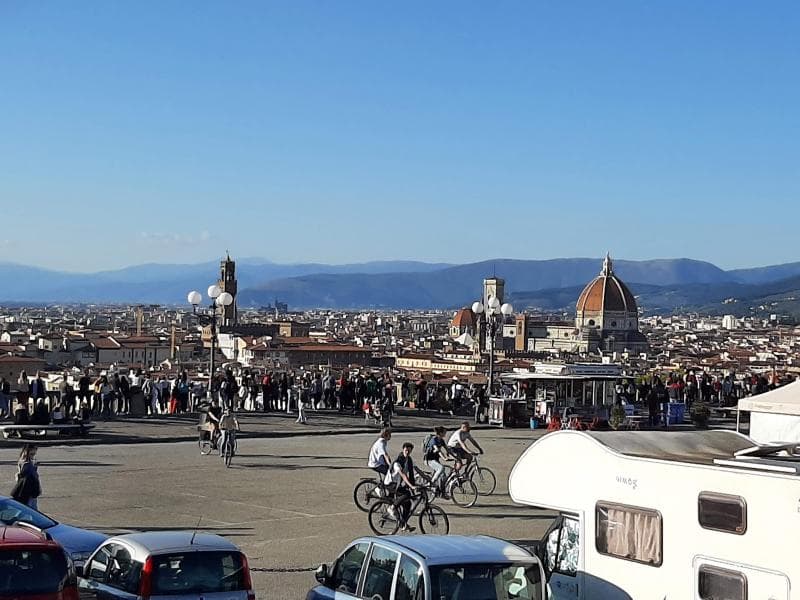
Experience the breathtaking panoramic views of Florence from Piazzale Michelangelo. Discover its history, the bronze David, and the iconic cityscape of Italy.
Overview
Perched high on a hill overlooking Florence, Italy, Piazzale Michelangelo offers one of the most iconic and breathtaking panoramic views of the city. This magnificent square, a true terrace over Florence, provides an unrivaled vista encompassing the Arno River, the Ponte Vecchio, the Duomo's majestic dome, Palazzo Vecchio, and the verdant Tuscan hills beyond. It serves as a beloved meeting point for both locals and travelers, especially at sunset, to witness the city bathed in golden light.
Designed in the 19th century, Piazzale Michelangelo is more than just a viewpoint; it's a dedicated homage to the great Renaissance master Michelangelo Buonarroti. At its heart stands a monument featuring bronze copies of some of his most celebrated works, including the iconic David and the four allegorical figures from the Medici Chapels. This blend of stunning natural beauty and profound artistic tribute makes it an essential stop on any Florentine journey.
History & Cultural Background
The creation of Piazzale Michelangelo was a significant part of Florence's urban renewal efforts during a pivotal moment in Italian history. Designed by the architect Giuseppe Poggi, construction began in 1869, at a time when Florence held the prestigious title of the capital of Italy, from 1865 to 1871.
Poggi's vision was grand: to transform the area into a panoramic tree-lined street, the Viale dei Colli, culminating in this expansive square dedicated to Michelangelo. The entire project was part of a broader 'Risanamento' or 'Renovation' of the city, aimed at enhancing its prestige and celebrating its rich artistic heritage. The square was officially opened two years after its commencement.
Initially, Poggi had intended for the neoclassical loggia that dominates the terrace to house a museum dedicated to Michelangelo's works. However, this museum never materialized, and the building was repurposed, becoming a restaurant-café by 1876. Nevertheless, the square still fulfills its purpose as a grand open-air tribute to the artist, solidifying Florence's identity as a hub of creativity and innovation.
What Makes It Special
What truly sets Piazzale Michelangelo apart is its unparalleled vantage point, offering arguably the finest panoramic view of Florence. From this elevated position, visitors can absorb the entire canvas of the Renaissance city in one sweeping gaze. The dome of Florence Cathedral, designed by Brunelleschi, stands prominently, alongside the medieval towers of Palazzo Vecchio and the unique Ponte Vecchio spanning the Arno.
Beyond the breathtaking vistas, the square's dedication to Michelangelo provides a profound connection to Florence's artistic soul. The central monument, with its bronze replica of David, serves as a powerful symbol. This copy, along with the bronze allegories of Day, Night, Dawn, and Dusk from the Medici Chapel, allows visitors to admire interpretations of Michelangelo's genius in an open, public space, contrasting with the original marble masterpieces housed within the city's museums.
The deliberate design by Giuseppe Poggi, transforming a hillside into such a magnificent public space, reflects a monumental civic pride. It's a place where history, art, and natural beauty converge, creating a truly unforgettable experience for anyone who visits.
Stories, Fun Facts & Local Details
One fascinating detail about the bronze David at Piazzale Michelangelo is its journey to the square. In 1873, the monumental statue, alongside the four allegories, was transported to its prominent position with the help of no fewer than nine pairs of oxen. Imagine the spectacle as this impressive artwork made its way up the hill to overlook the city!
While the square is named 'Piazzale Michelangelo,' the term 'piazzale' itself suggests an open space, often with one or more open sides, distinguishing it from a 'piazza' which is typically enclosed by buildings on all sides. This architectural distinction underscores its design as a vast, open terrace.
Another intriguing aspect is Poggi's neoclassical loggia. Though originally intended as a museum, its transformation into a panoramic restaurant, La Loggia, has allowed it to become a historic venue where artists, intellectuals, and visitors have gathered for generations, enjoying both food and the magnificent views.
Just below the square, visitors can explore the enchanting Rose Garden (Giardino delle Rose), also designed by Giuseppe Poggi in 1865, boasting thousands of rose varieties and sculptures by Jean-Michel Folon. Nearby is the Iris Garden (Giardino dell'Iris), another botanical gem, although it has more limited opening times.
Visitor Perspective
Reaching Piazzale Michelangelo is an experience in itself. Many visitors opt for the scenic walk from the city center, following paths that wind up the hillside, offering glimpses of Florence along the way. Public buses, such as lines 12 or 13, also provide convenient access directly to the square, allowing for a relaxed journey up the hill.
Upon arrival, the immediate impact of the sweeping vista is profound. It's a moment to pause, take in the grandeur of Florence's skyline, and appreciate the scale of its historical and artistic legacy. The square is a popular spot throughout the day, but many consider late afternoon and sunset to be the most magical times to visit, when the city lights begin to twinkle against the fading sky.
While the primary draw is the view, take time to admire the bronze sculptures and perhaps enjoy a refreshment at one of the cafes. For those wishing to extend their visit, the stunning Romanesque Basilica of San Miniato al Monte is a short uphill walk from the piazzale, offering even higher views and its own rich history.
Coordinates: 11.265, 43.762778
View on Google Maps💬 How Travelers Describe This Place
Based on community votes
Photogenic
964Unique
926Beautiful
646Interesting
482Must See
380
Traveler Stories
Discover memorable experiences shared by travelers who have visited this place.
No traveler stories yet.
Be the first traveler to share what made this place memorable.
Things to see at Piazzale Michelangelo



Tour
By
Spot
Discover amazing places around the world. Your journey starts here.
Explore
© 2026 TourBySpot. All rights reserved.