San Miniato Al Monte Nearby
Florence, Italy
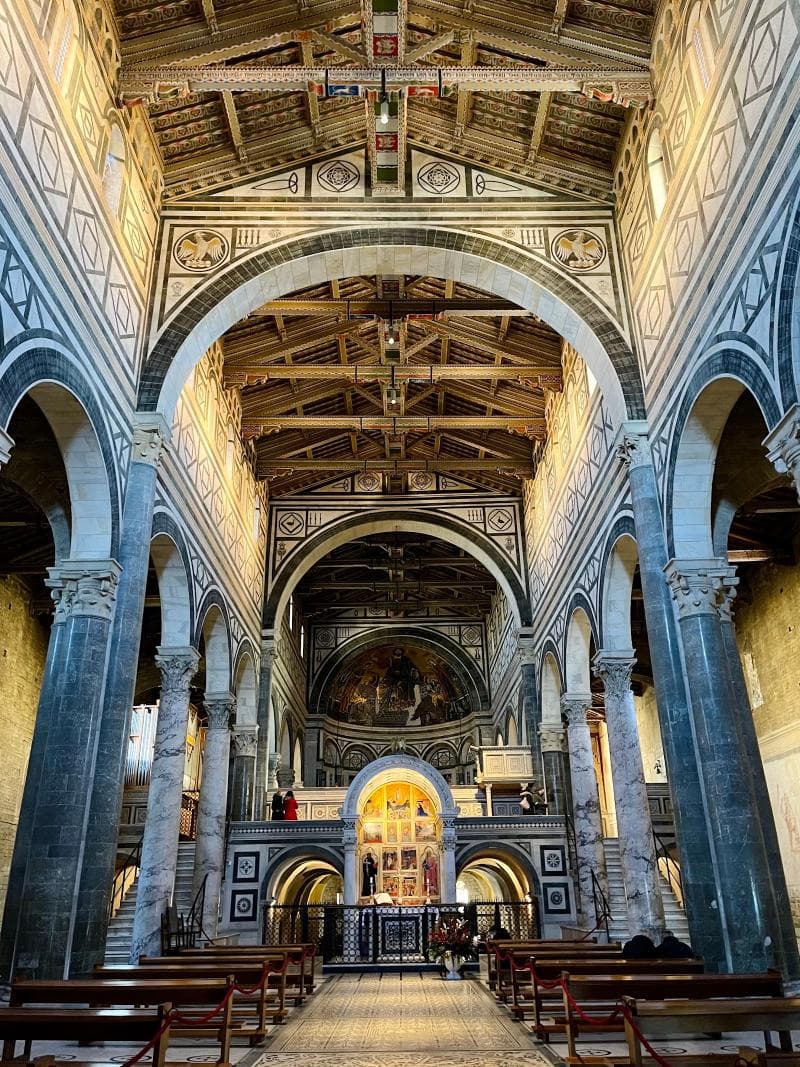
Discover San Miniato al Monte, a stunning Romanesque basilica in Florence, Italy, offering breathtaking panoramic city views and rich history.
Overview
Perched majestically atop Monte alle Croci, just above the iconic Piazzale Michelangelo, San Miniato al Monte offers an unparalleled perspective of Florence, Italy. This eleventh-century basilica, a luminous example of Florentine Romanesque architecture, stands as a testament to the city's rich spiritual and artistic heritage. It provides not only breathtaking panoramic views across the cityscape, encompassing the Duomo and Palazzo Vecchio, but also a profound journey into centuries of faith, artistry, and legend.
Visitors often describe San Miniato al Monte as a tranquil escape from the bustling city below, a place where history resonates in every marble inlay and ancient fresco. Its distinctive green and white marble facade, a hallmark of Tuscan Romanesque style, immediately captivates the eye, promising the treasures within. Beyond its architectural grandeur, the site invites contemplation, drawing travelers into a serene atmosphere high above the Arno River valley.
History & Cultural Background
The history of San Miniato al Monte is steeped in early Christian tradition, tracing its origins back to the 4th century. The site is believed to be the burial place of Saint Minias (San Miniato), revered as Florence's first Christian martyr. Legend recounts that Minias, an Armenian prince or merchant, was martyred during the persecutions of Emperor Decius around 250 A.D. Miraculously, after his decapitation, he is said to have picked up his own head and walked from the Roman amphitheater across the Arno to Monte alle Croci, where he had lived as a hermit, ultimately dying there.
An oratory dedicated to the saint stood on this sacred hill in the 8th century, but the construction of the magnificent basilica we see today began in 1013 under Bishop Alibrando (Hildebrand) of Florence. Completed around the 13th century, the basilica evolved into a quintessential example of Florentine Romanesque style. It was originally a Benedictine monastery before passing to the Olivetan friars in 1373, who continue their monastic life here.
What Makes It Special
San Miniato al Monte is distinguished by several unique features that elevate it beyond a typical historical site. Foremost is its exquisite facade, a harmonious blend of white Carrara marble and dark green Prato serpentine, arranged in intricate geometric patterns. At its apex, a magnificent 12th-century mosaic depicts Christ enthroned between the Virgin Mary and Saint Minias, radiating a golden glow. The bronze eagle grasping a bundle of wool, prominently displayed on the facade, symbolizes the powerful Calimala (Cloth Merchants' Guild) of Florence, which financed much of the church's construction and upkeep from the 13th century onwards.
Inside, the basilica's elevated presbytery and crypt are particularly striking. The crypt, considered the most ancient and sacred part, houses the relics of Saint Minias beneath its altar and features 14th-century frescoes by Taddeo Gaddi, a pupil of Giotto. The Chapel of the Cardinal of Portugal, a Renaissance marvel, is another highlight, showcasing a rare preserved ensemble of architecture, painting, and sculpture from the 15th century. Furthermore, the church's central marble pavement, adorned with zodiac signs and symbolic animals from the 13th century, offers a fascinating glimpse into medieval artistry and symbolism.
Stories, Fun Facts & Local Details
One of the most enduring stories associated with San Miniato al Monte is the miraculous journey of Saint Minias himself, carrying his own head after martyrdom. This powerful legend underscores the profound sanctity attributed to this particular spot. Another intriguing detail is the inscription 'Haec est Porta Coeli' ('This is the Gate of Heaven'), found within the basilica, which eloquently captures the spiritual significance and transcendent beauty of the place.
The monastic community of Olivetan friars continues its ancient traditions here. Visitors can sometimes hear their Vespers, celebrated daily in Latin and Gregorian chant, adding an ethereal layer to the experience. Adjacent to the basilica is the monumental cemetery, Cimitero delle Porte Sante, a beautiful and historic resting place for many prominent Florentines, offering quiet pathways and stunning views. The monks also produce and sell local products like honey, herbal teas, and liqueurs in a small shop next to the church, providing a tangible connection to their ongoing presence.
Visitor Perspective
Visiting San Miniato al Monte is an experience that combines spiritual reflection with awe-inspiring panoramas. The walk up from Piazzale Michelangelo, while uphill, is short (approximately 5-8 minutes) and incredibly rewarding, especially during sunset when the light bathes Florence in a golden hue. Many travelers choose to combine a visit to Piazzale Michelangelo with the basilica, discovering that the view from San Miniato is even more expansive and less crowded.
Inside, the serene atmosphere encourages quiet contemplation. The intricate details of the marble facade, the ancient mosaic, the historic pavement, and the crypt provide a rich tapestry of art and history to explore. Taking the time to observe the architectural nuances and soak in the spiritual ambiance makes for a truly memorable visit. Whether arriving on foot, by bus, or by taxi, the journey to this 'Gate of Heaven' offers one of Florence's most profound and visually stunning encounters.
Coordinates: 11.26577, 43.76342
View on Google Maps💬 How Travelers Describe This Place
Based on community votes
Photogenic
951Unique
748Beautiful
499Interesting
427Must See
94
Traveler Stories
Discover memorable experiences shared by travelers who have visited this place.
No traveler stories yet.
Be the first traveler to share what made this place memorable.

Tour
By
Spot
Discover amazing places around the world. Your journey starts here.
Explore
© 2026 TourBySpot. All rights reserved.