Musée Des Confluences
Lyon, France
Explore Lyon's Musée des Confluences, a unique science and anthropology museum at the Rhône and Saône confluence. Discover its stunning architecture and vast collections.
Overview
Perched dramatically at the southern tip of Lyon's Presqu'île, where the Rhône and Saône rivers converge, stands the extraordinary Musée des Confluences. This architectural marvel, opened on December 20, 2014, is more than just a museum; it is a captivating science centre and a museum dedicated to natural history, anthropology, societies, and civilizations. Its striking deconstructivist design, a creation of the Austrian firm Coop Himmelb(l)au, immediately captures attention with its unique, fluid, and ever-shifting silhouette of glass, concrete, and stainless steel. Housing an immense collection of over 2.2 million objects, the museum invites visitors on a journey through time and across continents, exploring the grand narratives of humanity and the living world.
History & Cultural Background
The Musée des Confluences carries forward a rich legacy, having inherited the substantial collections of the former Musée d'histoire naturelle — Guimet de Lyon. These extensive holdings, amassed by enthusiasts and scientists alike between the 16th and 21st centuries, form the bedrock of the museum's exhibits. The very name 'Musée des Confluences' reflects a dual meaning: it acknowledges its literal geographical position at the meeting point of two major rivers, and metaphorically signifies its mission to bring together diverse branches of human knowledge and scientific inquiry under one roof. Even during its construction, the museum garnered national recognition, receiving the prestigious 'Musée de France' designation from the Ministry of Culture and Communication in May 2011. The building itself was conceived as a bold urban statement, part of a broader redevelopment project for Lyon's Confluence quarter, intended to serve as a distinctive beacon and gateway to the city from the south.
What Makes It Special
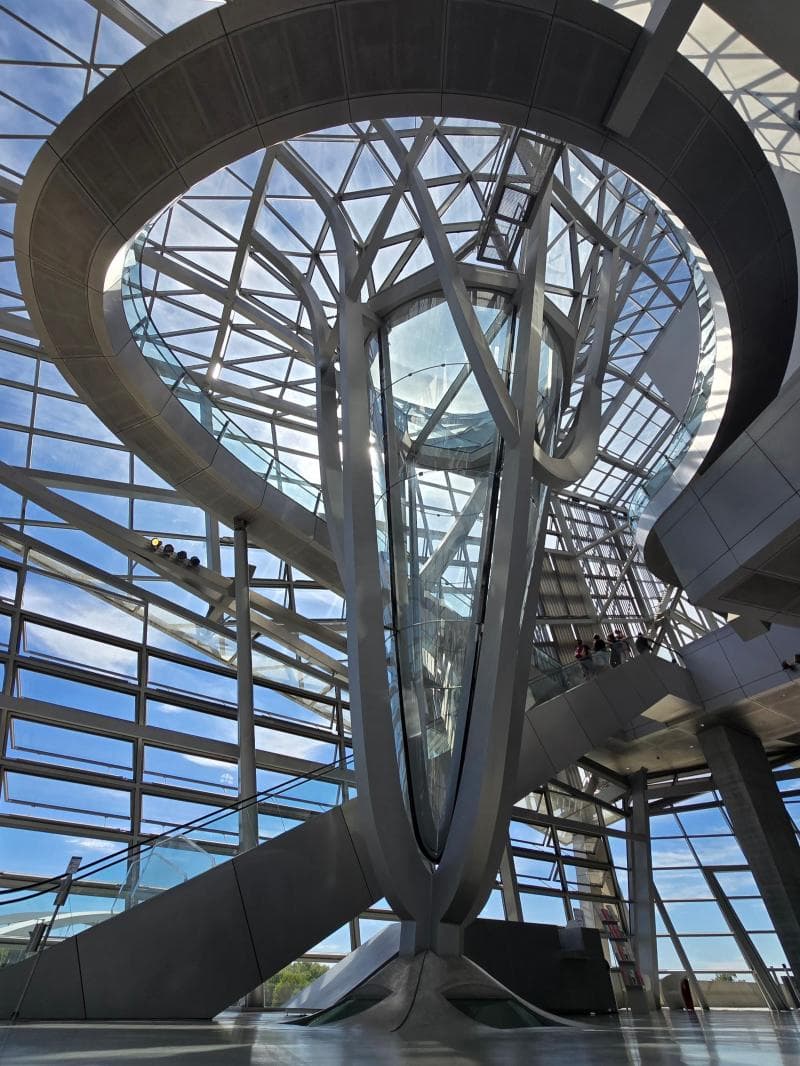
What truly sets the Musée des Confluences apart is its audacious and symbolic architecture, often described as a 'floating crystal cloud'. The design is broken down into three distinct elements: 'The Crystal,' a transparent steel and glass entrance hall symbolizing openness to the world; 'The Cloud,' a more opaque, flowing structure housing the main exhibition galleries, representing the unknown; and 'The Plinth,' a concrete base containing auditoriums and technical spaces. Its unparalleled location, precisely at the confluence of the Rhône and Saône rivers, offers visitors breathtaking panoramic views of Lyon and the surrounding landscape, including distant Mont Blanc from its terraces. The museum's curatorial approach is equally remarkable, adopting an interdisciplinary philosophy that weaves together natural sciences, human sciences, and societal issues to provide a holistic understanding of the world and humanity's place within it. With over 2.2 million objects, spanning paleontology, ethnography, and scientific instruments, its collections are so vast and varied that they have been affectionately called a 'cabinet of wonders'.
Stories, Fun Facts & Local Details
The museum's architecture itself is a story. It boasts 'zero symmetry' and its appearance seemingly transforms with every angle a visitor takes, making it a favorite for photographers. Among its celebrated treasures is the complete skeleton of the Choulans mammoth, a significant local discovery unearthed in 1859. Beyond ancient mammoths, the collections feature an eclectic mix of artifacts that spark the imagination: from meteorites and pterodactyls to hummingbird specimens, representations of early Homo sapiens, models of the Sputnik satellite, elaborate samurai armor, and even ancient Egyptian mummies. The Musée des Confluences is a vibrant cultural hub, regularly hosting not only temporary exhibitions but also a diverse agenda of workshops, scientific conferences, and even world music concerts. For those seeking to explore specific areas, the museum's permanent exhibition is thoughtfully divided into four major sections: 'Origins - Stories of the World,' 'Species — the Web of life,' 'Societies — Human theatre,' and 'Eternities — Visions of the beyond.'
Visitor Perspective
Designed with the visitor experience in mind, the Musée des Confluences offers a welcoming environment for all. It is typically open Tuesday through Sunday, from 10:30 AM to 6:30 PM, with extended hours until 10:00 PM on the first Thursday of each month, allowing for evening cultural excursions. Given its popularity, booking tickets online is highly recommended to bypass potential queues and maximize your visit time. The museum's location is easily accessible via public transport, with a dedicated tram station named 'Musée des Confluences.' Visitors can freely access certain parts of the building, such as the luminous entrance hall and the terrace, offering splendid views even without an exhibition ticket. Practical amenities include complimentary Wi-Fi, a free cloakroom, and the availability of mobility aids like wheelchairs and pushchairs, as well as baby-changing facilities on multiple levels. For refreshments or a souvenir, the museum features a bookshop, a brasserie, and a café, with one restaurant offering a panoramic terrace for an added dining experience.
Coordinates: 4.818333, 45.732778
View on Google Maps💬 How Travelers Describe This Place
Based on community votes
Photogenic
961Must See
804Beautiful
733Unique
404Interesting
336
Traveler Stories
Discover memorable experiences shared by travelers who have visited this place.
No traveler stories yet.
Be the first traveler to share what made this place memorable.
Things to see at Musée Des Confluences



Tour
By
Spot
Discover amazing places around the world. Your journey starts here.
Explore
© 2026 TourBySpot. All rights reserved.