Market Square
Lviv, Ukraine
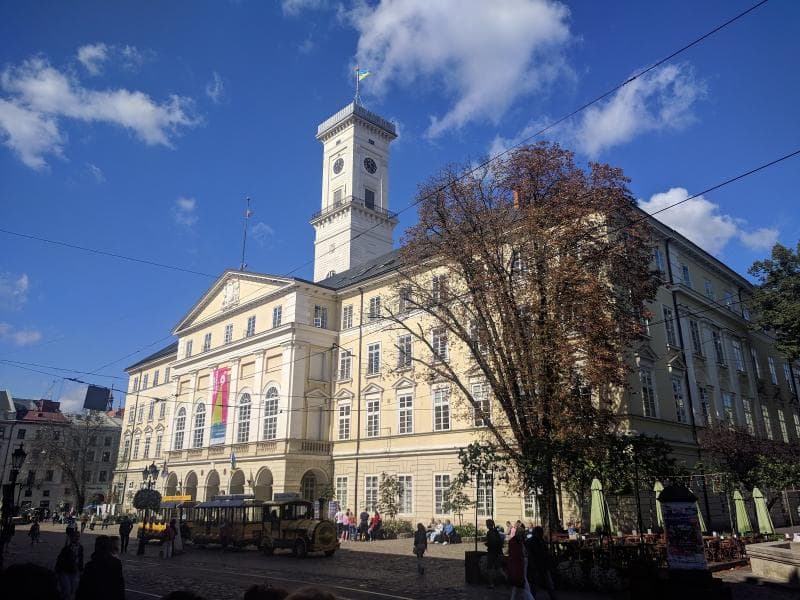
Discover Market Square (Rynok Square) in Lviv, Ukraine, a UNESCO World Heritage site and the city's historic heart. Explore its unique architecture, rich history, and vibrant cultural life.
Overview
Lviv's Market Square, known locally as Rynok Square (Ploshcha Rynok), stands as the vibrant historical heart of this Ukrainian city. This central plaza has been the core of urban life since the Middle Ages, serving as a hub for commerce, administration, and social gatherings. Its rectangular layout, approximately 142 meters by 129 meters, is a testament to meticulous medieval urban planning, influenced by Magdeburg Rights. [3, 5, 8] The square, along with Lviv's historic center, was designated a UNESCO World Heritage Site in 1998, recognizing its exceptional preservation and cultural significance. [3, 4, 5]
Surrounded by over forty intricately designed tenement houses, each a Ukrainian National Historic Architectural Monument, Market Square offers a captivating journey through centuries of architectural evolution. [3, 4, 15] At its center proudly stands the Lviv City Hall, an imposing structure whose tower provides panoramic views of the city's historic rooftops. [4, 11]
History & Cultural Background
The origins of Market Square date back to the 13th and 14th centuries, when Lviv began to take shape as a 'walled city'. [3, 4] Following the granting of Magdeburg Rights, which allowed for municipal self-governance, a new city center was planned. [3, 17] This new core, to the south of the older settlement, became the present-day Market Square, quickly establishing itself as a vital trading post. [3, 5]
While originally featuring Gothic architecture, a devastating fire on June 3, 1527, largely destroyed the wooden and early Gothic structures. [5, 9, 10] This catastrophic event paved the way for Lviv's rebuilding in the prevailing Renaissance style, though hints of its Gothic past can still be found in some buildings. [5, 9] Over subsequent centuries, the square's architectural face underwent repeated alterations, incorporating Baroque and Classicist influences. [3, 4] Wealthy merchants and noble families commissioned renowned architects, often Italian, to design their residences, resulting in a unique ensemble of individually crafted buildings that collectively tell the story of Lviv's rich and diverse past. [3, 9, 11]
What Makes It Special
What truly sets Market Square apart is its remarkable architectural diversity and its enduring role as a living museum. Each of the forty-four to forty-five tenement houses encircling the square possesses its own distinct character, showcasing a blend of Gothic, Renaissance, Baroque, and Classicist styles. [4, 5, 15, 16] These facades, many retaining original decorative details like carved portals and stone reliefs, once belonged to the city's most affluent residents. [4] The Lviv City Hall, with its roots stretching back to the 14th century and its current 19th-century facade, dominates the square's center. [4, 11] Its 65-meter tall observation tower offers an unparalleled perspective of the UNESCO-listed historic center. [4, 5, 11]
Adding to its charm are the four fountains at each corner of the square, built in 1793. [5, 9] Each is adorned with a neoclassical statue depicting a Greek mythological figure: Neptune, Diana, Amphitrite, and Adonis, likely sculpted by Hartman Witwer. [3, 4, 5, 9, 17] These artistic elements not only enhance the square's aesthetic appeal but also harken back to a time when water from these wells was crucial for city life. [9, 17]
Stories, Fun Facts & Local Details
Market Square has witnessed countless historical moments and boasts numerous fascinating details. In medieval times, the square wasn't just a market; it was also the center of civil government and social life. [3] An interesting historical detail is that in 1407, Lviv established one of the earliest plumbing systems, which supplied spring water to the city, converging near the Town Hall. [9] For centuries, a 'Pillar of Shame' stood on the western side of the square, where public punishments, including death sentences for nobles and chaining of quarrelsome wives, took place. [9] The famed 'Black House', one of the most recognizable buildings on the square, was built in the late 16th century for an Italian tax collector. Its sandstone facade darkened over centuries, giving it its distinctive name and making it an architectural marvel. [5, 11]
Another notable building is the Bandinelli Palace, where the first post office in Lviv was established in 1629 by Roberto Bandinelli from Florence. [5, 11] Today, many of these historic tenement houses host museums, galleries, cafes, and shops, inviting visitors to step inside and experience their preserved interiors. [4, 10, 11]
Visitor Perspective
For any traveler exploring Lviv, Market Square is an essential first stop, offering a lively introduction to the city's rich heritage. The square's cobblestones have absorbed centuries of stories, and its atmosphere remains as vibrant today as in ages past. [10, 20] Climbing the 408 steps to the observation deck of the City Hall tower is highly recommended for breathtaking panoramic views of the entire city. [4, 11, 20] From this vantage point, one can truly appreciate the unique layout and architectural splendor of the surrounding buildings and the eight streets radiating from the square's corners. [5, 9]
Visitors can spend hours simply strolling, admiring the diverse architecture, and soaking in the lively ambiance. Cafes spill onto the sidewalks, offering a perfect spot for people-watching, while street performers often add to the festive mood, especially during the numerous concerts and festivals hosted here. [3, 4, 16, 20] Exploring the various museums housed within the historic buildings, such as the Pharmacy Museum, provides deeper insight into Lviv's past. [11, 14] Market Square is a place where history and contemporary life blend seamlessly, creating a memorable experience for every visitor. [4]
Coordinates: 24.031265, 49.841466
View on Google Maps💬 How Travelers Describe This Place
Based on community votes
Unique
931Must See
692Photogenic
655Beautiful
491Interesting
266
Traveler Stories
Discover memorable experiences shared by travelers who have visited this place.
No traveler stories yet.
Be the first traveler to share what made this place memorable.
Things to see at Market Square



Tour
By
Spot
Discover amazing places around the world. Your journey starts here.
Explore
© 2026 TourBySpot. All rights reserved.