Golden Roof
Innsbruck, Austria
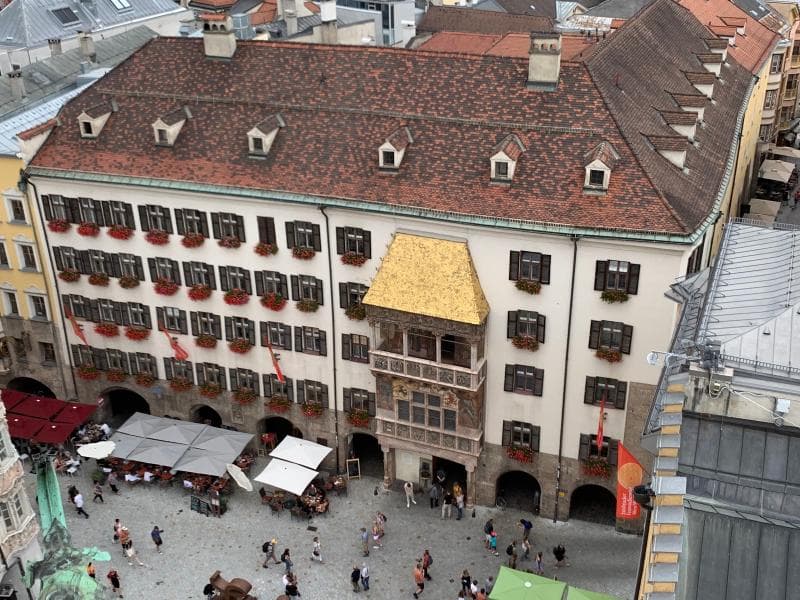
Discover Innsbruck's iconic Golden Roof, a dazzling landmark in Austria's Old Town. Explore its rich history, unique gilded tiles, and imperial stories.
Overview
The Golden Roof, known locally as the Goldenes Dachl, stands as Innsbruck's most celebrated landmark, drawing visitors to its historic heart. Located prominently in the Old Town, this late Gothic oriel window is instantly recognizable by its gleaming facade. It is adorned with an impressive 2,657 fire-gilded copper tiles that shimmer under the Tyrolean sun, making it a truly unique architectural marvel. More than just a striking exterior, the building houses a museum that offers a deep dive into its rich history and the era it represents.
Situated in the pedestrian zone along Herzog-Friedrich-Straße, the Golden Roof is easily accessible on foot, allowing curious travelers to immerse themselves in the medieval charm of its surroundings. It serves as a central point from which to explore Innsbruck's vibrant Old Town, where history seems to whisper from every cobblestone.
History & Cultural Background
The story of the Golden Roof begins long before its golden tiles were laid. The main building, known as the Neuhof, was originally constructed around 1420 under the patronage of Duke Frederick IV, serving as the residence for the Tyrolean sovereigns. This established the foundational structure upon which the famous oriel would later be added.
The iconic Golden Roof itself was commissioned by Emperor Maximilian I, often referred to as the 'last knight', between 1493 and 1500. It was an extravagant addition, designed to mark the turn of the new century and, importantly, to celebrate his wedding to Bianca Maria Sforza. The Emperor intended it as a powerful symbol of his wealth and influence, a royal box from which he and his entourage could observe the lively festivals, tournaments, and public events unfolding in the square below. The intricate design and construction of the oriel are attributed to Niklas Türing the Elder, a master builder of the late Gothic period. The beautiful frescoes adorning the structure were painted by Jörg Kölderer, Maximilian's court painter.
For many years following Maximilian's reign, the building endured a rather unassuming existence, serving roles such as an administrative building and even a barracks. It was not until the advent of tourism in the 19th century that its magnificent bay window truly gained recognition and became the beloved symbol of Innsbruck it is today. The museum within has been thoughtfully redesigned, with a significant renovation in 2019, to tell the compelling story of Maximilian I and the fascinating transition from the Middle Ages to the modern era.
What Makes It Special
The Golden Roof's most striking feature is undoubtedly its roof, composed of 2,657 fire-gilded copper tiles that reflect the sunlight with a spectacular glow. This dazzling display was not merely for aesthetics; it was a deliberate statement of imperial power and prosperity.
Beyond its shimmering surface, the oriel is a treasure trove of artistic detail. Its balustrade is adorned with eighteen reliefs. The original reliefs, carved by Niklas Türing the Elder, depict various scenes including Emperor Maximilian I with his two wives, Maria of Burgundy and Bianca Maria Sforza, alongside his court jester and other notable figures of his court. You can also spot intriguing Moorish dancers, whose tight, exotic clothing and acrobatic movements remain a mystery to this day. The frescoes, created by Jörg Kölderer, show two knights bearing the heraldic flags of the Holy Roman Empire and Tyrol. While the reliefs on the exterior today are copies from the 20th century to protect the originals, six of the original panels can be admired within the Golden Roof Museum.
Stories, Fun Facts & Local Details
The name 'Goldenes Dachl' itself translates to 'Golden Little Roof', a charming local touch for such an impressive structure. A popular legend, though historically inaccurate regarding the Golden Roof itself, tells of Duke Frederick IV, known as 'Frederick with the Empty Pockets', who supposedly had a gilded roof built to shame those who mocked his alleged poverty. While this tale pertains to an earlier period, it highlights the enduring fascination with golden displays of wealth in Tyrolean history.
An interesting anecdote involves the theft of eight original shingles during restoration work in 2012, with five fortunately recovered shortly thereafter. These tales add layers of intrigue to the landmark's story. For those with a keen eye, a small, often overlooked fountain crafted by the renowned Grassmayr bell foundry can be found nearby, offering fresh drinking water.
Inside the museum, the experience is enriched with multimedia presentations and exhibits dedicated to Emperor Maximilian I's life, his impact, and the fascinating transition of eras. Children can enjoy special stations and a puzzle rally, making history engaging for younger visitors. The museum also proudly offers accessibility features, including a stairlift, ensuring everyone can enjoy the unique view of Innsbruck's Old Town from the oriel.
Visitor Perspective
Visiting the Golden Roof is an essential experience for anyone exploring Innsbruck. Its location in the heart of the Old Town means it is surrounded by picturesque narrow streets, historic buildings, and charming cafes. The landmark itself can be admired for free from the outside, offering countless opportunities for memorable photographs, particularly when the morning sun illuminates its golden tiles.
For those seeking a deeper understanding, a visit to the Museum Goldenes Dachl is highly recommended. The museum provides an intimate look at the structure's history, the life of Emperor Maximilian I, and the cultural context of his time. From the oriel window within the museum, visitors can enjoy the same commanding view of the bustling square below that Emperor Maximilian himself once did. During the winter months, the square in front of the Golden Roof transforms into a magical Christmas market, adding another enchanting dimension to this historic site.
Coordinates: 11.39328, 47.26857
View on Google Maps💬 How Travelers Describe This Place
Based on community votes
Photogenic
457Interesting
252Beautiful
147Must See
114Unique
19
Traveler Stories
Discover memorable experiences shared by travelers who have visited this place.
No traveler stories yet.
Be the first traveler to share what made this place memorable.
Things to see at Golden Roof



Tour
By
Spot
Discover amazing places around the world. Your journey starts here.
Explore
© 2026 TourBySpot. All rights reserved.