Historic Facade Details
Innsbruck, Austria
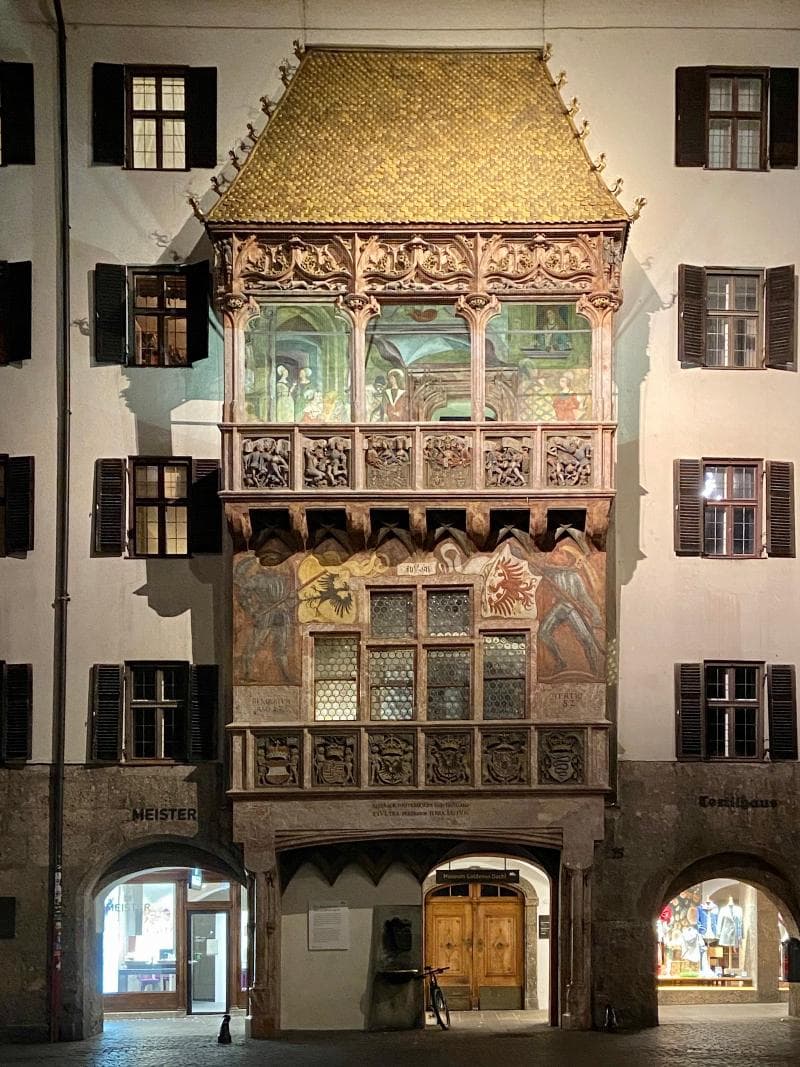
Explore the Historic Facade Details of Innsbruck's Golden Roof. Discover intricate reliefs, frescoes, and stories of Emperor Maximilian I in Austria.
Overview
Nestled in the heart of Innsbruck's historic Old Town, the Golden Roof (Goldenes Dachl) stands as a dazzling testament to imperial grandeur and architectural artistry. While its 2,657 fire-gilded copper tiles are what give this late Gothic oriel its iconic name, it's the 'Historic Facade Details' that truly captivate the curious eye. This magnificent bay window, extending from what was once a princely residence, is far more than just a shimmering roof; it is a meticulously crafted historical canvas, adorned with intricate frescoes and sculpted reliefs that narrate tales of power, courtly life, and cultural exchange from the turn of the 16th century.
Every element on the facade, from the vibrant murals to the detailed stone carvings, offers a window into the world of Emperor Maximilian I, the visionary behind its creation. Visitors today can trace the stories embedded in its stonework, understanding the symbols and figures that shaped a pivotal era in European history. The Golden Roof serves as a central landmark, inviting travelers to pause, look up, and delve into the rich layers of Innsbruck's past, revealing secrets hidden in plain sight.
History & Cultural Background
The building housing the Golden Roof has roots stretching back to 1420, originally serving as the residence for Tyrolean princes. However, the celebrated oriel, or bay window, and its elaborate facade details were a commission from Emperor Maximilian I, added between 1497 and 1500. His primary motivation was to establish a lavish royal box, from which he and his court could observe the bustling tournaments, festivals, and public life unfolding in the square below. More profoundly, it was a potent symbol designed to broadcast his immense wealth and formidable power to both his subjects and visiting dignitaries.
The creation of these historic facade details was a collaborative masterpiece. Nikolaus Türing the Elder, a renowned stonemason, sculptor, and master builder of the late Gothic period, is credited as the architect and the creator of the sophisticated reliefs. Complementing his work, Jörg Kölderer, Emperor Maximilian I's esteemed court painter, brought color and life to the structure through his exquisite frescoes. Together, these artists imbued the facade with a complex artistic narrative, intertwining heraldry, imperial portraits, and intriguing cultural depictions, all reflecting Maximilian's self-image and the spirit of his reign.
What Makes It Special
What truly distinguishes the Historic Facade Details of the Golden Roof is their rich narrative tapestry. The frescoes, attributed to Jörg Kölderer, notably feature two standard-bearers proudly displaying the flags of the Holy Roman Empire and Tyrol, underscoring the political allegiances of the time. Emperor Maximilian I himself is depicted within the loggia, a personalized touch that hints at his direct connection to and patronage of the arts.
Below these murals, the balustrade showcases a series of 18 intricate relief panels. While the originals have been moved to the Golden Roof Museum for preservation, their meticulously crafted copies remain on display, allowing visitors to appreciate the artistry. Among the most compelling are two central reliefs of Maximilian. One captures him alongside his two wives: Maria of Burgundy, his beloved first consort, and Bianca Maria Sforza, his second wife, who is depicted holding an apple. The other prominent relief presents the Emperor with his court jester and, according to some interpretations, his chancellor or Archduke Sigmund 'the Coin-rich' of Tyrol.
Adding an element of lively mystique, four outer reliefs depict Moorish dancers, known as Morisco dancers. These figures are caught in mid-performance, engaging in what appears to be 'acrobatic and grotesque dancing.' Their exotic attire, unusual headgear, and the presence of bells and rattles on their limbs suggest a vibrant, non-traditional form of entertainment, likely a nod to Maximilian's known appreciation for spirited festivities. Below these captivating dancers lies a fascinating detail: a scroll bearing mysterious symbols that, to this day, remain undeciphered, adding an enduring enigma to the facade.
Stories, Fun Facts & Local Details
The Golden Roof's facade is not just an architectural marvel; it's a storytelling canvas. Imagine Emperor Maximilian I, often called 'the last knight,' gazing down from his opulent balcony, observing the lively square below. He wasn't merely a spectator; the facade was an extension of his persona, a public declaration of his imperial standing. It's a common misconception that the Golden Roof was built to dispel rumors of his financial difficulties, but historical research confirms it was a deliberate show of power.
A fun fact for observant visitors: while admiring the reliefs, you'll see Emperor Maximilian I not once, but several times, ensuring his prominent place in the narrative woven into the stone. The Moorish dancers, with their enigmatic movements and unusual costumes, offer a glimpse into the diverse cultural influences present in Europe during Maximilian's reign. The precise meaning and origin of their dance remain a delightful historical mystery, inviting speculation and imagination.
Moreover, the eight sculpted coats of arms on the first-floor balustrade are more than mere decoration; they are a visual map of Maximilian's extensive territories, a subtle yet powerful display of his vast domain. Taking a moment to decipher these symbols adds an extra layer of engagement to your visit, transforming a casual glance into an archaeological quest. The fact that the original reliefs are now safeguarded in the Golden Roof Museum, with highly accurate copies on the building, means that the artistry can be appreciated both in situ and up close, allowing for a deeper understanding of their intricate details.
Visitor Perspective
Approaching the Golden Roof, one is immediately drawn to its dazzling namesake, but a closer look reveals the true treasure in its facade details. As a curious traveler, stepping into the Herzog-Friedrich-Straße, you're encouraged to slow down and truly 'read' the building. The facade is best appreciated by taking a few moments to observe the intricate carvings and painted scenes, allowing their historical weight and artistic detail to sink in. Its central location in the pedestrianized Old Town means you can walk right up to it, offering an intimate viewing experience.
Standing beneath the oriel, you can almost feel the presence of Emperor Maximilian I and his court, envisioning the tournaments and celebrations they once witnessed from this very spot. The detailed reliefs, though copies, faithfully convey the original mastery of Nikolaus Türing the Elder, while Kölderer's frescoes add bursts of color that bring the historical figures to life. It's an opportunity to connect with the past on a deeply human level, appreciating not just the grandeur but also the storytelling inherent in every artistic choice. For an even deeper dive, the Golden Roof Museum, located within the same building, offers invaluable context and displays some of the original reliefs, enriching the understanding of this iconic landmark's profound historical and cultural significance.
Coordinates: 11.39328, 47.26857
View on Google Maps💬 How Travelers Describe This Place
Based on community votes
Photogenic
950Beautiful
929Interesting
858Must See
730Unique
275
Traveler Stories
Discover memorable experiences shared by travelers who have visited this place.
No traveler stories yet.
Be the first traveler to share what made this place memorable.

Tour
By
Spot
Discover amazing places around the world. Your journey starts here.
Explore
© 2026 TourBySpot. All rights reserved.