Dam Square
Amsterdam, Netherlands
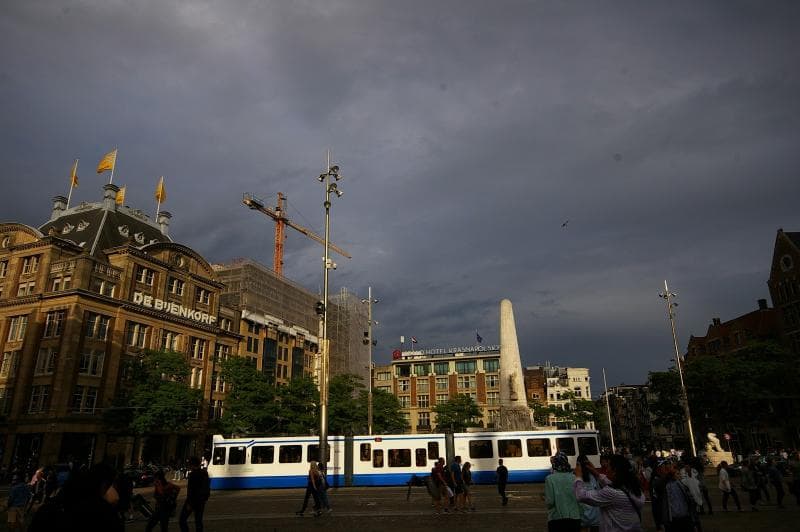
Explore Dam Square in Amsterdam, Netherlands, the city's historic and cultural heart. Discover the Royal Palace, National Monument, and Nieuwe Kerk.
Overview
Dam Square, nestled in the historic heart of Amsterdam, Netherlands, stands as a vibrant testament to the city's rich past and dynamic present. It is the central and best-known square in the capital, approximately 750 meters south of Amsterdam Centraal Station. Its roughly rectangular shape stretches about 200 meters from west to east and 100 meters from north to south. This expansive public space is where several major streets converge, including Damrak and Rokin, which follow the original course of the Amstel River. The square is a perpetual hub of activity, drawing locals and travelers alike to its bustling atmosphere, surrounded by iconic buildings that narrate Amsterdam's journey through centuries.
History & Cultural Background
The story of Dam Square is intrinsically linked to the origin of Amsterdam itself. Around 1270, a dam was constructed across the Amstel River to protect the burgeoning settlement from flooding by the Zuiderzee. This vital construction not only gave the square its name – 'Dam' – but also gave rise to the city's name, 'Amestelledamme,' meaning 'at the dam in the Amstel'. What began as a practical water barrier quickly evolved into a bustling marketplace and the city's civic center.
Over the centuries, Dam Square witnessed significant transformations. The neoclassical Royal Palace, a dominant feature on the square, was originally built as Amsterdam's City Hall between 1648 and 1665, a grand structure designed to symbolize the city's Golden Age prosperity. It was converted into a royal residence in 1808 by Louis Bonaparte, Napoleon's brother, and today serves the Dutch monarchy for official receptions and state functions, while also being largely open to the public as a museum. The square has been a stage for numerous historical events, from moments of national celebration to profound mourning. Each May 4th, it becomes the focal point for National Remembrance Day (Dodenherdenking), where the Dutch monarch and prime minister lay a wreath at the National Monument, and the nation observes two minutes of silence to honor war victims.
What Makes It Special
Dam Square's unique allure stems from its concentration of historically significant and culturally rich landmarks. Dominating the west side is the magnificent Royal Palace, a monumental example of Dutch Classicist architecture. Its sheer size and the feat of its construction – built on 13,659 wooden piles driven into the soft Amsterdam soil – earned it the moniker 'eighth wonder of the world' by contemporaries. Adjacent to the palace is the 15th-century Nieuwe Kerk, or New Church, a Gothic masterpiece that, despite its name, is steeped in history. No longer used for regular church services, it hosts significant art exhibitions, cultural events, and has been the site for Dutch royal inaugurations and weddings.
On the opposite side of the square stands the striking National Monument, a white stone obelisk erected in 1956 to commemorate the victims of World War II. It features symbolic sculptures and contains urns with soil from all Dutch provinces, and even from the former Dutch East Indies, a poignant reminder of national sacrifice. Adding a touch of modern entertainment, Madame Tussauds Amsterdam is also situated on Dam Square, offering visitors an interactive experience with lifelike wax figures of celebrities and historical icons.
Stories, Fun Facts & Local Details
Imagine standing on Dam Square and realizing you are literally on 'hundreds of years of engineering achievement' – the Royal Palace's immense foundation of wooden piles underneath your feet speaks volumes about 17th-century ingenuity. A lesser-known fact is that the Amsterdam Ordnance Datum, a crucial elevation benchmark for the entire Netherlands, is located beneath Dam Square, establishing the starting point for all height measurements in the country.
In the 1960s, Dam Square gained a reputation as a gathering place for 'hippies,' reflecting a period of social change and free expression. While its role has evolved, it continues to be a space for public assembly, demonstrations, and vibrant street performances. The square also hosts temporary attractions like funfairs in spring and various street artists throughout the summer, adding to its lively character.
Visitor Perspective
For any traveler, Dam Square offers an immersive introduction to Amsterdam. It's a place where history feels alive, echoing in the grand facades of its buildings and the flow of people across its expanse. The square serves as a natural meeting point, easily accessible and often the starting point for explorations deeper into the city. From enjoying a coffee at one of the surrounding cafes to browsing the upscale department store De Bijenkorf, there is always something to observe. The constant flow of trams, bicycles, and pedestrians creates an energetic atmosphere, ensuring that Dam Square remains, as it has for centuries, the beating heart of Amsterdam.
Coordinates: 4.8928, 52.3731
View on Google Maps💬 How Travelers Describe This Place
Based on community votes
Must See
684Beautiful
363Photogenic
302Unique
250Interesting
88
Traveler Stories
Discover memorable experiences shared by travelers who have visited this place.
No traveler stories yet.
Be the first traveler to share what made this place memorable.
Things to see at Dam Square



Tour
By
Spot
Discover amazing places around the world. Your journey starts here.
Explore
© 2026 TourBySpot. All rights reserved.