Central Market Hall
Budapest, Hungary
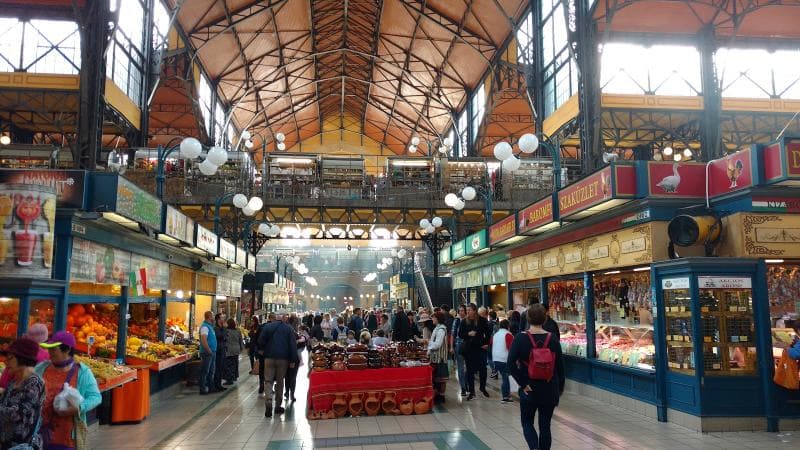
Explore Budapest's Central Market Hall, Hungary's largest and oldest indoor market. Discover Hungarian foods, crafts, and history under a stunning Zsolnay-tiled roof.
Overview
The Central Market Hall, known locally as Nagyvásárcsarnok or Központi Vásárcsarnok, stands as Budapest, Hungary's largest and oldest indoor market. More than just a place to shop, it is a magnificent architectural landmark and a vibrant cultural hub. Situated prominently at Fővám tér, on the Pest side of the Liberty Bridge, and at the termination of the popular Váci utca, its striking Neo-Gothic design with its iconic, colorfully tiled Zsolnay roof immediately captures attention. Inside, the market spans three expansive floors, covering approximately 10,000 square meters. It bustles daily with both locals seeking fresh produce and provisions, and curious travelers eager to immerse themselves in authentic Hungarian flavors and traditions.
History & Cultural Background
The vision for such a grand market hall emerged from Budapest's first mayor, Károly Kamermayer, who aimed to modernize the city's food trade and enhance public health standards. Construction began in 1894, with the building designed by the esteemed Hungarian architect Samu Pecz. Its completion in 1897 coincided with a period of significant urban development, including the Hungarian Millennium celebrations of 1896, marking a thousand years since the Hungarian tribes' arrival in the Carpathian Basin.
Interestingly, a fire damaged a substantial part of the roof just days before its scheduled opening in 1896, delaying its official inauguration until February 15, 1897. While initially met with some local criticism due to rising prices, the Central Market Hall quickly became an indispensable part of Budapest's daily life.
Throughout its history, the market faced adversity. It suffered significant damage during World War II and subsequently fell into disrepair. By 1991, its structural integrity was compromised, leading to its closure. However, a comprehensive restoration effort from 1991 to 1994 meticulously brought the market back to its original splendor, reopening in 1997—exactly a century after its first debut. This remarkable restoration earned it the prestigious FIABCI Prix d'Excellence in 1999, often considered the 'Oscars of architecture'. Furthermore, it was designated a protected monument in 1977 and recognized by CNN Travel in 2013 as one of Europe's most beautiful markets.
What Makes It Special
The Central Market Hall's allure lies in its captivating blend of historical grandeur and vibrant commerce. Its architectural brilliance is a major draw, featuring a Neo-Gothic exterior with intricate detailing and an impressive, brightly colored roof adorned with unique Zsolnay ceramic tiles, famously also seen on Matthias Church. Inside, a soaring steel and glass structure creates an airy, light-filled space, often likened to a 'railway cathedral' or 'symphony in iron'.
The market's expansive layout across three levels offers an incredible array of goods. The ground floor is a feast for the senses, overflowing with fresh fruits and vegetables, an assortment of quality meats, Hungarian sausages and salami, freshly baked pastries, various candies, and a dazzling display of spices, most notably paprika. You'll also find local spirits like Tokaji wine and Pálinka.
Ascending to the upper floor, visitors discover a lively mezzanine dedicated to eateries and souvenirs. Here, the aroma of traditional Hungarian street food, such as lángos (deep-fried dough with toppings), goulash, and strudel, fills the air. This level is also a treasure trove for unique handicrafts, embroidered textiles, folk art, and other local keepsakes, including the iconic Rubik's Cube. The basement level caters to specialized needs, housing fishmongers, stalls selling pickled vegetables, and dedicated butcher shops, often alongside a small supermarket.
Stories, Fun Facts & Local Details
The strategic location of the Central Market Hall at Fővám tér was no accident; it was historically the site of a main customs office where goods transported along the Danube River were processed. Early designs even incorporated a canal allowing barges to deliver goods directly into the market, a detail that speaks to its original purpose as a bustling trading hub. Today, while the canal is used for waste removal, the market remains a central distribution point.
One interesting architectural detail is the slight incline of the main market floor, designed to compensate for the downward slope of the adjacent streets. Soon after its opening, Emperor Franz Joseph himself visited the market, reportedly impressed by its architecture and the quality of the Zsolnay ceramics on the roof.
For those seeking authentic Hungarian flavors, the market is a culinary playground. Look for 'Sweet' (Édes) or 'Hot' (Erős) paprika, often sold in charming tins or cloth bags. Sampling traditional items like Pick salami, Tokaji wine, and the sweet Túró Rudi is a must. Many vendors offer tastes, encouraging visitors to discover their favorite Hungarian delicacies.
Visitor Perspective
For any traveler exploring Budapest, the Central Market Hall is an essential destination. It offers a unique blend of a food market, a history lesson, and a fantastic photo opportunity. To fully experience its vibrant atmosphere, it's often recommended to visit in the morning, ideally between 9:00 AM and 11:00 AM, when the stalls are fully stocked, and before the busiest midday crowds arrive.
Navigating the three distinct levels is relatively easy. The ground floor remains the heart of the market for everyday provisions. The upper gallery is particularly popular for sampling Hungarian street food and browsing a wide selection of souvenirs. While many vendors now accept credit cards, having some Hungarian Forints (HUF) on hand is always a good idea, as some smaller stalls might prefer cash. Although not a widespread practice, a bit of friendly haggling might be possible, especially when purchasing souvenirs. The market is typically closed on Sundays, with Saturdays being a particularly bustling day to witness local life in full swing.
Coordinates: 19.0573, 47.4862
View on Google Maps💬 How Travelers Describe This Place
Based on community votes
Must See
623Unique
545Beautiful
343Photogenic
211Interesting
20
Traveler Stories
Discover memorable experiences shared by travelers who have visited this place.
No traveler stories yet.
Be the first traveler to share what made this place memorable.
Things to see at Central Market Hall



Tour
By
Spot
Discover amazing places around the world. Your journey starts here.
Explore
© 2026 TourBySpot. All rights reserved.