Cathédrale Saint-Jean-Baptiste De Lyon
Lyon, France
Explore Cathédrale Saint-Jean-Baptiste in Lyon, France, a stunning blend of Romanesque and Gothic architecture. Discover its astronomical clock and rich history.
Overview
Nestled in the heart of Vieux Lyon, the Cathédrale Saint-Jean-Baptiste de Lyon stands as a magnificent testament to centuries of French history and religious devotion. Officially known as the Primatiale Saint-Jean-Baptiste-et-Saint-Étienne, this Roman Catholic cathedral is not merely a place of worship but a living museum, exhibiting a remarkable fusion of Romanesque and Gothic architectural styles. Its prominent location on Place Saint-Jean, at the foot of the Fourvière hill and along the Saône river, makes it an unmissable landmark within the city's UNESCO World Heritage designated historic site.
Construction of this impressive edifice spanned over three centuries, beginning around 1175 and finally reaching completion by 1480. This lengthy building period accounts for its distinctive blended aesthetic, where the robust Romanesque foundations seamlessly transition into the soaring elegance of Gothic design. Serving as the seat of the Archbishop of Lyon, who uniquely holds the title of Primate of All the Gauls, the cathedral has played a pivotal role in both local and national affairs, bearing witness to profound historical moments and continuing to draw visitors with its spiritual grandeur and artistic treasures.
History & Cultural Background
The site upon which the Cathédrale Saint-Jean-Baptiste now stands has been a spiritual hub for well over a millennium, with earlier churches dating back to the 6th or 7th century. The current structure began its life in the late 12th century, evolving from these ancient roots. Its status as a 'primatiale' dates back to 1079, when the Pope granted the Archbishop of Lyon the title of Primate of All the Gauls, bestowing judicial supremacy over other archbishops in France due to Lyon's historical significance as the capital of Roman Gaul.
Throughout its long history, the cathedral has been a stage for momentous events. It hosted the First Council of Lyon in 1245 and the Second Council of Lyon in 1274, gatherings that profoundly shaped medieval Christendom. More than just ecclesiastical councils, it was also the venue for significant royal occasions, such as the wedding of King Henry IV to Marie de' Medici in 1600 and the ceremony for the presentation of the cardinal's biretta to Richelieu in 1622. While it endured damage during the Wars of Religion, notably from Calvinist iconoclasm in 1562 which saw many statues decapitated, and later during the French Revolution, diligent restorations have preserved its enduring splendor.
What Makes It Special
What truly sets the Cathédrale Saint-Jean-Baptiste apart is its remarkable blend of architectural styles and its extraordinary internal features. The eastern end, including the apse and choir, exemplifies the sturdy and solemn Romanesque, while the nave and majestic façade soar with intricate Gothic elements, creating a captivating visual journey through time. This architectural dialogue reflects the centuries of its construction, offering a unique textbook example of medieval building techniques and evolving aesthetics.
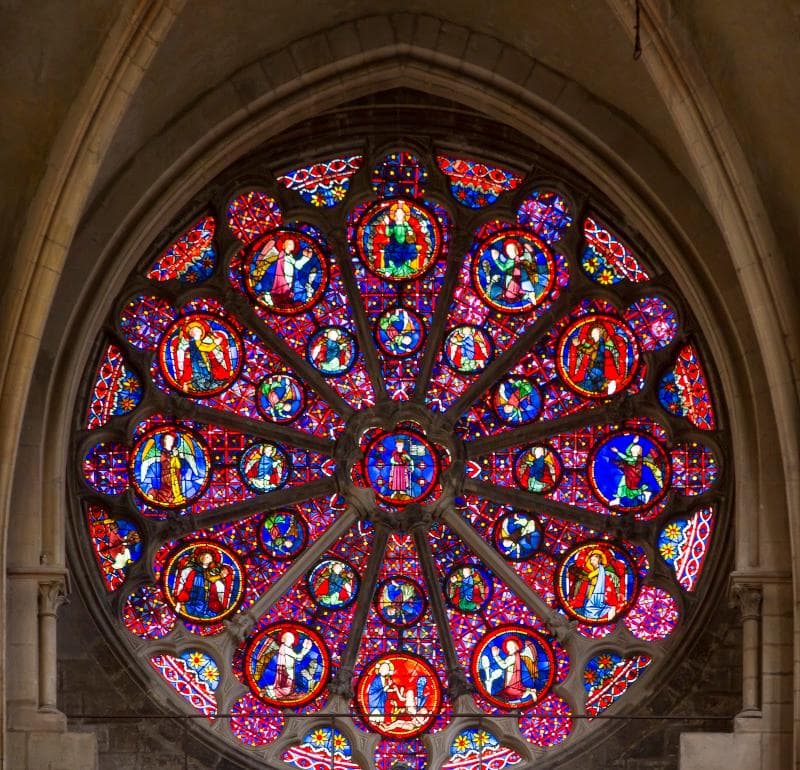
However, the cathedral's most celebrated treasure is arguably its astronomical clock, a marvel of medieval engineering located in the north transept. Dating back to the 14th century, with its current mechanism from the 17th century, this nine-meter-tall clock not only tells time but also indicates the date, the positions of the moon, sun, Earth, and even the stars above Lyon. Its intricate automatons—angels, an hourglass, a dove, and the Virgin Mary—perform at specific hours, creating a truly unique spectacle for visitors. The cathedral is also adorned with breathtaking stained glass windows, some dating to the early 12th century, including a magnificent central rose window that bathes the interior in a kaleidoscope of light.
Stories, Fun Facts & Local Details
Beyond its grand architecture and sacred purpose, the Cathédrale Saint-Jean-Baptiste is rich with charming stories and local character. One of its most intriguing features is the 280 square stone medallions carved into the portals of the west façade. These detailed carvings depict a fascinating array of scenes from the Bible and daily medieval life, serving as an open-air gallery that has narrated tales for over 700 years. It's a reminder of a time when images were crucial for communicating stories to a largely illiterate populace.
The famous astronomical clock, while a technological marvel, also reflects the cosmological understanding of its era, ingeniously placing the Earth at the center of the universe, with the sun and other celestial bodies revolving around it. This geocentric model, though later disproven, highlights the ingenuity of its medieval creators. Every December, the cathedral's façade becomes a focal point for Lyon's spectacular Festival of Lights (Fête des Lumières). Elaborate choreographed lighting displays transform the ancient stones into a canvas of vibrant colors and intricate patterns, drawing thousands to witness this annual tradition. The two crosses flanking the altar, preserved since the Second Council of Lyon in 1274, symbolize a historical union of churches, adding another layer of meaningful detail to the cathedral's rich tapestry.
Visitor Perspective
Visiting the Cathédrale Saint-Jean-Baptiste offers a profound journey into Lyon's past and an encounter with spiritual and architectural grandeur. Upon entering, the sheer scale and intricate details of the Romanesque and Gothic elements immediately captivate. The light filtering through the ancient stained glass windows casts ethereal glows, enhancing the sense of reverence and wonder. While exploring, one might notice the archaeological garden adjacent to the cathedral, which reveals remnants of even older religious structures, hinting at the continuous sacred history of this site.
The highlight for many is the astronomical clock. Witnessing its automatons spring to life, with angels striking bells and the rooster crowing, is a truly mesmerizing experience that transports visitors back in time. These performances typically occur at noon, 2 PM, 3 PM, and 4 PM, offering multiple opportunities to catch the spectacle. Admission to the cathedral itself is free, allowing everyone to soak in its history and beauty at their own pace. Whether you are a history enthusiast, an architecture admirer, or simply a curious traveler, the Cathédrale Saint-Jean-Baptiste provides an enriching and unforgettable experience, connecting you to the enduring spirit of Lyon.
Coordinates: 4.827216, 45.760775
View on Google Maps💬 How Travelers Describe This Place
Based on community votes
Must See
839Interesting
445Photogenic
416Beautiful
289Unique
141
Traveler Stories
Discover memorable experiences shared by travelers who have visited this place.
No traveler stories yet.
Be the first traveler to share what made this place memorable.
Things to see at Cathédrale Saint-Jean-Baptiste De Lyon



Tour
By
Spot
Discover amazing places around the world. Your journey starts here.
Explore
© 2026 TourBySpot. All rights reserved.