Botataung Pagoda
Yangon, Myanmar
Explore Botataung Pagoda in Yangon, Myanmar! Discover its ancient history, the unique hollow interior, and sacred Buddha relics from over 2,500 years ago.
Overview
Nestled beside the bustling Yangon River in downtown Yangon, Myanmar, the Botataung Pagoda stands as a revered and ancient Buddhist temple. Dating back over 2,500 years, it is believed to have been constructed by the Mon people around the same period as the iconic Shwedagon Pagoda. Its name, 'Botataung,' translates to '1,000 military leaders' in Burmese, a reference to a fascinating historical legend. This pagoda is particularly distinctive for its unique hollow interior, a feature that allows visitors to walk through its gilded halls and explore the treasures housed within, unlike many other solid stupas in Myanmar.
The golden spire of the Botataung Pagoda, rising approximately 40 meters (131 feet), gleams brightly, reflecting the rich cultural and spiritual heritage of Myanmar.
History & Cultural Background
The origins of the Botataung Pagoda are deeply intertwined with ancient Burmese tradition. It is said that over two millennia ago, a thousand military leaders stood guard on this very spot, awaiting the arrival of sacred relics of the Buddha from India. These relics included a revered hair relic and two body relics.
The pagoda was originally known by its Mon name, 'Kyaik-de-att.' According to one account, a Buddhist king named Sihadipa entrusted one of his ministers with a sacred hair and two body relics of the Buddha. Following the advice of a religious leader, the minister enshrined these precious items on Botataung Mount, by the banks of the Yangon River.
Tragically, the original Botataung Pagoda was almost completely destroyed during World War II, on November 8, 1943, by Allied bombing that targeted nearby wharves. However, its story did not end there. Reconstruction efforts began in 1948 and were completed by 1954, meticulously rebuilding the pagoda to mimic its original shape while incorporating modern construction techniques.
During the clearance works for reconstruction, a profound discovery was made: a relic chamber at the pagoda's heart. Astonished workers found a stone casket containing nearly 700 ancient objects, including precious stones, ornaments, and a terracotta plaque with inscriptions connecting the Mon people to ancient South Indian Brahmi script. Most significantly, a smaller golden pagoda-shaped vessel inside held a tiny golden cylinder, which, when opened, revealed two small body relics and a sacred hair of the Buddha. This discovery dramatically confirmed the ancient legends surrounding the pagoda.
What Makes It Special
What truly sets the Botataung Pagoda apart from many other Buddhist stupas in Myanmar is its remarkable hollow interior. Unlike solid pagodas that visitors circumambulate from the outside, here you can literally walk inside the golden structure.
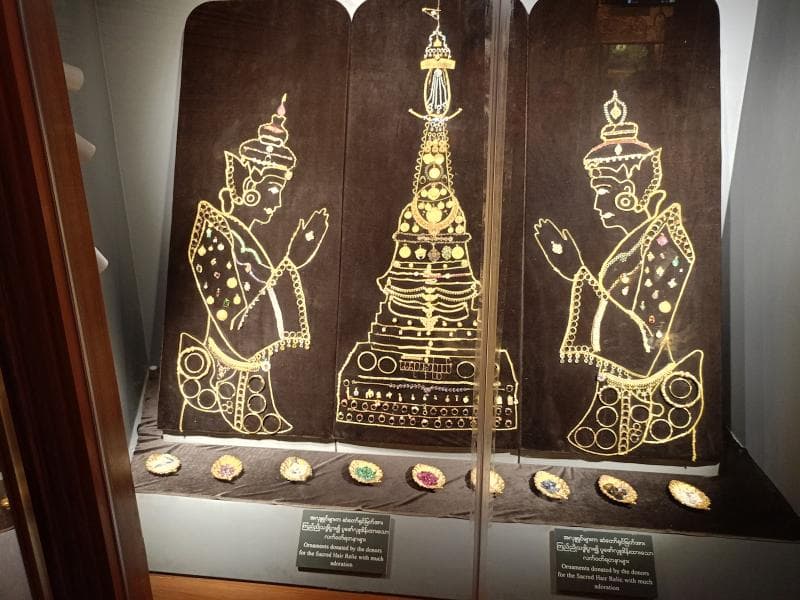
As you step through its entrance, you are enveloped in a dazzling, mirrored maze-like corridor with walls and ceilings entirely covered in gold leaf. Along this intricate pathway, glass showcases display a magnificent collection of ancient relics and artifacts that were excavated from the original pagoda after its wartime destruction. These include very old Buddha images and, most importantly, the revered sacred hair relic of the Buddha, prominently displayed in a glass-encased chamber, allowing visitors to pay their respects up close.
The pagoda's design is a testament to Mon architectural style, with a golden spire that rises to a considerable height. Even its ornamental 'hti' (umbrella) at the top of the spire is noted for its unique and unconventional design.
Stories, Fun Facts & Local Details
The name 'Botataung' itself tells a story. 'Bo' means 'leader' and 'tahtaung' means 'a thousand,' referring to the thousand military leaders who escorted the Buddha's relics.
Beyond the main stupa, the pagoda complex is a tapestry of local beliefs and spiritual practices. To the left of the main pagoda, you'll find an interesting worship place dedicated to Ahma Mya Nan Nwe, a spiritual being believed by locals to guard the pagoda. This shrine attracts many devotees seeking blessings.
Another fascinating aspect is the presence of altars for the day-of-the-week Buddhas. Following Burmese tradition, each day is associated with a specific Buddha posture. Devotees visit the statue corresponding to their birth day to pour water over it, a ritual symbolizing good luck and purification. The pagoda also houses a revered statue of Bo Bo Gyi, a wise old man figure believed to grant wishes and offer protection, attracting worshippers who bring offerings.
Annually, during the dry season, the Botataung Pagoda hosts a vibrant festival. This event features cultural theatrical performances, traditional weaving contests, and the much-loved Htamane cooking contest, where participants prepare a traditional Myanmar sticky rice dish with nuts and coconut, creating a lively and engaging atmosphere for both pilgrims and visitors.
Visitor Perspective
Visiting the Botataung Pagoda offers a deeply immersive cultural and spiritual experience. The moment you step into the complex, you are greeted by the shimmering gold of the temple. The ability to walk through the hollow stupa is often highlighted as a favorite feature, providing an intimate connection with its ancient history. Inside, you can gaze upon the meticulously displayed relics and artifacts, marveling at the craftsmanship and historical significance.
Pilgrims and curious travelers alike can participate in traditional Buddhist rituals, such as offering flowers, incense, and candles. Many choose to circumambulate the stupa clockwise, engaging in quiet reflection and prayer. Observing the daily puja ceremonies or finding a serene spot for meditation can further enhance your visit. For the best experience, consider visiting during the cooler months, from November to February, to avoid the heat and heavy rains. When entering, remember to dress modestly and be prepared to remove your shoes, as is customary in all Myanmar temples.
Coordinates: 96.17197, 16.76846
View on Google Maps💬 How Travelers Describe This Place
Based on community votes
Must See
963Beautiful
723Interesting
482Photogenic
396Unique
274
Traveler Stories
Discover memorable experiences shared by travelers who have visited this place.
No traveler stories yet.
Be the first traveler to share what made this place memorable.
Things to see at Botataung Pagoda



Tour
By
Spot
Discover amazing places around the world. Your journey starts here.
Explore
© 2026 TourBySpot. All rights reserved.