Arc de Triomphe
Paris, France
Discover the Arc de Triomphe in Paris, France: an iconic symbol of French history, military triumphs, and national remembrance. Explore its rich past.
Overview
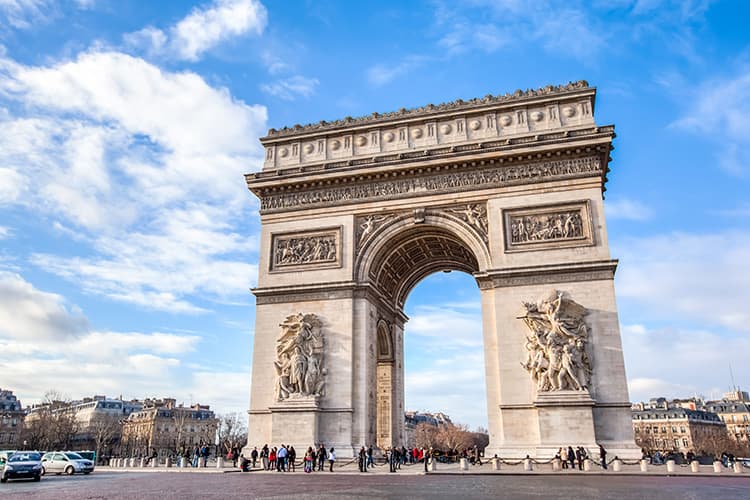
Standing majestically at the western end of the Champs-Élysées, the Arc de Triomphe is a powerful symbol of French national identity and one of Paris' most recognizable monuments. Located at the center of the Place Charles de Gaulle, formerly known as Place de l'Étoile, it commands a spectacular view, with twelve grand avenues radiating outwards in a star-shaped configuration. This impressive neoclassical arch, inspired by ancient Roman architecture, serves as a poignant tribute to those who fought and died for France in the French Revolutionary and Napoleonic Wars. Visitors can ascend to its panoramic terrace for breathtaking views across the city, witnessing the convergence of historic avenues and landmarks. Beneath its massive vault lies the Tomb of the Unknown Soldier, marked by an eternal flame, a solemn reminder of sacrifice and remembrance.
History & Cultural Background
The story of the Arc de Triomphe begins in 1806, when Emperor Napoleon I commissioned its construction after his decisive victory at the Battle of Austerlitz in 1805. He envisioned a grand arch to honor the French army and celebrate its triumphs. Designed by Jean-François-Thérèse Chalgrin, the monument's creation was a monumental undertaking, lasting 30 years and involving several architects and interruptions due to political upheavals. Napoleon never saw its completion, as it was finally inaugurated in 1836 under King Louis-Philippe I.
The Arc is not merely a static structure; it is deeply interwoven with French history and national memory. Its inner and outer surfaces are inscribed with the names of French victories and generals from the Revolutionary and Napoleonic Wars. A profound layer of symbolism was added in 1920 with the installation of the Tomb of the Unknown Soldier beneath its vault, commemorating unidentified French soldiers who perished in World War I. An eternal flame, first lit in 1923, burns continuously, rekindled every evening in a moving ceremony.
What Makes It Special
Beyond its sheer architectural grandeur and imposing scale—standing 50 meters (164 feet) tall and 45 meters (148 feet) wide—the Arc de Triomphe is unique for its profound historical resonance and its strategic position within Paris' urban landscape. It anchors the 'Historic Axis' (Axe Historique), a monumental alignment of buildings and thoroughfares that stretches from the Louvre Museum, through the Tuileries Gardens, Place de la Concorde, up the Champs-Élysées, and culminates at the Grande Arche de la Défense.
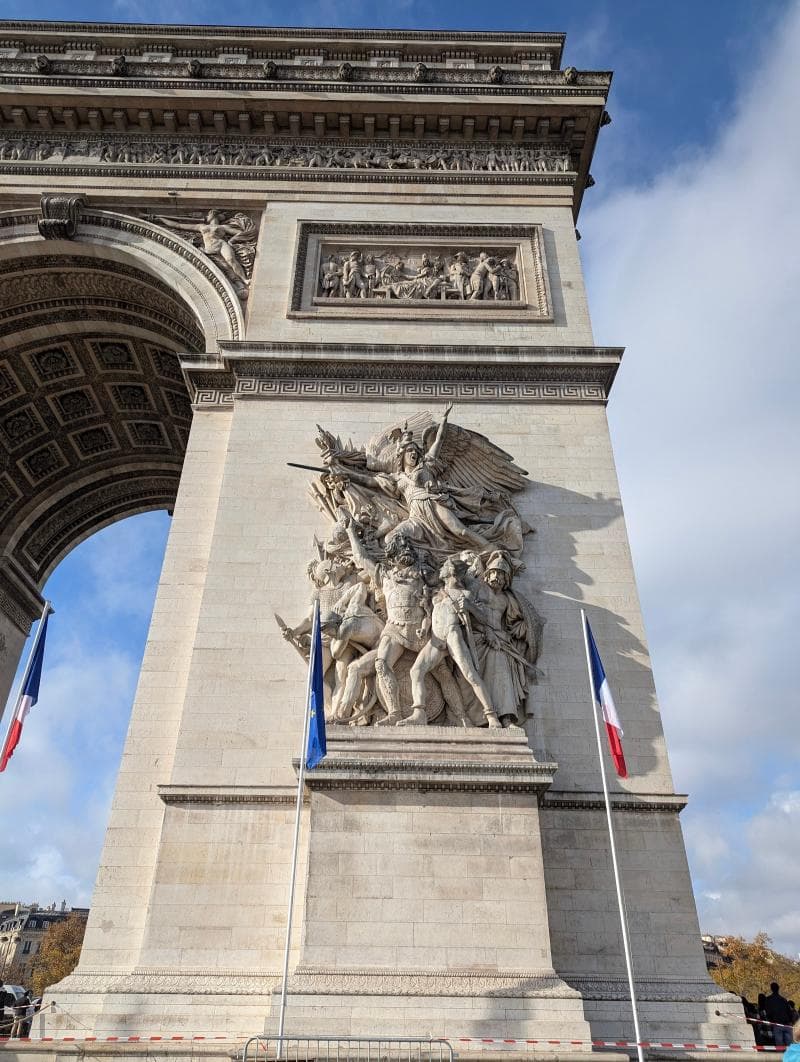
The intricate relief sculptures adorning its facades are masterpieces of French Romantic sculpture. Among the most famous is 'The Departure of the Volunteers of 1792,' often called 'La Marseillaise,' by François Rude, which dynamically captures the spirit of the French Revolution. These sculptures, along with the engraved names of generals and battles, transform the arch into a vast historical ledger, telling stories of courage, sacrifice, and national pride.
Stories, Fun Facts & Local Details
The Arc de Triomphe is steeped in fascinating stories. It is said that twice a year, around specific dates in May and August, the sun perfectly aligns with the arch, setting directly through its central opening, creating a truly magical spectacle. Interestingly, before the Arc's construction, an audacious proposal was made for a giant elephant structure to occupy the site, highlighting the ambitious visions for Parisian urban planning.
In 2021, the Arc de Triomphe gained renewed attention when it was temporarily wrapped in fabric as part of a posthumous art installation by the artists Christo and Jeanne-Claude, transforming its appearance and sparking global conversations about art and public spaces. Visitors often notice that access to the monument is via an underground pedestrian tunnel, a crucial detail for safety given the busy traffic circle surrounding it.
Visitor Perspective
A visit to the Arc de Triomphe offers more than just a view; it's an immersive journey into French history and Parisian splendor. After navigating the pedestrian tunnel from either the Champs-Élysées or Avenue de la Grande Armée, guests can explore the museum located inside the arch, which provides deeper insights into its construction and historical significance.
For those eager to experience the iconic panoramic vista, a climb of 284 steps leads to the observation deck at the summit. While an elevator is available for those needing assistance, it typically doesn't go all the way to the top, requiring a final set of stairs. From this elevated vantage point, the grand perspective down the Champs-Élysées towards the Louvre, or the intricate star-shaped layout of avenues below, is truly unforgettable, especially at sunset when the city lights begin to twinkle.
Coordinates: 2.295028, 48.873778
View on Google Maps💬 How Travelers Describe This Place
Based on community votes
Must See
995Unique
929Photogenic
858Beautiful
730Interesting
275
Traveler Stories
Discover memorable experiences shared by travelers who have visited this place.
No traveler stories yet.
Be the first traveler to share what made this place memorable.
Things to see at Arc de Triomphe



Tour
By
Spot
Discover amazing places around the world. Your journey starts here.
Explore
© 2026 TourBySpot. All rights reserved.