The Arch Structure
Paris, France
Explore the Arc de Triomphe in Paris, France, a monumental arch honoring French military victories and home to the Tomb of the Unknown Soldier. Discover its history and panoramic views.
Overview
At the heart of Paris, at the western end of the famous Champs-Élysées, stands the majestic Arc de Triomphe. This monumental arch structure, officially known as the Arc de Triomphe de l'Étoile, is not just an architectural marvel but a profound symbol of French national pride and history. It commands the Place Charles de Gaulle, a grand roundabout from which twelve avenues radiate, creating a striking star-like pattern, which gives the monument part of its name ('l'Étoile' means 'the star'). Conceived in the Neoclassical style, its imposing scale and intricate details immediately captivate visitors, hinting at the rich narratives etched into its stone. It serves as a powerful reminder of France's military past and a focal point for national remembrance and celebration.
History & Cultural Background
The story of the Arc de Triomphe begins with Emperor Napoleon I. Following his resounding victory at the Battle of Austerlitz in 1805, Napoleon commissioned the arch in 1806 to honor the glory and sacrifices of the French army. His vision was grand: a triumphal arch through which his victorious soldiers would march upon their return home. The design, by architect Jean-François Chalgrin, drew inspiration from the classical triumphal arches of ancient Rome, such as the Arch of Titus, but on an unprecedented scale. However, the construction was a prolonged endeavor, spanning three decades. Work halted and resumed multiple times due to political changes and financial constraints. Napoleon himself never saw its completion, as it was finally inaugurated in 1836, fifteen years after his death. Throughout the 19th and 20th centuries, the Arc de Triomphe evolved into more than just a monument to military success; it became a central stage for significant national events, embodying the spirit and resilience of France.
What Makes It Special
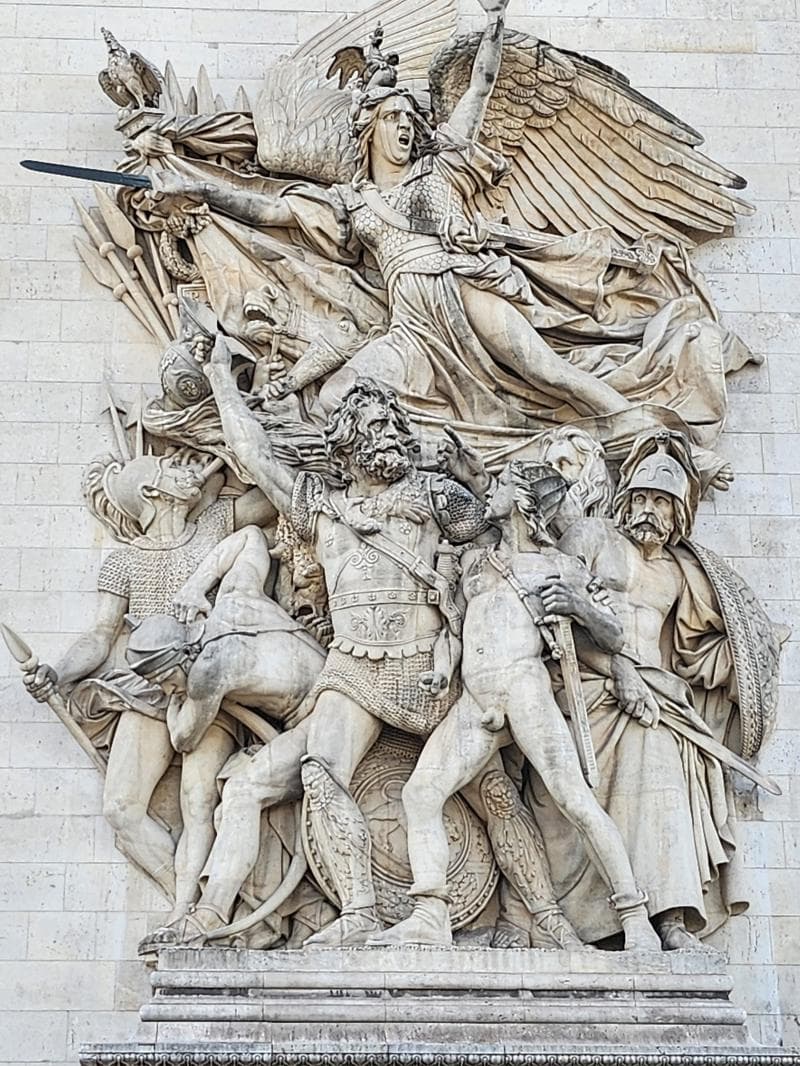
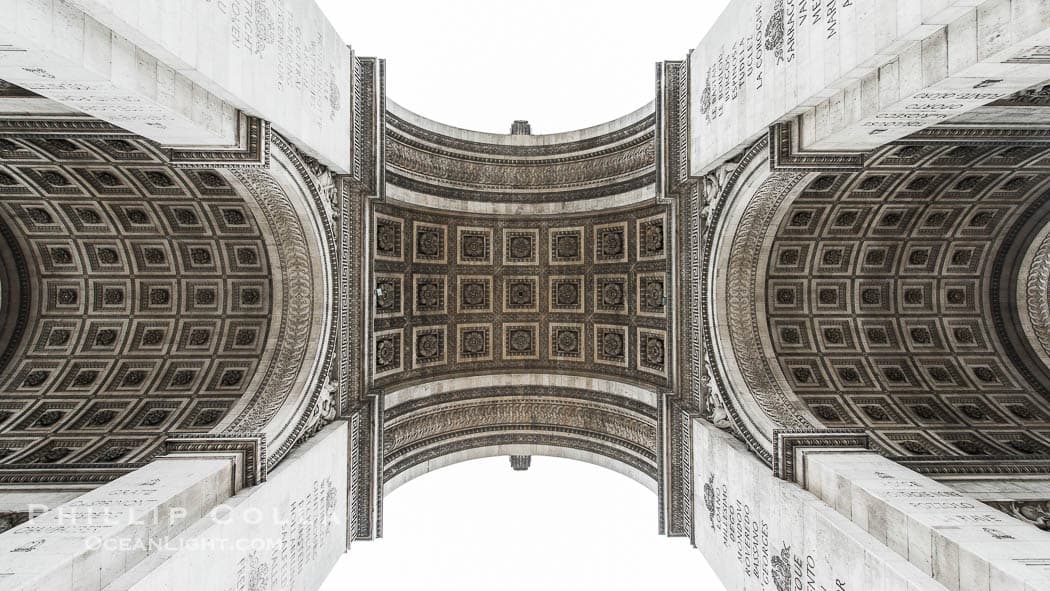
The Arc de Triomphe's uniqueness lies in its monumental scale, exquisite sculptural work, and profound symbolic significance. Standing nearly 50 meters (164 feet) tall and 45 meters (148 feet) wide, it is one of the largest triumphal arches ever built. Its facades are adorned with magnificent high-relief sculptures that depict key moments from French history and allegorical figures. The most famous of these is François Rude's 'The Departure of the Volunteers of 1792', commonly known as 'La Marseillaise', a dynamic representation of volunteers rallying to defend the nation. Other notable groups include 'The Triumph of 1810' by Jean-Pierre Cortot, and 'The Resistance of 1814' and 'The Peace of 1815' by Antoine Étex. Inscribed on its inner and outer surfaces are the names of hundreds of generals and battles from the French Revolutionary and Napoleonic Wars. Beneath the arch's vast central vault lies the Tomb of the Unknown Soldier, interred on November 11, 1920, to commemorate all French soldiers who died in World War I. An eternal flame, first lit in 1923, burns continuously over the tomb, a poignant reminder of unending remembrance.
Stories, Fun Facts & Local Details
The Arc de Triomphe is steeped in stories and traditions. One poignant detail is that its inauguration in 1836 was surprisingly discreet, largely due to fears of an assassination attempt on King Louis-Philippe. Despite this quiet start, it quickly became a focal point for national pride. After World War I, the idea of honoring an unknown soldier gained traction, leading to the selection of a fallen French soldier from Verdun whose remains were placed beneath the arch. The decision to bury the Unknown Soldier here, rather than the Panthéon, underscored its importance as a symbol for the entire nation. Each evening at 6:30 PM, a solemn ceremony takes place to rekindle the eternal flame, a tradition upheld since 1923. This daily ritual, often attended by veterans' associations, is a powerful, silent tribute to sacrifice. The arch has also witnessed countless historic processions, from Napoleon's remains passing under it in 1840 to Allied troops marching through after the liberation of Paris in 1944. Its strategic location at the 'Étoile' (star) roundabout, where twelve avenues converge, is a testament to Parisian urban planning and creates one of the most iconic perspectives in the city.
Visitor Perspective
Visiting the Arc de Triomphe offers an immersive journey through French history and breathtaking views of Paris. Access to the monument is safely managed via an underground pedestrian tunnel, avoiding the busy traffic circle above. Inside, a small museum provides detailed insights into the arch's construction, its historical context, and the symbolism of its sculptures and inscriptions. For many, the highlight is ascending to the panoramic terrace at the very top. Visitors can climb 284 steps or utilize an elevator for most of the ascent, followed by a shorter staircase. From this vantage point, you are rewarded with an unparalleled 360-degree panorama of Paris, including iconic landmarks like the Eiffel Tower, the Louvre, and the entire stretch of the Champs-Élysées, extending to the Grande Arche de la Défense. It's a place where history feels alive, where the stories of heroism and remembrance resonate, and where the beauty of Paris unfolds beneath your feet.
Coordinates: 2.2950275, 48.8737917
View on Google Maps💬 How Travelers Describe This Place
Based on community votes
Must See
950Beautiful
287Photogenic
255Unique
231Interesting
86
Traveler Stories
Discover memorable experiences shared by travelers who have visited this place.
No traveler stories yet.
Be the first traveler to share what made this place memorable.

Tour
By
Spot
Discover amazing places around the world. Your journey starts here.
Explore
© 2026 TourBySpot. All rights reserved.