Watchtowers
Tbilisi, Georgia
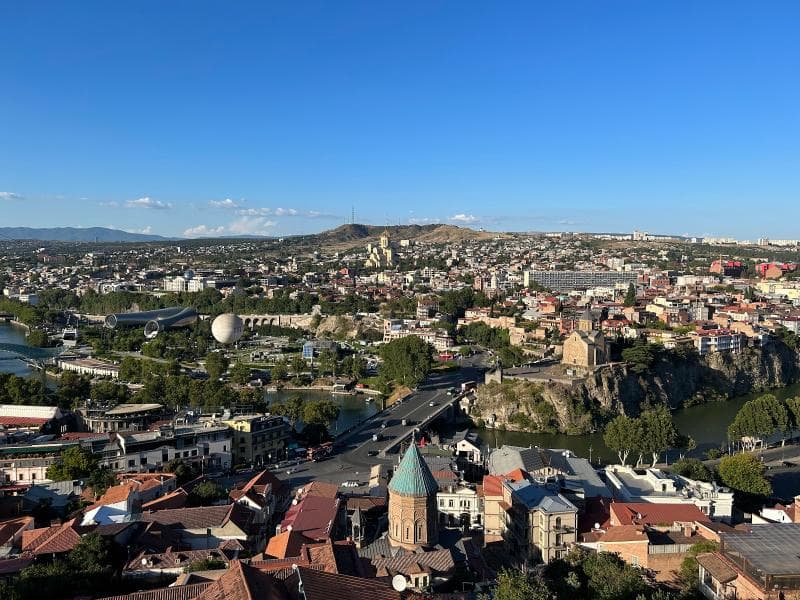
Discover the ancient watchtowers of Narikala Fortress in Tbilisi, Georgia. Uncover centuries of history and enjoy panoramic city views from these enduring defensive structures.
Overview
Perched majestically above Tbilisi, Georgia, the watchtowers of Narikala Fortress stand as enduring sentinels, embodying centuries of the city's tumultuous history and strategic importance. These ancient stone structures, integral to the larger Narikala complex, have overseen the Mtkvari River and the ever-evolving cityscape for over 1,500 years. While often viewed as part of the broader fortress, the watchtowers individually represent critical points of defense and observation, offering a tangible connection to Tbilisi's past as a crucial crossroads of trade and culture. Their weathered forms contribute significantly to the iconic silhouette that defines Tbilisi's Old Town, visible from nearly every corner of the capital.
These silent guardians have withstood countless invasions, natural disasters, and the passage of empires, each leaving its indelible mark on their robust masonry. Exploring them, even from a distance during ongoing renovations, allows a traveler to grasp the immense defensive genius of medieval architecture and the profound resilience of the Georgian spirit. The watchtowers are not merely ruins; they are storytellers etched in stone, inviting curious minds to delve into their storied past and appreciate the breathtaking panoramas they command.
History & Cultural Background
The origins of Narikala Fortress, and by extension its watchtowers, trace back to the 4th century AD, when the site served as a Persian citadel. Initially known as 'Shuris-tsikhe' – 'the Rival Fortress' or 'the Enviable Fortress' – it was strategically positioned to guard the narrow valley where Tbilisi would flourish.
Over subsequent centuries, the fortress underwent numerous expansions and reconstructions under the dominion of various powers. Arab emirs, who controlled Tbilisi in the 7th and 8th centuries, played a significant role in strengthening the fortifications, adding robust walls that still define the citadel's outline. During this period, Narikala became the administrative heart of their Caucasian territories. Later, Georgian kings, particularly David IV the Builder in the 11th–12th centuries, further enlarged and reinforced the fortress, ensuring its role as a primary defensive stronghold.
The name 'Narikala,' meaning 'Little Fortress,' is believed to have been given during the Mongol rule. The watchtowers, as key components of this defensive system, were continuously adapted and strengthened, bearing witness to the successive imprints of Byzantine, Ottoman, and Persian occupiers. A pivotal event in its history occurred in 1827 when a catastrophic explosion, possibly from a Russian ammunition depot or an earthquake, largely destroyed the internal structures, leaving much of the external walls and watchtowers in their present ruined, yet atmospheric, state.
What Makes It Special
What truly sets the watchtowers of Narikala apart is their unparalleled strategic placement and the panoramic vistas they afford. Built along a steep hill overlooking the Mtkvari River and the confluence of cultures below, these towers were perfectly positioned to monitor movements along vital trade routes and protect the burgeoning city.
From the fortress ramparts, including the areas where watchtowers once proudly stood or are still visible, visitors can embrace a sweeping perspective of Tbilisi. This includes the domed roofs of the Abanotubani sulfur baths, the intricate carved wooden balconies of the Old Town, the modern elegance of the Bridge of Peace, and the Metekhi Church across the river.
Among these, some watchtowers hold a more 'hidden' charm. For instance, specific stone watchtowers are subtly embedded in the hillside above the Botanical Garden valley, often unnoticed by casual visitors. These subtle details, combined with the visible grandeur of the main towers, underscore the comprehensive defensive network that Narikala represented. The blend of various architectural styles, remnants of the many empires that shaped Georgia, makes each stone and every surviving watchtower a unique testament to history.
Stories, Fun Facts & Local Details
Narikala Fortress is more than just a historical monument; it is widely regarded by locals as 'the heart and soul of Tbilisi.' The watchtowers, as an intrinsic part of this beloved landmark, are silent witnesses to countless historical narratives. Imagine the ancient guards peering from these very towers, observing caravans laden with Silk Road treasures making their way through the valley below, or spotting approaching armies from distant lands.
Legends often swirl around such ancient sites, and Narikala is no exception. While specific tales about individual watchtowers are less documented, the fortress as a whole is said to house hidden treasures and guardian spirits, adding a mystical layer to its rugged beauty. The resilience symbolized by these enduring structures aligns closely with the spirit of Georgia itself—a nation that has fiercely defended its identity and culture through centuries of external pressures. The strategic genius involved in selecting this site and continually reinforcing its defenses through its towers speaks volumes about the early inhabitants' understanding of their environment and the threats they faced.
Visitor Perspective
Experiencing the watchtowers of Narikala Fortress offers a truly immersive journey into Tbilisi's past, although visitors should note important access information. As of August 2026, Narikala Fortress is currently closed to visitors due to ongoing restoration and safety work. Access to the interior, fortress walls, and areas within the complex is restricted. No official reopening date has been confirmed.
Despite the current closure of the fortress interior, the watchtowers remain a captivating sight and can be appreciated from various vantage points. Visitors can still enjoy breathtaking panoramic views of Tbilisi by taking the scenic cable car ride from Rike Park, which ascends directly towards Narikala Hill. The pathways leading to the nearby Mother of Georgia statue (Kartlis Deda) also provide excellent perspectives of the fortress walls and its many towers. For those wishing to spot the 'hidden' watchtowers, walking to the back of the lower fortress, opposite the main entrance, and peering over the edge toward the Botanical Garden valley is recommended.
It is always advisable to check local tourism updates for the latest information on accessibility and to adhere strictly to any signs or barriers for safety. Even from the surrounding areas, the majestic watchtowers of Narikala continue to offer a profound connection to Tbilisi's ancient legacy and its unyielding spirit.
Coordinates: 44.8095528, 41.6877649
View on Google Maps💬 How Travelers Describe This Place
Based on community votes
Beautiful
950Must See
858Unique
287Interesting
231Photogenic
86
Traveler Stories
Discover memorable experiences shared by travelers who have visited this place.
No traveler stories yet.
Be the first traveler to share what made this place memorable.

Tour
By
Spot
Discover amazing places around the world. Your journey starts here.
Explore
© 2026 TourBySpot. All rights reserved.