Watchtower
Berlin, Germany
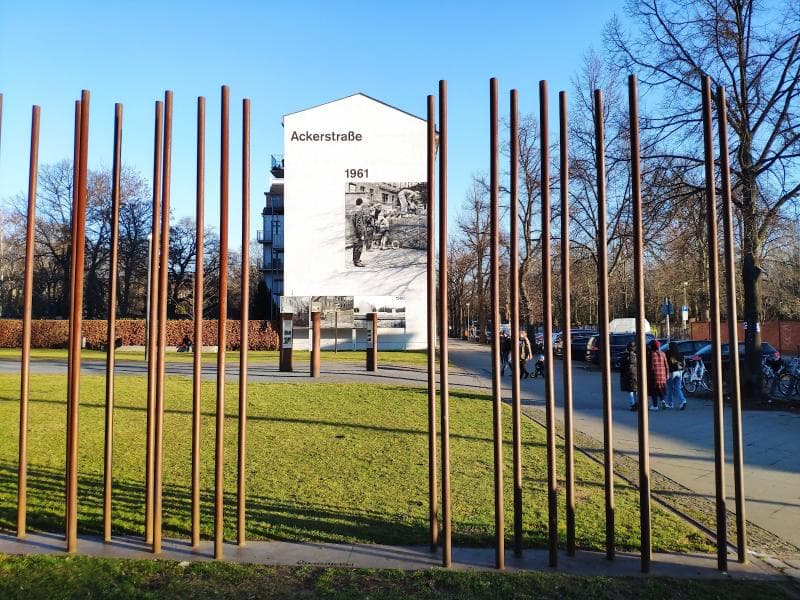
Explore the Watchtower at Berlin Wall Memorial in Berlin, Germany. Gain insight into the Cold War's division, the 'death strip,' and the guards' vigilance.
Overview
Within the poignant expanse of the Berlin Wall Memorial in Berlin, Germany, stands a watchtower that serves as a stark reminder of the city's divided past. While some original watchtowers still exist elsewhere in Berlin, the one integrated into the memorial on Bernauer Straße is a reconstruction, carefully placed to visually complete the preserved section of the border fortifications. This memorial watchtower, along with sections of the inner and outer walls and the dreaded 'death strip', offers visitors a tangible representation of the Iron Curtain that once sliced through the city and separated lives.
The Berlin Wall Memorial is not just a collection of historical artifacts; it is an open-air exhibition that allows a deeply immersive experience. The watchtower here helps visitors understand the formidable system designed by the German Democratic Republic (GDR) to prevent its citizens from fleeing to West Berlin. It is a central element in recreating the grim atmosphere of surveillance and control that defined daily life along the border for nearly three decades.
History & Cultural Background
The Berlin Wall was erected on August 13, 1961, initially as a barbed-wire fence, quickly evolving into a complex and impenetrable barrier system. The primary purpose of this construction was to halt the mass emigration from East Germany, which was causing significant economic and social drain. The watchtowers were an integral part of this system, strategically positioned at regular intervals—approximately 250 meters apart—to provide border guards with an unobstructed view of the 'death strip' and the territory beyond.
These towers came in various forms, from early wooden structures to more robust concrete models, including the 'BT-type' observation towers and 'Führungsstellen' or command towers that coordinated surveillance over multiple sections. Each tower was manned by armed guards, often with strict orders to shoot anyone attempting to cross the border, a chilling policy known as the 'Schiessbefehl'. The watchtower at the Berlin Wall Memorial embodies this grim history, symbolizing the constant vigilance and the human cost of the Cold War division. The Bernauer Straße itself holds immense historical significance, having been the site of dramatic escapes and forced relocations in the early days of the Wall.
What Makes It Special
What makes the watchtower at the Berlin Wall Memorial special is its role as a powerful educational and commemorative tool. While it may be a reconstruction, its presence is crucial for conveying the full extent of the border fortifications to visitors. It allows for a holistic understanding of the 'death strip'—the barren, heavily guarded area between the inner and outer walls—and the oppressive gaze under which East Berliners lived.
Unlike other surviving original watchtowers in Berlin, which stand somewhat isolated amidst changed urban landscapes, the memorial's watchtower is part of a larger, carefully designed exhibition that recreates the full context of the Wall. This integrated approach helps visitors grasp the sheer scale and psychological impact of the border system. It forces contemplation on the stories of separation, desperate escape attempts, and the constant threat faced by those living near the Wall. The memorial strives to provide an authentic experience, ensuring that this dark chapter of history is never forgotten.
Stories, Fun Facts & Local Details
The watchtowers were not merely architectural structures; they were the nerve centers of the GDR's border security. Guards spent long, solitary shifts inside these confined spaces, tasked with unwavering surveillance. One notable, and tragic, story connected to the watchtowers is that of Günter Litfin, who was the first person to be shot dead by GDR border guards while attempting to flee just days after the Wall's construction in 1961. This occurred near the Kieler Eck command tower, another original watchtower in Berlin, highlighting the deadly reality enforced from these vantage points.
A less somber, yet illustrative, detail about the watchtowers reveals the ingenuity or desperation of the guards: when heating units broke down in the concrete towers, border guards sometimes resorted to using heating elements from their hot plates to warm up concrete slabs. These small, human details offer a glimpse into the mundane realities endured within such a hostile environment, contrasting sharply with the towers' menacing public image.
Visitor Perspective
For visitors to the Berlin Wall Memorial, the watchtower offers a profound perspective. From the five-story observation tower at the Documentation Center, you can look out over the preserved sections of the border fortifications, including the reconstructed watchtower, the 'death strip', and remnants of the Wall itself. This elevated vantage point provides a unique opportunity to comprehend the intricate layers of the border system and visualize the lives impacted by it.
Walking along the memorial grounds on Bernauer Straße, one can feel the weight of history. The watchtower stands as a silent sentinel, evoking the ever-present threat of surveillance. It prompts reflection on themes of freedom, human rights, and the consequences of political division. The experience is designed to be deeply moving, allowing individuals to connect with the personal stories of those who lived through this era and to understand the immense significance of the Wall's fall. The memorial grounds, including the watchtower, are accessible for visitors, providing a vital educational and commemorative journey.
Coordinates: 13.390125425357455, 52.53502271238896
View on Google Maps💬 How Travelers Describe This Place
Based on community votes
Beautiful
921Interesting
831Unique
232Photogenic
211Must See
147
Traveler Stories
Discover memorable experiences shared by travelers who have visited this place.
No traveler stories yet.
Be the first traveler to share what made this place memorable.

Tour
By
Spot
Discover amazing places around the world. Your journey starts here.
Explore
© 2026 TourBySpot. All rights reserved.