Wall Walkways
Dubrovnik, Croatia
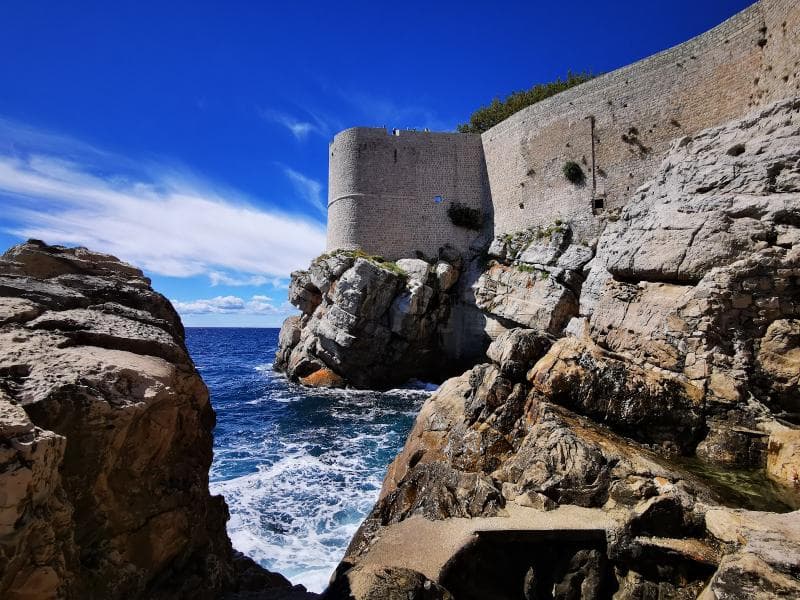
Explore the historic Wall Walkways of Dubrovnik City Walls in Dubrovnik, Croatia. Discover medieval defenses, stunning Adriatic views, and rich history.
Overview
The Wall Walkways, an integral part of the magnificent Dubrovnik City Walls in Dubrovnik, Croatia, represent one of Europe's most remarkably preserved medieval fortifications. These formidable stone ramparts completely encircle the historic Old Town, offering an unparalleled journey through history and breathtaking vistas. Recognized as a UNESCO World Heritage site since 1979, the walls stretch for an impressive 1,940 meters (approximately 1.2 miles), reaching heights of up to 25 meters (82 feet). Their robust construction and strategic design were crucial in safeguarding the independent Republic of Ragusa, making them a defining symbol of Dubrovnik's enduring spirit and earning the city its moniker, 'Pearl of the Adriatic'.
Walking these ancient pathways allows visitors to literally step into the past, experiencing the city from a unique elevated perspective. The walkways traverse a complex system of forts, towers, bastions, and gates, each telling a part of Dubrovnik's rich narrative of defense and diplomacy. From the broad land-facing sections to the narrower sea walls, every turn presents a new panorama, encompassing the iconic terracotta rooftops, the shimmering Adriatic Sea, and the intricate layout of the Old Town below.
The 'Wall Walkways' are not merely a path but a living museum, illustrating centuries of architectural and military evolution.
History & Cultural Background
The history of the Dubrovnik City Walls is a testament to the city's continuous struggle for independence and its strategic importance. Early fortifications date back to the 9th century, with significant developments occurring between the 13th and 17th centuries, shaping the walls into their current form. The defensive system was primarily conceived to protect the prosperous maritime Republic of Ragusa from various threats, notably the Venetian Republic and the Ottoman Empire.
Construction was an ongoing effort, evolving with military technology. In the 15th century, with the emergence of firearms, the walls underwent significant reinforcement. Architects like Michelozzo di Bartolomeo and Paskoje Miličević played pivotal roles in enhancing their design and strength, introducing features such as casemates for cannons. The landward walls, facing potential artillery attacks, were built with impressive thickness, ranging from 4 to 6 meters, while the seaward walls were typically 1.5 to 3 meters thick.
These walls famously withstood the devastating earthquake of 1667 and, more recently, the siege during the 1990s Homeland War, proving their enduring resilience and strategic effectiveness. The collective effort and dedication of Dubrovnik's citizens throughout history are deeply embedded in the very stone of these walls.
What Makes It Special
What sets Dubrovnik's Wall Walkways apart is not just their age or scale, but their exceptional state of preservation and the complete circuit they form around the Old Town. Unlike many other ancient fortifications, these walls were never breached, allowing them to retain their original integrity. The limestone used in their construction, some of which was sourced from a quarry near Dubac, combined with a unique mortar that reputedly included seaweed and eggshells, contributed to their remarkable durability.
Along the walkways, visitors encounter an impressive array of defensive structures: the commanding Minčeta Tower in the north, Fort Bokar guarding the western approach, Fort Revelin protecting the eastern side, and the complex St. John's Fortress on the southeast. Just outside the city walls, the imposing Fort Lovrijenac stands majestically on a 37-meter-high cliff, its walls facing the sea being up to 12 meters thick, explicitly designed to deter Venetian attacks.
The varying thicknesses of the walls, strategically designed for land and sea defense, and the intricate network of forts and towers, showcase advanced medieval engineering. This comprehensive defensive system provided a secure haven, allowing Dubrovnik to flourish as an independent maritime republic for centuries.
Stories, Fun Facts & Local Details
The Wall Walkways are imbued with fascinating tales and local lore. One popular story recounts that during a significant reconstruction phase in the 15th century, every person entering Dubrovnik was required to bring a stone proportionate to their size as an 'entry fee' to contribute to the walls' rebuilding. This anecdote highlights the communal commitment to the city's defense.
Above the entrance to Fort Lovrijenac, an iconic inscription proudly proclaims, 'Non Bene Pro Toto Libertas Venditur Auro' — 'Liberty is not to be sold for all the riches of this world.' This motto, often shortened to 'Libertas,' encapsulates the spirit of Dubrovnik and its unwavering dedication to freedom.
Historically, the Republic of Ragusa maintained no standing army; instead, its citizens themselves manned the defenses, ensuring 24-hour vigilance. The city gates were famously closed and locked each night, preserving the city within its protective embrace until morning. Even in modern times, during the 1990s siege, these ancient walls once again served their purpose, protecting the city, although many of the Old Town's famous terracotta roofs were damaged and subsequently replaced.
Visitor Perspective
Walking the Wall Walkways of Dubrovnik City Walls offers an unforgettable experience, providing a continuous loop of panoramic views that unfold with every step. The circuit, approximately 1.9 kilometers (1.2 miles) long, typically takes around 1.5 to 2 hours to complete at a leisurely pace, allowing time for photographs and contemplation.
Due to the considerable number of steps (over a thousand in total) and the exposure to the sun, it is highly recommended to undertake the walk either early in the morning shortly after opening or in the late afternoon. This strategy helps avoid both the midday heat and the largest crowds, particularly during peak season or when cruise ships are in port.
The path offers varied perspectives: on one side, the endless expanse of the Adriatic Sea, dotted with islands like Lokrum; on the other, the mesmerizing sea of terracotta rooftops, narrow streets, and historic buildings of the Old Town. Small cafes are often found along the route, providing refreshing breaks with stunning backdrops. This journey along the Wall Walkways provides not just scenic beauty, but a profound connection to Dubrovnik's rich past and its enduring identity.
Coordinates: 18.108, 42.64
View on Google Maps💬 How Travelers Describe This Place
Based on community votes
Photogenic
981Interesting
795Unique
753Beautiful
172Must See
79
Traveler Stories
Discover memorable experiences shared by travelers who have visited this place.
No traveler stories yet.
Be the first traveler to share what made this place memorable.

Tour
By
Spot
Discover amazing places around the world. Your journey starts here.
Explore
© 2026 TourBySpot. All rights reserved.