Vyšehrad Cemetery
Prague, Czech Republic
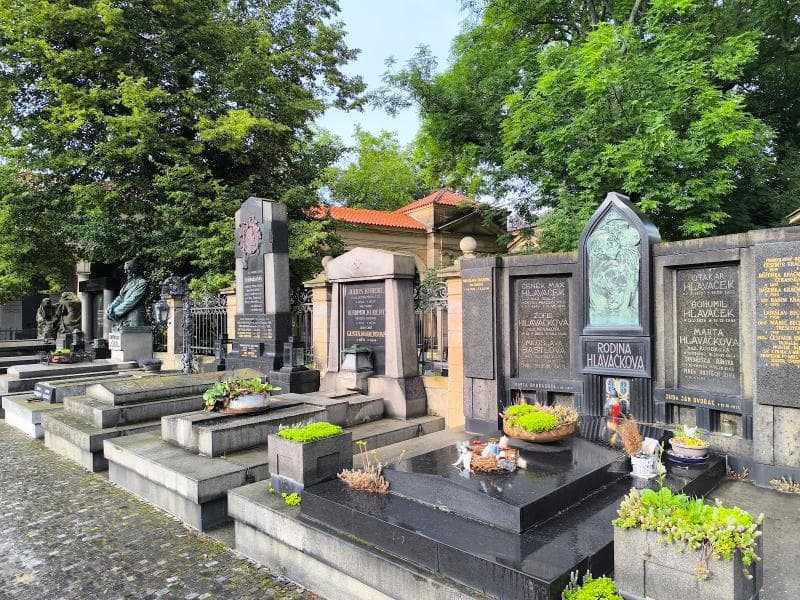
Explore Vyšehrad Cemetery in Prague, Czech Republic, the national resting place for Czech cultural giants like Dvořák, Mucha, and Čapek.
Overview
Nestled within the historic Vyšehrad fortress in Prague, Czech Republic, lies the serene and profoundly significant Vyšehrad Cemetery. More than just a burial ground, it serves as the Czech national cemetery, a hallowed final resting place for many of the nation's most celebrated figures from the worlds of art, science, literature, music, and politics. Adjacent to the stunning Basilica of St. Peter and St. Paul, this picturesque cemetery offers visitors a unique blend of history, culture, and tranquil beauty.
Established as a national pantheon in the late 19th century, the cemetery is characterized by its magnificent Neo-Renaissance arcades and its crowning jewel, the monumental Slavín tomb. It provides a quiet space for reflection, surrounded by artfully crafted tombstones that tell stories of Czech national identity and achievement.
History & Cultural Background
The origins of the Vyšehrad Cemetery date back much further than its designation as a national cemetery. Initially, it served as a parish burial ground, with archaeological findings suggesting burials in the Vyšehrad area as early as the 11th or 12th century, and the oldest mention of the cemetery itself appearing in 1660.
However, its transformation into the national cemetery we know today began in the mid-19th century. During the fervent period of the Czech National Revival, there was a growing desire to establish a dignified resting place for important Czech personalities. In 1869, the idea, championed by figures like politician František Ladislav Rieger, became a reality, converting the existing cemetery into a national pantheon.
A significant development was the construction of the beautiful Neo-Renaissance arcades around the cemetery's perimeter, starting in 1881, designed by architect Antonín Wiehl. Wiehl was also responsible for the design of the iconic Slavín tomb, built between 1889 and 1893, which solidified the cemetery's role as a symbol of national pride and cultural legacy.
What Makes It Special
What truly sets Vyšehrad Cemetery apart is its status as a national pantheon, a tangible representation of Czech history and cultural heritage. The artistry displayed throughout the cemetery is remarkable; each gravestone is a unique work of art, ranging from classical to Art Nouveau styles, often created by leading Czech sculptors and architects.
The centerpiece is undoubtedly the Slavín tomb, a grand communal mausoleum where the most esteemed Czech figures are interred. Designed with neoclassical grandeur and adorned with sculptural works, Slavín symbolizes the nation's respect for its cultural heroes. Within the cemetery's 0.81 hectares, approximately 1,200 grave sites exist, housing about 600 notable individuals, with 57 specifically laid to rest within the Slavín tomb.
This concentration of national luminaries, combined with the exquisite funerary art and the tranquil atmosphere, makes it a powerful and moving place to visit.
Stories, Fun Facts & Local Details
Walking through Vyšehrad Cemetery is like strolling through a 'Who's Who' of Czech history and culture. You'll find the graves of world-renowned composers such as Antonín Dvořák and Bedřich Smetana, whose music defined a nation. Literary giants like writer Karel Čapek, author of 'R.U.R.', and Božena Němcová, whose image graces the 500 crown note, are also laid to rest here. The artistic legacy continues with painter Alfons Mucha, a key figure in the Art Nouveau movement, and Nobel laureate Jaroslav Heyrovský, inventor of polarography.
A deeply moving detail is the inscription on the Slavín tomb: 'Ač zemřeli, ještě mluví.' This translates to 'Though they are dead, they still speak,' beautifully encapsulating the enduring impact of those interred within. The first person buried in Slavín was poet Julius Zeyer in 1901. The cemetery also runs an 'Adoption of Significant Graves' program, allowing individuals and institutions to contribute to the preservation of these historically and artistically valuable monuments.
Visitor Perspective
Visiting Vyšehrad Cemetery offers a profoundly reflective and inspiring experience. Located high on a rocky bluff above the Vltava River, within the larger Vyšehrad complex, it provides not only a historical journey but also breathtaking panoramic views of Prague. The peaceful pathways, surrounded by meticulously maintained graves and artistic sculptures, invite quiet contemplation. It is a place where you can connect with the spirit of Czech creativity and resilience. While the cemetery is a place of solemn remembrance, it is also a beautiful and peaceful park. The atmosphere is generally quiet, often shared with locals enjoying the serene surroundings. It's a destination that encourages visitors to slow down, absorb the stories etched in stone, and appreciate the rich tapestry of Czech national identity. The cemetery is generally open to the public, with varying hours depending on the season.
Coordinates: 14.41778, 50.065
View on Google Maps💬 How Travelers Describe This Place
Based on community votes
Photogenic
915Beautiful
211Interesting
123Unique
74Must See
20
Traveler Stories
Discover memorable experiences shared by travelers who have visited this place.
No traveler stories yet.
Be the first traveler to share what made this place memorable.

Tour
By
Spot
Discover amazing places around the world. Your journey starts here.
Explore
© 2026 TourBySpot. All rights reserved.