Victory Column
Berlin, Germany
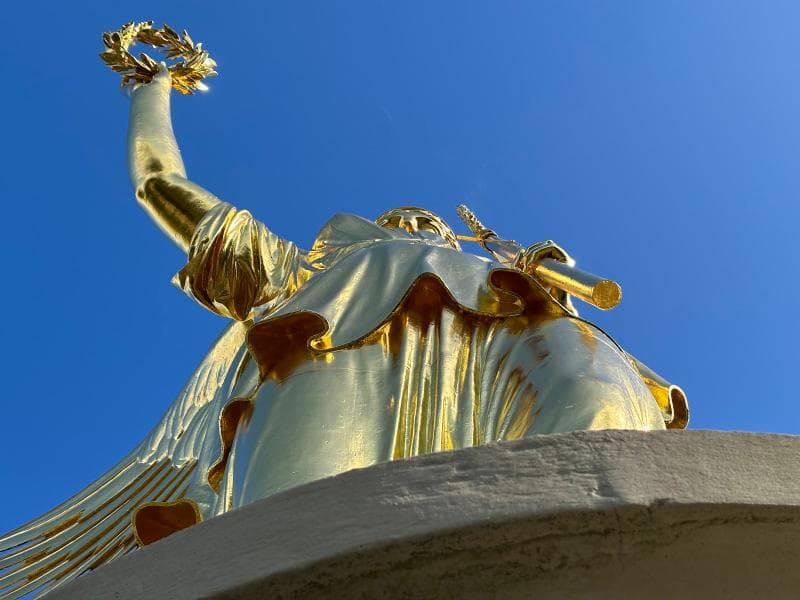
Explore Berlin's iconic Victory Column (Siegessäule) in Tiergarten, Germany. Discover its rich history, the 'Goldelse' statue, panoramic views, and cultural significance.
Overview
Standing majestically in the heart of Berlin's expansive Tiergarten park, the Victory Column, known locally as the 'Siegessäule', is an iconic monument that tells a compelling story of Germany's past. Crowned by the gleaming golden statue of Victoria, affectionately nicknamed 'Goldelse' by Berliners, this landmark offers more than just historical reflection; it provides breathtaking panoramic views of the city's verdant landscape and architectural marvels. It serves as a pivotal point for understanding Berlin's historical evolution and its vibrant contemporary culture.
Originally conceived to commemorate Prussian military triumphs, the Victory Column has transcended its initial purpose to become a beloved symbol of Berlin itself. Its distinctive golden figure, visible from afar, acts as a beacon, drawing curious travelers to uncover the narratives etched into its very structure and to experience the unique perspective it offers over the German capital.
History & Cultural Background
The construction of the Victory Column began in 1865, designed by architect Heinrich Strack. It was initially planned to celebrate Prussia's decisive victory in the 1864 Danish-Prussian War. However, by its inauguration on September 2, 1873, Prussia had achieved further victories against Austria in 1866 and France in 1870-71, events collectively known as the Wars of German Unification. These subsequent successes expanded the monument's commemorative scope.
The column's original location was Königsplatz, now known as Platz der Republik, directly in front of the Reichstag building. A significant transformation occurred between 1938 and 1939, during the Nazi era, when the column was relocated to its current prominent position in the Großer Stern roundabout within the Tiergarten. This move was part of Hitler's ambitious plan to redesign Berlin into a monumental 'Germania'. During this relocation, a fourth cylindrical section was added to the column, increasing its height and altering its original proportions.
Remarkably, the Victory Column survived the intense bombing raids of World War II largely intact, a testament to its robust construction. After the war, there were even discussions among the Allied forces about its potential demolition due to its symbolic ties to Prussian militarism. However, it was ultimately spared.
Over the decades, the monument's cultural meaning has evolved. While still acknowledging its historical roots, modern Berliners often associate it with public gatherings and celebrations rather than solely with military might. It famously served as a focal point for the annual Love Parade techno festival and was the backdrop for a memorable speech by then-presidential candidate Barack Obama in 2008.
What Makes It Special
What truly sets the Victory Column apart is its striking golden figure of Victoria, the Roman goddess of victory, perched atop the shaft. This 8.3-meter-tall, 35-ton gilded bronze sculpture, created by Friedrich Drake, is what locals affectionately call 'Goldelse' ('Golden Lizzy'). She holds a laurel wreath, a classical symbol of triumph, in one hand and a standard with the Iron Cross in the other, symbolizing Prussia's honors.
The column itself rises to an impressive height of 67 meters. Its design is rich in detail, featuring a robust base made of polished red granite. Above this, four fluted sandstone column drums rise. The first three drums are uniquely adorned with 60 gun barrels captured from the defeated armies of the Danish, Austrian, and French wars, serving as tangible war trophies. The fourth, later added drum, is decorated with gilded garlands.
Inside the base, a circular hall features intricate bronze reliefs depicting scenes from the unification wars and a vibrant glass mosaic by Anton von Werner, which portrays the foundation of the German Empire in 1871. These artistic elements offer a deeper dive into the historical context commemorated by the monument.
Stories, Fun Facts & Local Details
The nickname 'Goldelse' for the statue of Victoria is a charming local touch, believed to derive from an 1866 novel featuring a heroine of the same name. Another interesting historical tidbit comes from World War II, when Soviet troops, upon encountering the monument during the Battle of Berlin in 1945, reportedly nicknamed it 'the Tall Woman'. On May 2, 1945, Polish Army troops, fighting alongside their Soviet allies, even hoisted the Polish flag on top of the column.
Beyond its solemn historical origins, the Victory Column has woven itself into the fabric of Berlin's modern identity. It gained international prominence as the dramatic centerpiece for the Love Parade, a massive techno music festival that took place annually in Berlin. This transformation from a symbol of military might to a stage for global electronic music culture highlights Berlin's capacity for reinvention.
The monument has also made its mark in popular culture, featuring in Wim Wenders' iconic 1987 film 'Wings of Desire' and subsequently in U2's 1993 music video for 'Stay (Faraway, So Close!)', which paid homage to the film. Furthermore, a long-standing queer monthly magazine in Berlin proudly bears the name 'Siegessäule', reflecting its importance to the local LGBTQ+ community.
Surrounding the Victory Column in the Großer Stern roundabout are other significant monuments dedicated to figures like Otto von Bismarck, Albrecht von Roon, and Helmuth Karl Bernhard von Moltke, offering further insights into Prussian history. The monument also serves as a landmark for events like the Berlin Marathon and New Year's Eve celebrations.
Visitor Perspective
Approaching the Victory Column is an experience in itself. While it stands in the middle of a busy traffic circle, the Großer Stern, visitors can safely access it via neoclassical gatehouses that lead to underground pedestrian tunnels. These tunnels offer a convenient and protected path to the monument's base, ensuring a smooth transition from the bustling city to this historical site.
For those seeking an unforgettable view of Berlin, the climb to the observation platform is highly recommended. A spiral staircase with 285 steps ascends to a viewing point located approximately 51 meters high, directly beneath the 'Goldelse' statue. The ascent, while requiring a reasonable level of physical fitness as there is no elevator, is rewarded with breathtaking panoramic vistas that sweep across the Tiergarten, encompassing landmarks like the Brandenburg Gate and the Reichstag building in the distance.
Before embarking on the climb, visitors can explore a small exhibition housed within the column's base, providing further historical context and information about the monument. After descending, the surrounding Tiergarten park offers a peaceful respite, with its sprawling green spaces, walking paths, and proximity to other notable sites such as Bellevue Palace, the official residence of the German Federal President. The Victory Column is easily accessible by public transport, with bus lines like the 100 stopping directly at Großer Stern.
Coordinates: 13.35, 52.51444
View on Google Maps💬 How Travelers Describe This Place
Based on community votes
Unique
848Beautiful
830Interesting
797Must See
410Photogenic
100
Traveler Stories
Discover memorable experiences shared by travelers who have visited this place.
No traveler stories yet.
Be the first traveler to share what made this place memorable.

Tour
By
Spot
Discover amazing places around the world. Your journey starts here.
Explore
© 2026 TourBySpot. All rights reserved.