Vestibule
Split, Croatia
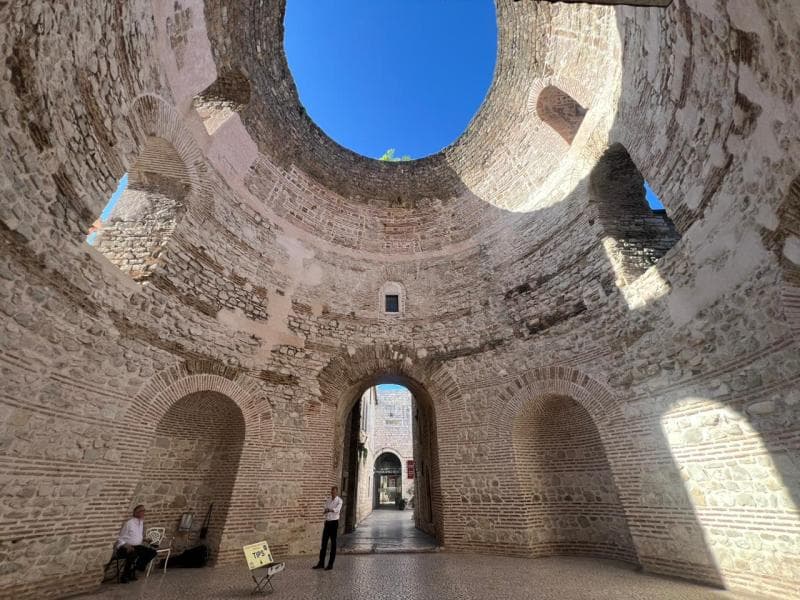
Explore the Vestibule, a grand Roman entrance to Diocletian’s Palace in Split, Croatia. Discover its imperial history, unique architecture, and vibrant cultural life.
Overview
Deep within the ancient heart of Split, Croatia, lies a remarkable architectural marvel known as the Vestibule. This circular hall served as the grand entrance to the private apartments of Roman Emperor Diocletian, forming a pivotal part of his sprawling retirement palace. Today, it stands as a captivating historical site, seamlessly integrated into the vibrant urban fabric of modern Split, which itself is a UNESCO World Heritage site. The Vestibule offers a unique window into the imperial past, drawing visitors into a world where ancient grandeur meets contemporary life.
History & Cultural Background
The Vestibule's origins trace back to the late 3rd and early 4th centuries AD, when Emperor Diocletian commissioned the construction of his colossal palace. Designed as a ceremonial 'prothyron,' it functioned as a majestic antechamber, creating a symbolic transition between the palace's public Peristyle and the emperor's sacred, private residential quarters. The intention was clear: to awe and impress all who approached the emperor, underscoring the immense power and wealth of Rome. In its heyday, the Vestibule was a spectacle of lavish decoration. It was crowned by a massive dome, and its high walls were adorned with colorful marble cladding, intricate mosaics, and possibly gold leaf and precious stones. Semicircular niches within the structure likely housed statues, perhaps of deities or members of the imperial family. Although much of this original opulence has faded with time, the sheer scale and architectural sophistication of the Vestibule continue to convey its imperial grandeur. The European public rediscovered the beauty of this place in the 18th century thanks to the British architect Robert Adam, whose detailed drawings significantly influenced the Neoclassicism movement.
What Makes It Special
What truly sets the Vestibule apart today is its striking architectural presence and its extraordinary acoustic qualities. The structure is cylindrical with high vaulted ceilings, and while its original dome has long since collapsed, the resulting open oculus now frames the sky, much like the Pantheon in Rome. This architectural feature allows natural light to flood the space and contributes to its unique sound resonance. The curved stone walls act as a natural amplifier, creating a resonating chamber that enhances sound in a remarkable way. This makes it a favored spot for a cappella performances, particularly by traditional Dalmatian 'klapa' groups, whose harmonies gain a magical quality within its ancient embrace. The Vestibule is not merely a ruin; it is a living space where ancient history palpably interacts with the present moment.
Stories, Fun Facts & Local Details
Imagine ancient ambassadors and high-ranking guests waiting in this very spot, surrounded by opulent displays, before being granted an audience with Emperor Diocletian. Today, the atmosphere is decidedly different, yet equally captivating. The Vestibule has transformed from an imperial antechamber into a lively city square where ancient solemnity blends harmoniously with the rhythm of modern life. It's a place where history whispers through the stone, while the melodies of klapa singers fill the air, echoing stories that span nearly two millennia. It's a fun fact that little over half a century ago, some parts of the Vestibule were used for residential purposes, with locals even keeping poultry there and cultivating gardens, showcasing the organic evolution of the palace into a living city. The surrounding medieval quarter, southeast of the Vestibule, further highlights this continuous habitation, featuring one of the oldest early Romanesque houses from the 10th century.
Visitor Perspective
Visiting the Vestibule is an immersive experience that transports one through time. As you step into this circular space, you are immediately enveloped by a sense of history and grandeur. The preserved semicircular arches and carved capitals offer glimpses of its former luxury, inviting contemplation of the lives once lived within these walls. One of its greatest advantages is its accessibility; the Vestibule is open to visitors 24/7, and entrance is free, as it is part of an open architectural complex. This allows for varied experiences, from quiet early morning visits to bustling afternoon encounters, or even atmospheric evenings under city lights. For photography enthusiasts, the play of light and shadow on the ancient stones creates endless opportunities for striking images. It serves as a powerful reminder of how the past remains an integral, breathing part of Split's identity, inviting curious travelers to connect with its enduring legacy.
Coordinates: 16.440119, 43.507966
View on Google Maps💬 How Travelers Describe This Place
Based on community votes
Must See
623Unique
545Beautiful
343Photogenic
211Interesting
20
Traveler Stories
Discover memorable experiences shared by travelers who have visited this place.
No traveler stories yet.
Be the first traveler to share what made this place memorable.

Tour
By
Spot
Discover amazing places around the world. Your journey starts here.
Explore
© 2026 TourBySpot. All rights reserved.