Vasari Corridor Exterior
Florence, Italy
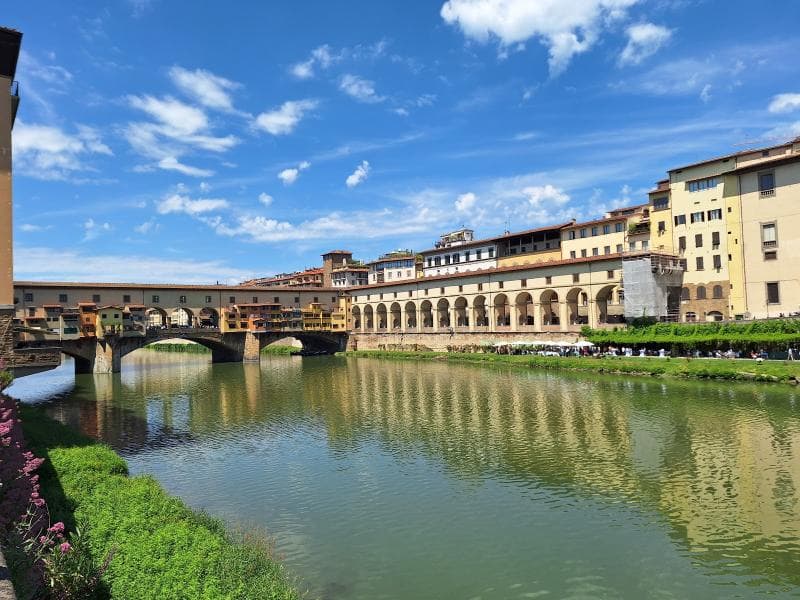
Explore the unique exterior of Florence's Vasari Corridor, a 16th-century elevated walkway over Ponte Vecchio. Discover its rich history and cultural significance in Italy.
Overview
The Vasari Corridor Exterior, a magnificent and often-overlooked architectural marvel, gracefully stretches across the Arno River in Florence, Italy, prominently featuring its passage over the iconic Ponte Vecchio. This elevated, enclosed walkway offers a unique perspective on the city's rich history, visible to all who stroll along the riverbanks or cross the 'Old Bridge'. It's an integral part of Florence's landscape, seamlessly connecting significant Medici residences and administrative centers, yet designed to keep its royal occupants largely out of public sight. Observing its exterior provides a tangible connection to the power and ingenuity of Renaissance Florence, revealing the structural solutions employed to allow a private pathway through a bustling city.
From the outside, one can appreciate how the corridor winds above shops and along buildings, culminating in its most famous section atop the Ponte Vecchio. It's a structure that speaks volumes about the Medici family's desire for privacy and security, transforming parts of the city into their personal thoroughfare. The exterior view alone tells a story of ambition, architectural brilliance, and the unique challenges of constructing such a passage in the 16th century.
History & Cultural Background
The Vasari Corridor was commissioned in 1565 by Grand Duke Cosimo I de' Medici and designed by the renowned architect Giorgio Vasari. Its construction was a remarkable feat, completed in a mere five months, ahead of the marriage of Cosimo's son, Francesco I, to Johanna of Austria. The primary purpose was to allow the Grand Duke and his family to move securely and privately between their residence, Palazzo Pitti, and the government palace, Palazzo Vecchio, passing through the Uffizi Gallery.
This ingenious design addressed Cosimo's concerns for his personal safety and his desire to travel undisturbed through a city where the Medici's grip on power, though strong, faced undercurrents of resentment. Before the corridor's construction, the shops on the Ponte Vecchio were primarily occupied by butchers, whose waste disposal into the Arno created an unpleasant odor. As the new, elevated passageway was planned directly above these shops, Cosimo I ordered the butchers to be replaced by goldsmiths and jewelers, a trade deemed more suitable for the noble passage overhead. This decision permanently altered the character of the Ponte Vecchio, establishing its enduring association with fine jewelry.
What Makes It Special
The Vasari Corridor's most striking feature, particularly from an exterior perspective, is its audacious path. It is not merely a bridge; it's an architectural ribbon weaving through the urban fabric of Florence. As it traverses the Arno River atop the Ponte Vecchio, it transforms an already famous landmark into something even more extraordinary. The way it deftly incorporates existing structures, like the shops on the bridge and even parts of the Church of Santa Felicita, showcasing remarkable engineering for its time.
A particularly unique aspect visible from the exterior is its ingenious circumvention of the Mannelli Tower at the end of Ponte Vecchio. The Mannelli family refused to allow the corridor to pass through their property, a bold defiance of Medici power. Rather than forcing the issue, Vasari famously designed the corridor to curve around the tower on large corbels, a visible testament to both architectural adaptability and a rare instance of an individual standing up to the powerful Medici.
Stories, Fun Facts & Local Details
One fascinating anecdote related to the Vasari Corridor involves Benito Mussolini and Adolf Hitler. In 1939, for Hitler's official visit to Florence, Mussolini reportedly ordered the small, original windows in the central section of the corridor over the Ponte Vecchio to be enlarged. This was done to provide Hitler with a grander panoramic view of the Arno River and Ponte Santa Trinita. Legend has it that Hitler was so impressed by this vista that he specifically ordered the Ponte Vecchio to be spared during the German retreat in World War II, making it the only bridge in Florence not destroyed.
Another local detail pertains to the shops below the corridor on Ponte Vecchio. Before the corridor, the Ponte Vecchio was home to butchers, tanners, and farmers. The Medici's decree to replace them with jewelers due to the smells rising into the Duke's private passage highlights the direct and lasting impact the corridor had on the bridge's economy and identity. The tradition of jewelers on Ponte Vecchio continues to this day.
Visitor Perspective
While the interior of the Vasari Corridor offers a unique museum experience, the exterior provides a constant, tangible presence of Florentine history for any visitor. Walking across the Ponte Vecchio or along the Lungarno, one can trace the path of this elevated passageway, imagining the Medici family moving above the crowds. The discreet windows, some small and almost hidden, others later enlarged, hint at the private world that existed just above the public thoroughfare.
The view of the corridor curving around the Mannelli Tower is a powerful visual reminder of historical defiance and architectural solutions. Even without entering, observing the Vasari Corridor exterior is an immersive historical experience, offering a glimpse into the strategic planning and opulent lifestyle of one of Europe's most influential Renaissance families. It stands as a silent sentinel, connecting the past and present of Florence, inviting curiosity and contemplation about its hidden stories.
Coordinates: 11.2519, 43.7675
View on Google Maps💬 How Travelers Describe This Place
Based on community votes
Must See
556Photogenic
540Unique
470Interesting
410Beautiful
254
Traveler Stories
Discover memorable experiences shared by travelers who have visited this place.
No traveler stories yet.
Be the first traveler to share what made this place memorable.

Tour
By
Spot
Discover amazing places around the world. Your journey starts here.
Explore
© 2026 TourBySpot. All rights reserved.