University Of Helsinki Main Building
Helsinki, Finland
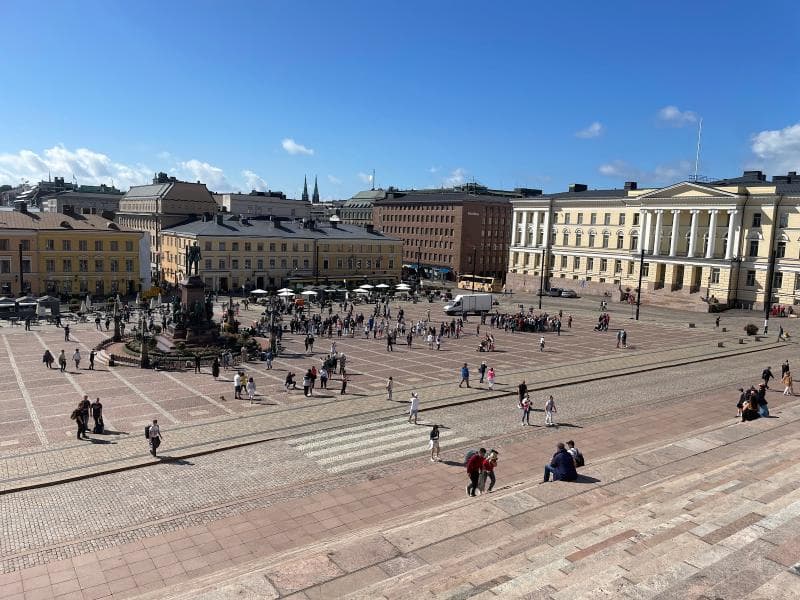
Discover the University of Helsinki Main Building in Senate Square, Helsinki, Finland. Explore its Neoclassical architecture and rich history.
Overview
Nestled within Helsinki's iconic Senate Square, the University of Helsinki Main Building stands as a magnificent example of Neoclassical architecture and a cornerstone of Finnish intellectual life. Designed by the renowned architect Carl Ludvig Engel, this impressive structure is more than just a university building; it's a profound statement of national identity and academic pursuit. Its white facade and symmetrical columns contribute significantly to the harmonious Empire-style milieu that defines the heart of Helsinki, facing other architectural masterpieces like the Helsinki Cathedral and the Government Palace. It serves as the administrative core and a vibrant academic hub for the University of Helsinki, the oldest and largest university in Finland.
History & Cultural Background
The story of the University of Helsinki Main Building is deeply intertwined with Finland's national narrative. The university itself traces its origins back to the Royal Academy of Turku, founded in 1640. However, a pivotal moment arrived in 1827 with the Great Fire of Turku, which devastated the city and led Emperor Nicholas I to order the university's relocation to Helsinki, then the new capital of the Grand Duchy of Finland. In its new home, it was renamed the Imperial Alexander University in Finland.
Carl Ludvig Engel was tasked with designing a main building that would be a fitting symbol for this burgeoning capital. Completed in 1832, Engel's design firmly established the university's presence in the city center, directly opposite the Imperial Senate. This strategic placement ensured the academic community remained closely connected to Finnish society and under imperial supervision. Following Finland's full independence in 1917, the institution, now known as the University of Helsinki, took on a crucial role in building the nation-state and, later, the welfare state. The building sustained significant damage during World War II air raids in 1944, including the destruction of original murals in its Great Hall. However, it was meticulously repaired and restored, a testament to its enduring importance. J.S. Sirén also expanded the building in the 1930s, encompassing an entire city block, while meticulously following Engel's original design language.
What Makes It Special
What truly sets the University of Helsinki Main Building apart is its seamless integration into the grand urban plan of Senate Square. Engel envisioned the square as a cohesive architectural allegory of political, religious, scientific, and commercial powers, and the university building perfectly embodies the scientific and intellectual aspect. Its Neoclassical style, characterized by clean lines, classical proportions, and a stately white facade, reflects the Greek-Caesarical Humanism that inspired the new capital's design.
Beyond its aesthetic appeal, the building represents an unbroken chain of academic tradition. It has housed generations of scholars and students, witnessing and contributing to countless intellectual advancements that have shaped Finland. The building's interior combines historical charm with modern functionality, especially after recent renovations that aimed to enhance accessibility and update facilities while respecting its unique heritage.
Stories, Fun Facts & Local Details
The main building has witnessed nearly two centuries of Finnish history, from imperial rule to independence and wartime struggles, demonstrations, parades, and victory celebrations. Its resilience is perhaps best exemplified by its post-WWII restoration, where the Great Hall's murals, once destroyed, were eventually recreated, symbolizing the nation's and the university's recovery.
Today, the building remains a vibrant center of activity. It hosts ceremonies, lectures, and cultural events, drawing people from across the city. Inside, visitors can find facilities like the Helsinki University Museum Flame, which tells the story of the university's people, disciplines, and places, along with cafeterias and cafés that serve the academic community and guests.
Visitor Perspective
For a curious traveler, approaching the University of Helsinki Main Building from Senate Square offers a striking visual experience, as it forms an integral part of one of Europe's most beautiful Neoclassical ensembles. While primarily an active academic institution, certain areas are accessible to the public. Visitors interested in history and architecture can admire its exterior and, during public events, may have the opportunity to explore parts of its interior.
The main entrance on Fabianinkatu (Fabianinkatu 33) provides an accessible entry point, and recent renovations have significantly improved accessibility within the building, including new lifts. However, it's always advisable to check the university's website for current opening hours and public access details, as some areas are reserved for classes and official university functions. Its central location makes it easily reachable on foot from Helsinki's city center and nearby public transport hubs.
Coordinates: 24.95043, 60.16953
View on Google Maps💬 How Travelers Describe This Place
Based on community votes
Unique
886Interesting
564Must See
443Beautiful
233Photogenic
201
Traveler Stories
Discover memorable experiences shared by travelers who have visited this place.
No traveler stories yet.
Be the first traveler to share what made this place memorable.

Tour
By
Spot
Discover amazing places around the world. Your journey starts here.
Explore
© 2026 TourBySpot. All rights reserved.