Triumph Arch
Chisinau, Moldova
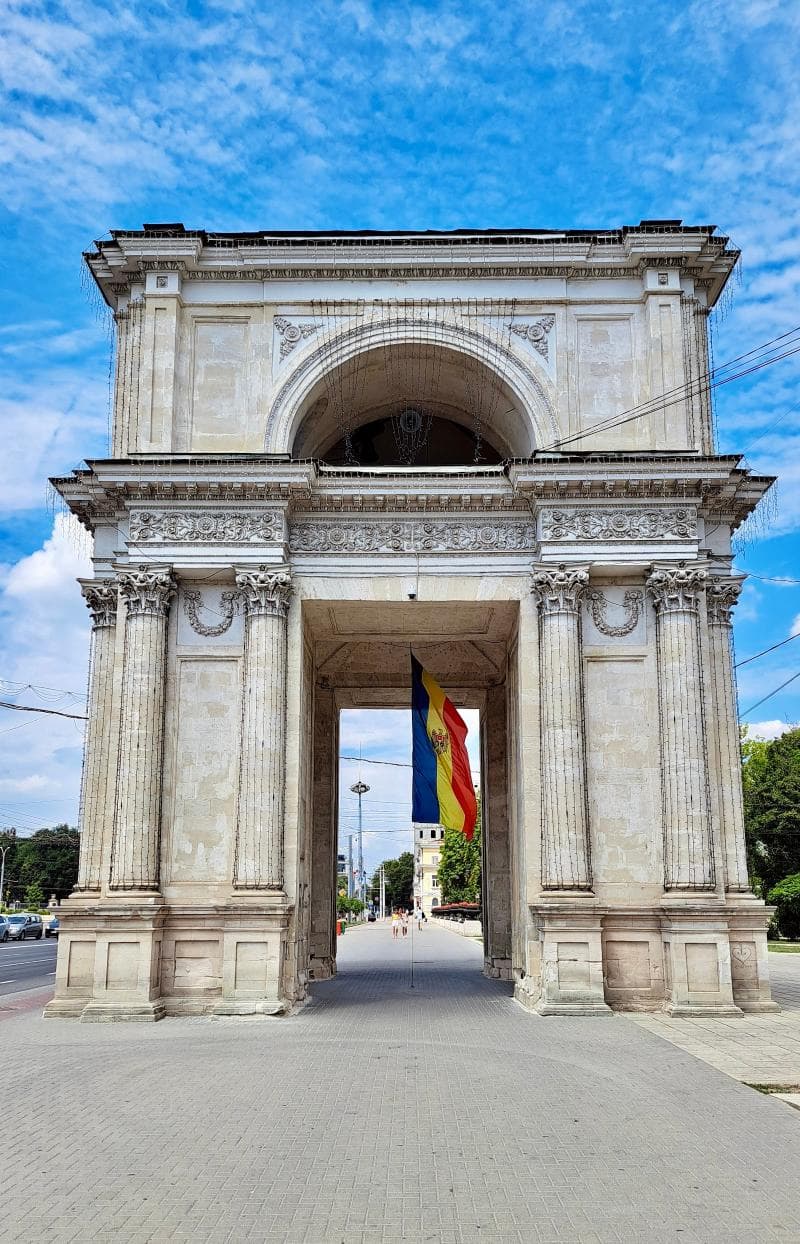
Discover Chisinau's Triumph Arch, a neoclassical symbol of victory in Moldova's Cathedral Park. Explore its unique history and architecture.
Overview
Standing proudly in the heart of Chisinau, Moldova, the Triumph Arch is more than just a monument; it is a profound symbol of national pride and historical triumph. Situated adjacent to the tranquil Cathedral Park and facing the majestic Nativity Cathedral, it forms a central and iconic landmark in the city's architectural ensemble. Often referred to by locals as the 'Holy Gates' or 'Arch of Victory', this neoclassical structure was erected in 1840 to commemorate a pivotal moment in history: the Russian Empire's victory over the Ottoman Empire during the Russo-Turkish War of 1828-1829. Its stately presence, crafted from polished white stone, draws the eye with its four grand openings, Corinthian columns, and a distinguished mechanical clock on its upper facade.
History & Cultural Background
The story of Chisinau's Triumph Arch is deeply intertwined with a fascinating twist of fate. Initially, the monument's construction in 1840, under the design of architect Luka Zauschevic, served a very practical purpose beyond mere commemoration. A massive 6.4-ton bell, cast from captured Turkish cannons, had been intended for the nearby Nativity Cathedral. However, upon its completion, the bell proved too large for the cathedral's belfry. Thus, the Triumph Arch was conceived and built specifically to house this colossal bell, integrating it into the city's urban fabric as both a symbol of victory and a functional bell tower.
Over its long history, the arch has witnessed and reflected Moldova's shifting political landscape. The first clock, acquired from donations, was installed in 1839 or 1842, originating from Odessa. This timepiece experienced various repairs and replacements over the decades, notably after being damaged by a strong wind and later during World War II bombings. During the Soviet era, specifically in 1945, the arch bore marble memorial plaques commemorating Soviet heroes and wartime events, which were subsequently removed in 1991 following Moldova's independence.
What Makes It Special
What truly sets the Chisinau Triumph Arch apart is its unique blend of historical significance, architectural elegance, and an unexpected origin story. While many triumphal arches across Europe celebrate grand military victories, Chisinau's arch boasts the charming narrative of being built, in part, to accommodate a bell too large for its intended home. This architectural solution created a monument that is both a historical marker and a unique piece of urban design. Its neoclassical style, characterized by sturdy Corinthian columns, polished white stone, and ceramic ornamentation, lends it a timeless beauty.
Standing at 13 meters tall, its square form with four passageways beautifully frames the view of the Cathedral, making it a focal point in the city's central square. It is recognized for its graceful proportions and the intricate details that can be appreciated up close as visitors walk beneath it. The arch has even gained international acclaim, being ranked among the five most beautiful triumphal arches worldwide by 'Aeroflot Premium' magazine, a testament to its aesthetic appeal and cultural resonance.
Stories, Fun Facts & Local Details
One of the most captivating stories surrounding the Triumph Arch is its almost 'accidental' creation. The massive 6.4-ton bell, forged from the metal of captured Turkish cannons, was meant for the Nativity Cathedral but, humorously, turned out to be too big. This led to the ingenious decision to build a separate structure – the arch – to house it, thus giving Chisinau one of its most cherished landmarks.
The clock gracing the arch's facade also has a rich, albeit somewhat turbulent, history. The first clock mechanism, installed in 1839 or 1842, faced dislodgement of its dials due to strong winds and later sustained damage during wartime. Each replacement tells a tale of resilience and dedication to maintaining this public timepiece, ensuring it continued to mark the hours for the city's inhabitants.
Locals affectionately refer to it as the 'Holy Gates' due to its precise alignment with the Nativity Cathedral, creating a harmonious and spiritually significant urban axis. It serves as a popular meeting point and a backdrop for public events and national celebrations, where people gather and military parades pass beneath its symbolic span. The arch is particularly enchanting in the evenings when subtle lighting enhances its architectural grandeur, offering a serene and picturesque view.
Visitor Perspective
For any curious traveler exploring Chisinau, the Triumph Arch offers an accessible and enriching experience. Its central location on Piața Marii Adunări Naționale, directly opposite the Government House and at the entrance to Cathedral Park, makes it an unmissable stop. Getting there is straightforward, with numerous public transport options converging in the city center.
The arch is an open-air monument, accessible 24/7, and free to visit, allowing for spontaneous exploration at any time of day. While a visit might only take 20-30 minutes, the experience is profound. You can walk directly beneath its arches, admiring the intricate Corinthian column capitals and ceramic details, feeling the weight of history in its polished white stone. Combining a visit with a leisurely stroll through the adjacent Cathedral Park, with its peaceful greenery and the imposing Nativity Cathedral, creates a comprehensive and memorable cultural immersion into the heart of Chisinau.
Coordinates: 28.8325, 47.02472
View on Google Maps💬 How Travelers Describe This Place
Based on community votes
Unique
948Interesting
913Must See
595Photogenic
337Beautiful
196
Traveler Stories
Discover memorable experiences shared by travelers who have visited this place.
No traveler stories yet.
Be the first traveler to share what made this place memorable.

Tour
By
Spot
Discover amazing places around the world. Your journey starts here.
Explore
© 2026 TourBySpot. All rights reserved.