Treasury
Vienna, Austria
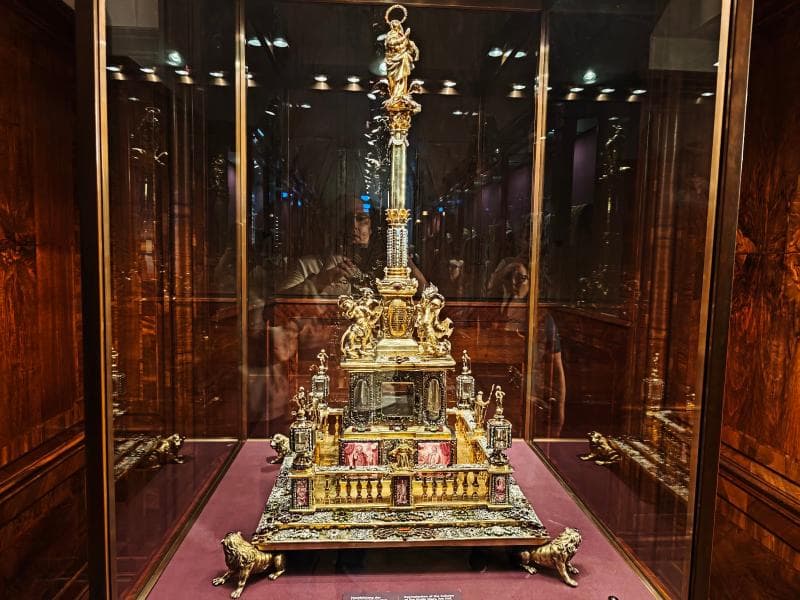
Explore the Imperial Treasury in Vienna's Hofburg Palace, home to crowns, regalia, and priceless artifacts of the Holy Roman and Austrian Empires.
Overview
Nestled within the historic Hofburg Palace in Vienna, Austria, the Imperial Treasury, known in German as the Kaiserliche Schatzkammer, stands as a captivating repository of European history and imperial grandeur. This esteemed institution, part of the Kunsthistorisches Museum, houses an extraordinary collection of secular and ecclesiastical treasures spanning over a thousand years. From the glittering regalia of emperors to sacred relics, the Treasury offers a unique glimpse into the power, wealth, and spiritual beliefs that shaped the Habsburg dynasty and the Holy Roman Empire.
Located in the Schweizerhof, the oldest part of the Hofburg Palace, the Treasury presents its opulent displays in 21 rooms, carefully arranged to guide visitors through centuries of historical significance. It is a destination where every artifact tells a story, revealing the intricate tapestry of European royalty and the deep symbolic meanings embedded in each precious object. The sheer volume and rarity of the items make it one of the most significant treasure chambers globally.
History & Cultural Background
The origins of the Imperial Treasury trace back to the 14th century, when the Habsburg House began to secure its most valuable possessions, including gold and silver artifacts, precious jewels, important documents, and religious relics, within the confines of the Hofburg Palace. These early collections were not merely displays of wealth but also served to legitimize the Habsburgs' earthly power and divine right through significant insignia and spiritual pledges.
A pivotal moment in the Treasury's development came with Emperor Rudolf II (1576–1612), a renowned collector who transformed the medieval princely treasure into an encyclopedic 'Kunstkammer' or cabinet of curiosities. This expansion laid the groundwork for what would become the vast collections of the Kunsthistorisches Museum. Further significant restructuring occurred under Empress Maria Theresia in the 18th century, who commissioned magnificent walnut display cases, some of which are still used today in the Ecclesiastical Treasury. The Napoleonic Wars dramatically impacted the collection, leading to the transfer of the Holy Roman Empire's insignia and regalia from Nuremberg and Aachen to Vienna between 1794 and 1800, further enriching the Imperial Treasury with items of unparalleled historical importance.
What Makes It Special
The Imperial Treasury is distinguished by its unparalleled collection of artifacts that served as tangible symbols of authority and divine endorsement. A definite highlight is the Imperial Crown of the Holy Roman Empire, a masterwork from the 10th century, distinguished by its octagonal shape and rich biblical symbolism. Equally impressive is the Austrian Imperial Crown, crafted in 1602 for Emperor Rudolf II, which later became the crown of the Austrian Empire, though it was never actually used for a coronation.
Beyond the crowns, visitors can marvel at the legendary Holy Lance, an artifact steeped in medieval lore, and the regalia of the prestigious Order of the Golden Fleece, a dynastic order of the Habsburgs. The collection also features precious gems, including one of the world's largest emeralds, and significant portions of the 15th-century Burgundian Treasury. The Treasury uniquely separates its holdings into secular and ecclesiastical collections, each offering distinct insights into the imperial household's temporal power and spiritual devotion.
Stories, Fun Facts & Local Details
Among the Treasury's most intriguing exhibits are two objects once considered 'inalienable heirlooms of the House of Austria,' shrouded in myth and wonder. One is a giant narwhal tooth, long believed to be the horn of a legendary unicorn, a symbol of purity and power. The other is a late antiquity agate bowl, which, for centuries, was thought to be the fabled Holy Grail, sparking tales of mystical quests and divine connections.
Another fascinating detail is the presence of jewelry belonging to Empress Elisabeth, affectionately known as 'Sisi,' offering a personal glimpse into the life of this iconic figure. The collection even includes the key to her tomb, adding a somber yet intimate touch. The entrance to the Treasury itself is through the Schweizerhof, or 'Swiss Courtyard,' a name that harks back to the Swiss Guards who once stood watch here, underscoring the deep historical layers of the Hofburg Palace.
Visitor Perspective
Visiting the Imperial Treasury is an immersive journey through centuries of European heritage. Its central location within the sprawling Hofburg Palace complex makes it highly accessible, whether by Vienna's efficient public transport system – U-Bahn, tram, or bus – or as a pleasant walk from many central city landmarks.
The Treasury is generally open daily, except for Tuesdays, typically from 9:00 AM to 5:30 PM, though it is always advisable to check the official website for current opening hours before your visit. For a more serene experience, weekdays during the morning, particularly in spring or early autumn, are recommended to avoid larger crowds. Photography without flash is usually permitted, allowing visitors to capture memories of the extraordinary displays. Combine your visit with other Hofburg attractions like the Sisi Museum or the Imperial Apartments to fully appreciate the imperial legacy of Vienna.
Coordinates: 16.36528, 48.20639
View on Google Maps💬 How Travelers Describe This Place
Based on community votes
Photogenic
755Must See
728Beautiful
481Unique
183Interesting
28
Traveler Stories
Discover memorable experiences shared by travelers who have visited this place.
No traveler stories yet.
Be the first traveler to share what made this place memorable.

Tour
By
Spot
Discover amazing places around the world. Your journey starts here.
Explore
© 2026 TourBySpot. All rights reserved.