Town Hall
Brussels, Belgium
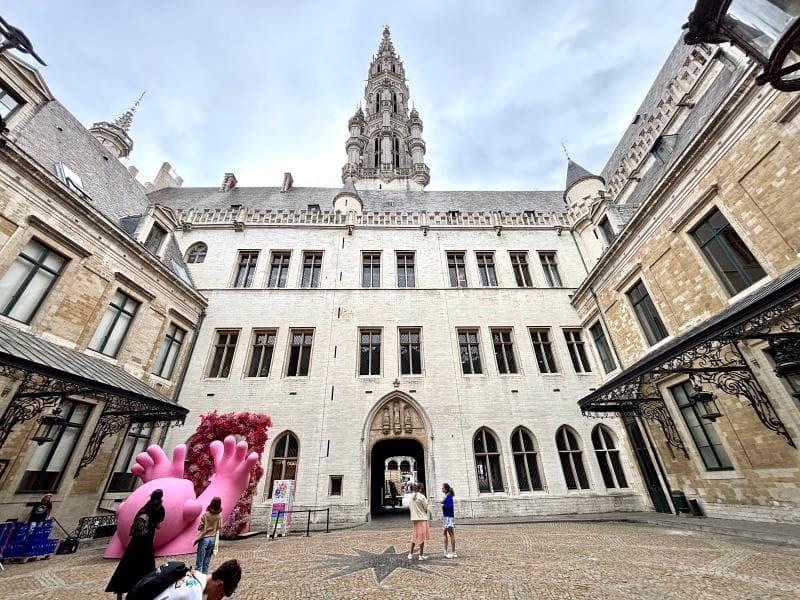
Explore the Brussels Town Hall (Hôtel de Ville), a stunning Brabantine Gothic masterpiece on Grand Place in Brussels, Belgium. Discover its history, architecture, and unique stories.
Overview
Dominating the southern side of the Grand Place in Brussels, the Town Hall, known locally as Hôtel de Ville or Stadhuis, stands as a magnificent testament to Brabantine Gothic architecture. This iconic landmark serves as the seat of the City of Brussels' municipal government and is the only medieval building remaining within the Grand Place, a UNESCO World Heritage Site since 1998. Its soaring, asymmetrical tower, crowned by a gilded statue of Saint Michael, is instantly recognizable and forms the central focus of one of Europe's most beautiful squares.
With its intricate facade adorned with hundreds of statues and its rich historical narrative, the Town Hall is more than just an administrative center; it is a living museum that encapsulates centuries of Brussels' identity and resilience. Whether admiring its exterior from the cobbled square or exploring its opulent interiors, visitors are transported to a bygone era of civic pride and artistic mastery.
History & Cultural Background
The construction of the Brussels Town Hall unfolded in several stages, beginning in 1401 and culminating in 1455. The oldest section, the east wing, was built between 1401 and 1421, likely under the direction of architects Jacob van Thienen and Jean Bornoy. The foundation stone for a second wing was laid in 1444, with the iconic 96-meter spire designed by Jan van Ruysbroeck, completed in 1455. This multi-stage construction reflects the growing power and prosperity of Brussels during the Middle Ages, establishing the Grand Place as the heart of municipal authority.
A pivotal moment in its history occurred during the devastating French bombardment of Brussels in 1695. While most of the Grand Place was reduced to rubble, the Town Hall remarkably survived, its facade and tower standing defiant. Irony has it that the French forces used the tower as their aiming point, meaning shots landed around rather than directly on the building. This act of resilience allowed the Town Hall to become the anchor for the square's subsequent reconstruction in a magnificent Baroque style, preserving its medieval essence amidst the new. For centuries, it housed not only the city's magistrate but also the States of Brabant until 1795, and even served as a makeshift hospital during World War I, highlighting its enduring role in civic life.
What Makes It Special
The Brussels Town Hall is celebrated for its exceptional Brabantine Gothic architecture, a style characterized by its verticality, elaborate ornamentation, and intricate stone carving. Its most striking feature is the magnificent 96-meter tower, which soars skyward, topped by a 2.7-meter gilded copper statue of Saint Michael, the patron saint of Brussels, vanquishing a demon. This statue not only serves as a symbol of the city but also functions as a weathervane.
A unique aspect that captivates many is the tower's deliberate asymmetry; it is not perfectly centered on the facade, a detail that adds to its charm and mystique. The exterior is a veritable outdoor gallery, featuring nearly 300 statues carved between 1844 and 1902, depicting dukes, duchesses, saints, and allegorical figures that narrate Brussels' rich history. Inside, the Town Hall reveals equally impressive ceremonial rooms, including the ornate Gothic Hall (neo-Gothic in its current form) with its wooden cladding and tapestries representing Brussels' guilds, and the Wedding Room. The walls are often adorned with beautiful Flemish tapestries from the 16th to 18th centuries, showcasing the city's artistic heritage.
Stories, Fun Facts & Local Details
A popular local legend, though likely apocryphal, suggests that the architect responsible for the Town Hall's asymmetrical tower was so mortified by his 'mistake' that he leaped from its heights. In reality, the asymmetry was either intentional or a result of the building's phased construction over many decades by different architects and the need to integrate with existing structures, making the tower's placement above the entrance portal a considered design choice.
The Town Hall played a dramatic role during the 1695 French bombardment; it was practically the sole structure on the Grand Place to remain standing, serving as a powerful symbol of the city's resilience. Its survival ensured that the architectural spirit of the square could be faithfully resurrected. Furthermore, the Grand Place is famed for its biennial Flower Carpet event, where hundreds of thousands of begonias create an immense, vibrant tapestry across the square, with the Town Hall as its majestic backdrop. The building continues its civic function today, with the Mayor's office still located within its historic walls, allowing its six-century-old purpose to endure.
Visitor Perspective
Visiting the Brussels Town Hall offers a profound journey into the city's past and present. While the stunning exterior is freely admired from the Grand Place, guided tours provide access to its magnificent interiors, revealing the ceremonial and administrative rooms. Visitors can opt for a self-guided experience with a video guide or take a panoramic guided tour, which includes access to halls like the Wedding Hall and the Gothic Hall, and even an ascent up the tower for a breathtaking 360-degree view of Brussels.
The climb to the top of the tower, via a narrow spiral staircase, rewards adventurers with unparalleled vistas. Given its active status as a municipal building, tours are typically offered on specific days and times, and checking schedules in advance is recommended. The Town Hall's reception hall, accessible via the inner courtyard, is where tickets can be purchased. Whether admiring its details under the daytime sun or seeing it illuminated at night, the Town Hall provides an unforgettable experience for anyone exploring the heart of Brussels.
Coordinates: 4.35167, 50.84639
View on Google Maps💬 How Travelers Describe This Place
Based on community votes
Photogenic
998Must See
685Unique
472Beautiful
399Interesting
92
Traveler Stories
Discover memorable experiences shared by travelers who have visited this place.
No traveler stories yet.
Be the first traveler to share what made this place memorable.

Tour
By
Spot
Discover amazing places around the world. Your journey starts here.
Explore
© 2026 TourBySpot. All rights reserved.