Tower Staircase
Tallinn, Estonia
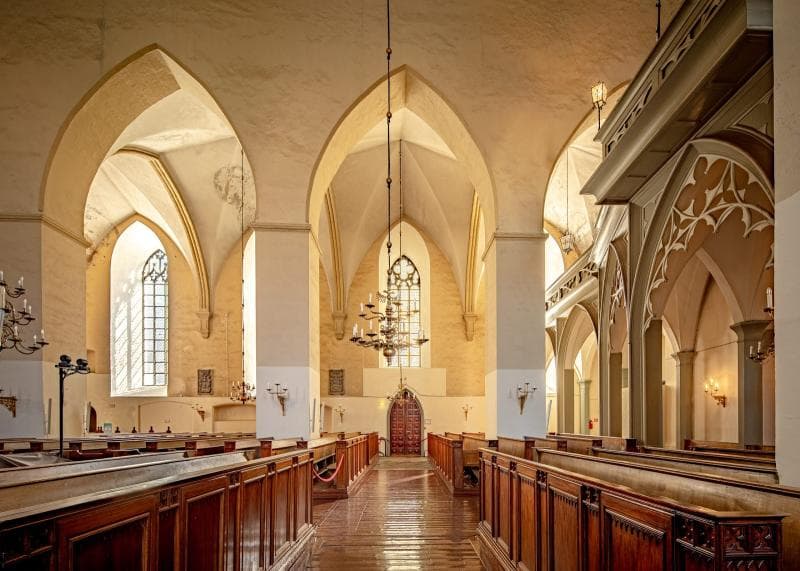
Climb St. Olaf's Church Tower Staircase in Tallinn, Estonia, for incredible panoramic views of the Old Town and Baltic Sea from a historic spire.
Overview
Ascending the Tower Staircase within St. Olaf’s Church in Tallinn, Estonia, offers a unique journey through centuries of history and breathtaking panoramic vistas. This iconic tower, known locally as Oleviste kirik, stands as a monumental testament to Tallinn's rich past, dominating the city's skyline with its imposing spire. Once considered the tallest building in the world for a period in the 16th century, the church's tower now provides curious travelers with an unforgettable experience, inviting them to conquer its winding steps for unparalleled views of the medieval Old Town, the Baltic Sea, and beyond.
The Tower Staircase itself is not merely a means to an end but an integral part of the historical adventure. As you navigate the ancient stone steps, you are enveloped by the church's enduring legacy, feeling the echoes of countless footsteps that have trodden this path over generations. It's a physical challenge rewarded with a profound sense of accomplishment and a visual feast from its observation platform, located approximately 60 meters above ground.
History & Cultural Background
St. Olaf's Church has roots stretching back to the 12th century, with its first recorded mention appearing in 1267. Believed to have been a center for Tallinn's Scandinavian community, it was dedicated to the sainted Norwegian King Olav II Haraldsson, a patron saint of seafarers.
Through the 14th and 15th centuries, the Gothic church underwent significant expansion and rebuilding. Its towering spire, which in the late 15th and early 16th centuries reached an astonishing height of around 159 meters, served as a crucial navigational landmark for sailors approaching Tallinn's harbor, making the trading city visible from far out at sea.
However, this immense height also made it a frequent target for lightning strikes. The church's spire has been hit by lightning at least a dozen times, leading to devastating fires in 1625, 1820, and 1931, which saw the entire church burn down three times. Each time, the resilient citizens of Tallinn painstakingly restored their beloved landmark.
Originally a Roman Catholic church, it became Lutheran during the Reformation and later, in 1950, was handed over to a Baptist congregation. Intriguingly, during the Soviet occupation from 1944 to 1991, the KGB utilized the church tower as a radio tower and a surveillance point, installing powerful antennas to block foreign signals.
What Makes It Special
The Tower Staircase of St. Olaf's Church is special due to its raw, authentic medieval character and the unparalleled perspective it offers. Unlike modern observation decks with elevators, this experience is a genuine physical immersion into history. The climb consists of approximately 232 to 258 steep, narrow, and uneven stone steps that spiral upward, providing a tactile connection to the past.
At the top, the reward is an unobstructed 360-degree panoramic view that is arguably the best in Tallinn. From this vantage point, you can gaze out over the red-tiled roofs of the Old Town, the shimmering expanse of Tallinn Bay, the distant modern cityscapes, and the green areas beyond. It allows visitors to truly grasp the geometric layout of the medieval city.
This is a place where you don't just see history; you climb through it, feel it in the worn stone, and witness the very landscape that inspired its construction and endured its tumultuous past. The very nature of the climb, demanding but immensely gratifying, makes it a cherished memory for many travelers.
Stories, Fun Facts & Local Details
St. Olaf's Church is steeped in captivating legends. One of the most famous tales concerns its mysterious builder, often named 'Olev'. According to the legend, the townspeople of Tallinn wanted a magnificent church to attract merchants. A stranger offered to build it for a large sum but would forgive the debt if they could discover his name before completion. Despite their efforts, his identity remained a secret until a spy overheard a lullaby sung by the builder's wife, revealing his name as Olev. When the townspeople shouted his name as he placed the final cross atop the spire, Olev was startled, lost his balance, and fell to his death. Legend claims that when he hit the ground, a toad and a snake crawled out of his mouth, symbolizing possible demonic possession, a detail depicted in a mural on the church's exterior.
Another fascinating detail is the church's history as a 'lightning rod'. Its immense height made it a natural target for thunderstorms, leading to its repeated destruction and reconstruction over centuries. This constant battle with the elements has embedded a narrative of resilience into the very fabric of the building.
Furthermore, the church's role during the Cold War as a KGB surveillance hub is a more recent, yet equally intriguing, chapter. Imagine the quiet operations, the clandestine radio jamming, all conducted from a medieval tower that once guided ships.
Visitor Perspective
The journey up St. Olaf's Tower Staircase is an adventure in itself, often described as physically demanding but immensely rewarding. Visitors should be prepared for a vigorous climb up a narrow, winding spiral staircase. There are no elevators, so good physical condition is advisable.
As you ascend, you'll notice the deeply worn steps, carved by centuries of feet, and the thick rope that serves as a handrail, providing a tangible link to the past. The stairwell can feel claustrophobic at times, especially when passing other visitors going in the opposite direction. However, the anticipation builds with every turn, culminating in the spectacular reward at the observation platform. Here, the fresh air and the expansive, uninterrupted views of Tallinn's Old Town, its vibrant red rooftops, ancient city walls, and the Baltic Sea stretch out beneath you, making every step worthwhile.
The tower is typically open seasonally, usually from April to October. It's recommended to arrive early to avoid crowds, allowing for a more serene ascent and unhurried enjoyment of the views. This climb is not just about reaching the top; it's about experiencing the layers of history and the breathtaking beauty of Tallinn from a truly unique vantage point.
Coordinates: 24.747806, 59.441417
View on Google Maps💬 How Travelers Describe This Place
Based on community votes
Interesting
989Unique
613Photogenic
581Must See
514Beautiful
207
Traveler Stories
Discover memorable experiences shared by travelers who have visited this place.
No traveler stories yet.
Be the first traveler to share what made this place memorable.

Tour
By
Spot
Discover amazing places around the world. Your journey starts here.
Explore
© 2026 TourBySpot. All rights reserved.