Tivoli Mansion
Ljubljana, Slovenia
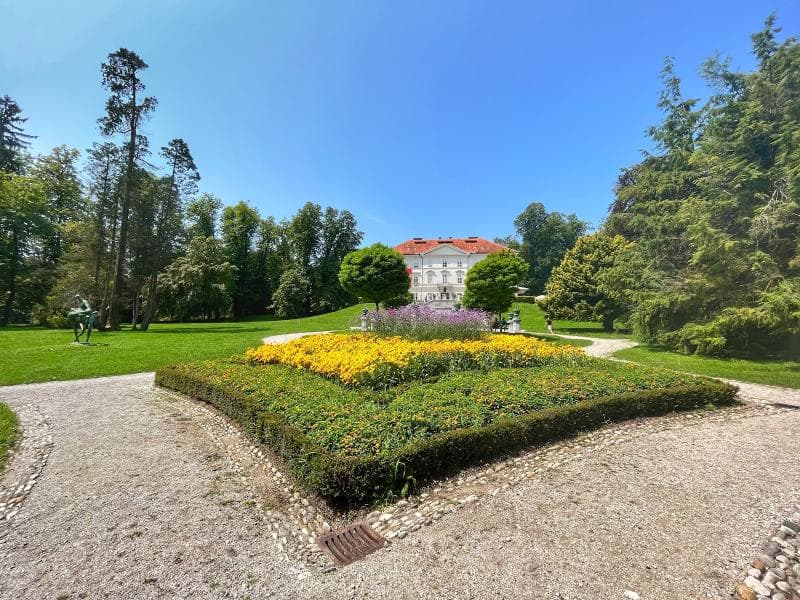
Discover Tivoli Mansion in Ljubljana, Slovenia, home to the International Centre of Graphic Arts, rich in history and culture.
Overview
Nestled within the expansive and verdant Tivoli Park in Ljubljana, Slovenia, lies the historic Tivoli Mansion. Often referred to locally as Grad Tivoli, this elegant structure serves as a cultural beacon, currently housing the International Centre of Graphic Arts (MGLC). Its prominent position at the end of the picturesque Jakopič Promenade makes it a focal point for both art enthusiasts and casual visitors exploring Ljubljana's largest green oasis. The mansion, with its neoclassical facade, stands as a testament to centuries of change and adaptation, from a defensive tower and Jesuit retreat to a significant public institution.
Today, the Tivoli Mansion is not just a beautiful historical building; it is a vibrant hub for contemporary art, particularly in the realm of graphic arts. It actively contributes to Ljubljana's cultural landscape by hosting exhibitions, workshops, and educational programs, and is notably the home of the world-renowned Ljubljana Biennial of Graphic Arts. Its blend of rich history, architectural grandeur, and modern artistic purpose offers a unique experience for anyone exploring the Slovenian capital.
History & Cultural Background
The story of Tivoli Mansion stretches back to the 13th century, when a defensive tower known as the Turn stood on the site. This tower was eventually destroyed in 1448 during a siege of Ljubljana. A new mansion, Podturn, was later built by Baron Apfaltrer, which was then purchased by the Jesuits in 1601. They replaced it with a new building, using it as a holiday retreat and a place for their students to perform plays.
Following the dissolution of the Jesuit order in 1773, the mansion transitioned through various hands, serving as a summer residence for the Bishop of Ljubljana and later belonging to the Provincial States. A significant chapter in its history began in 1852 when Emperor Franz Joseph I purchased it and granted a lifelong lease to Austrian Field Marshal Joseph Radetzky. It was Radetzky who undertook a thorough renovation, giving the mansion its present neoclassical appearance and opening up new walking paths and gardens to the public. The Municipality of Ljubljana acquired the mansion in 1865, and it served as a residential building until 1967. In the 1980s, it underwent reconstruction to become the permanent home of the International Centre of Graphic Arts, a role it has fulfilled since 1986.
What Makes It Special
Tivoli Mansion's distinctiveness stems from its harmonious blend of historical significance and its contemporary function as a leading art institution. Its neoclassical facade, shaped by the influence of Field Marshal Radetzky in the mid-19th century, distinguishes it architecturally. However, what truly sets it apart is its role as the International Centre of Graphic Arts (MGLC). This institution has transformed the mansion into a dynamic space dedicated to preserving and promoting graphic art from the 20th century to the present day.
Moreover, the mansion is the main venue for the Ljubljana Biennial of Graphic Arts, established in 1955. This makes it a globally recognized platform for contemporary graphic arts, attracting artists and visitors from around the world. The building itself, located at the end of the architect Jože Plečnik's beautifully designed Jakopič Promenade, offers a unique convergence of art, history, and urban planning.
Stories, Fun Facts & Local Details
One of the most intriguing details associated with Tivoli Mansion is the presence of four cast-iron dog statues guarding the entrance staircase. These statues, created by sculptor Anton D. Fernkorn around 1870, are famously tongueless. A popular local legend, though unsubstantiated, claims that Fernkorn, distraught by this perceived error, took his own life. These silent sentinels have become an iconic, albeit mysterious, feature of the mansion.
Another fascinating historical tidbit involves Field Marshal Radetzky. A full-size cast iron statue of him once stood on the steps in front of the mansion from 1882 to 1918. While the statue itself is now preserved by the City Museum of Ljubljana, its original pedestal remains in place, a subtle reminder of its past inhabitant and his significant contributions to the park's arrangement. The mansion's history also intertwines with that of Tivoli Park itself; the park's current layout, shaped by French engineer Jean Blanchard and later enhanced by Jože Plečnik's promenade, was designed using the gardens of Tivoli Mansion and the nearby Cekin Mansion as its foundation.
Visitor Perspective
For a curious traveler, a visit to Tivoli Mansion offers a multifaceted experience. Approaching the mansion along the tree-lined Jakopič Promenade, an open-air photographic gallery, sets a scenic tone. Inside, the International Centre of Graphic Arts provides a rich cultural journey with its diverse collection of fine art prints and contemporary art exhibitions. Whether you're a seasoned art critic or simply appreciate creative expression, the frequently changing exhibits and the renowned Biennial offer something to engage your interest.
Beyond the art, the mansion itself invites reflection on its long and varied past, from a strategic tower to an aristocratic residence and then a public cultural space. Its accessibility features for visitors with mobility disabilities demonstrate a commitment to inclusivity. The surrounding Tivoli Park complements the visit, offering beautiful gardens, ponds, and walking paths for relaxation and further exploration. There is also a café with a view, allowing visitors to pause and absorb the tranquil atmosphere of the park while enjoying refreshments.
Coordinates: 14.4930111, 46.0547056
View on Google Maps💬 How Travelers Describe This Place
Based on community votes
Beautiful
551Must See
547Photogenic
421Unique
298Interesting
212
Traveler Stories
Discover memorable experiences shared by travelers who have visited this place.
No traveler stories yet.
Be the first traveler to share what made this place memorable.

Tour
By
Spot
Discover amazing places around the world. Your journey starts here.
Explore
© 2026 TourBySpot. All rights reserved.