Ticket Hall
Yerevan, Armenia
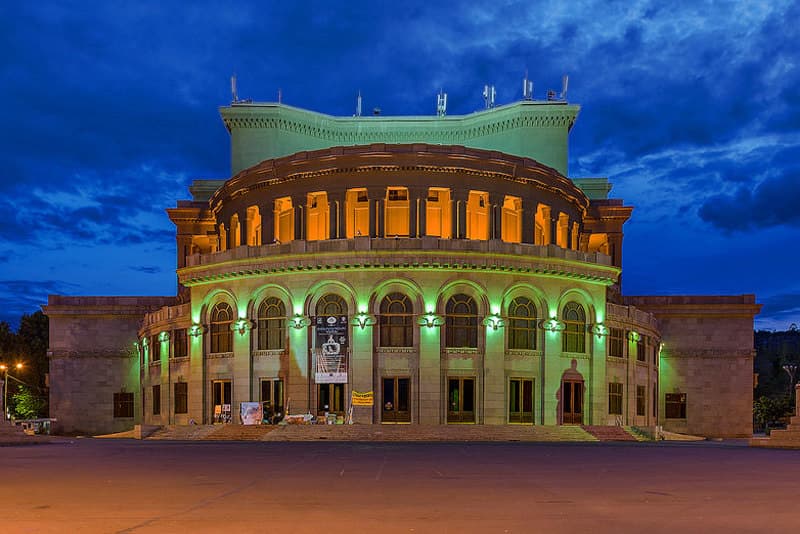
Discover the Ticket Hall experience at Yerevan Opera Theatre in Armenia, a cultural gem. Learn about its history, architecture, and visitor insights.
Overview
Stepping into the Yerevan Opera Theatre, officially known as the Alexander Spendiaryan National Academic Opera and Ballet Theatre, is an experience that begins long before the curtain rises. Situated majestically in the heart of Yerevan, Armenia, this iconic structure serves as a profound symbol of the nation's rich musical heritage and architectural prowess. It is a central cultural landmark, often simply referred to as 'Opera' by locals, and stands as a vibrant hub for artistic expression and community gathering.
While there isn't a distinct, separately named 'Ticket Hall' per se, the area where visitors acquire their tickets is integral to the overall initial impression of this grand institution. It's the gateway to a world of performing arts, reflecting the theatre's deep history and architectural splendor from the very first moment a patron steps inside. The initial lobby and ticketing space immerse visitors in the theatre's unique atmosphere, setting the stage for the artistic journey that awaits.
History & Cultural Background
The vision for the Yerevan Opera Theatre began to take shape with its ground-breaking on November 28, 1930, commemorating the 10th anniversary of Soviet Armenia. Designed by the eminent Armenian architect Alexander Tamanian, whose work profoundly influenced Yerevan's urban landscape, the theatre officially opened its doors on January 20, 1933. The inaugural performance was Alexander Spendiaryan's opera 'Almast,' a fitting tribute to the composer after whom the theatre is named.
Tamanian's architectural genius aimed to merge modern functional requirements with the timeless elegance of Armenian national art and classical design. The construction unfolded in stages, with the main theatre hall completed in 1939 under the supervision of Tamanian's son, and the entire building reaching its final, magnificent form by 1953. This architectural masterpiece garnered international acclaim, receiving the Grand Prize at the 1937 Paris World Expo, showcasing Armenia's distinctive classical architecture on a global stage. Since its inception, the theatre has been a cradle for Armenian opera and ballet, staging over 200 diverse productions by Armenian, Russian, and Western European composers, contributing significantly to the nation's cultural identity.
What Makes It Special
The Yerevan Opera Theatre is renowned for its stunning architecture, a harmonious blend of classical and national Armenian styles. Its circular structure, crafted from the characteristic pink-and-grey tufa stone, houses two distinct, acoustically superb halls: the Alexander Spendiaryan Opera and Ballet Theatre, offering around 1070 to 1200 seats, and the Aram Khachaturian Concert Hall, capable of seating 1300 to 1400 patrons. Tamanian designed each part of the complex as a self-sufficient amphitheater, and the stone construction, combined with the acoustically generated form, ensures exceptional sound transmission and minimal unwanted noise reflection, creating an immersive experience for every performance.
Even the entrance areas, including where tickets are procured, subtly reflect this grandeur. The spacious halls and elegant design elements welcome visitors, hinting at the artistic excellence housed within. It's not just a venue for performances; it's an architectural marvel that stands as a testament to Armenia's artistic aspirations and commitment to cultural preservation.
Stories, Fun Facts & Local Details
Beyond its formal role, the Yerevan Opera Theatre is deeply interwoven with the daily life and social fabric of the city. Locals affectionately refer to it simply as 'Opera,' underscoring its familiar and cherished place in their hearts. The theatre is strategically positioned at the edge of Freedom Square, a bustling public space adorned with statues of prominent Armenian figures like the poet Hovhannes Tumanyan and the composer Alexander Spendiaryan, serving as a popular gathering spot for residents and visitors alike.
This area transforms into Yerevan's 'social living room,' especially during warmer months, with numerous cafes, outdoor events, and the gentle murmur of conversation filling the air. The theatre has also welcomed international stars, hosting concerts by legends such as Charles Aznavour, Ian Anderson, and John McLaughlin. For those eager to delve deeper than a regular performance, the theatre offers special tours, providing unique access to its halls, backstage areas, the VIP lounge, and even production workshops, revealing the intricate workings behind the magic on stage.
Visitor Perspective
For the curious traveler, the journey to experiencing the Yerevan Opera Theatre typically begins at its box office. While not a distinct 'hall' of grand architectural renown itself, the ticket office is a well-organized point of entry, often situated within the theatre's spacious and aesthetically pleasing lobby. Visitors consistently praise the theatre's stunning architecture, both inside and out, creating an atmosphere that makes the pre-show moments feel as grand as the performance itself.
Tickets are notably affordable compared to Western European standards, with prices starting from approximately 2,000 AMD (under 5 EUR) for upper-circle seats, offering exceptional value for world-class performances. Tickets can be purchased directly at the box office, which typically operates from 11 am to 7 pm on performance days, and from 11 am to 5 pm on non-performance days. Many visitors find success by purchasing tickets a few hours before a performance, as walk-up options are often available, although online booking via the official website (opera.am) is also a convenient choice. The welcoming atmosphere and the ease of access make the initial steps into this cultural landmark a pleasant and exciting prelude to the artistic journey within.
Coordinates: 44.515, 40.18583
View on Google Maps💬 How Travelers Describe This Place
Based on community votes
Unique
995Beautiful
964Photogenic
929Interesting
730Must See
482
Traveler Stories
Discover memorable experiences shared by travelers who have visited this place.
No traveler stories yet.
Be the first traveler to share what made this place memorable.

Tour
By
Spot
Discover amazing places around the world. Your journey starts here.
Explore
© 2026 TourBySpot. All rights reserved.