Tian Tan Buddha
Hong Kong, China
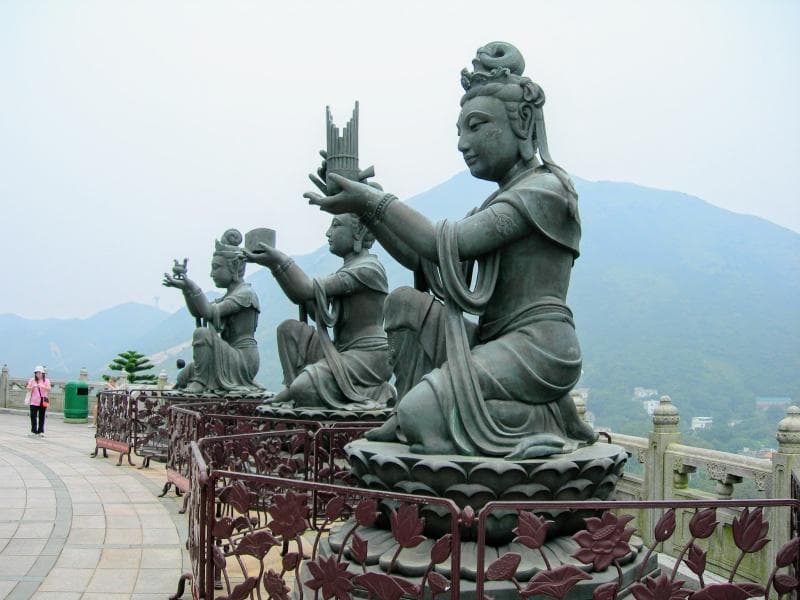
Discover the majestic Tian Tan Buddha, also known as the Big Buddha, a symbol of peace and harmony on Lantau Island, Hong Kong, China. Explore its history, cultural significance, and the serene Po Lin Monastery.
Overview
Perched majestically atop Mount Muk Yue on Lantau Island, the Tian Tan Buddha, often affectionately known as the Big Buddha, stands as a profound symbol of harmony and spiritual tranquility in Hong Kong, China. This monumental bronze statue is a beacon for pilgrims and curious travelers alike, drawing attention with its imposing size and serene presence. Part of the larger Ngong Ping 360 & Big Buddha complex, it forms a central element of a significant Buddhist cultural landscape, encompassing the revered Po Lin Monastery and the scenic Ngong Ping Village. The journey to reach this spiritual icon is an experience in itself, offering breathtaking panoramic views of Lantau Island's verdant landscapes and the South China Sea.
History & Cultural Background
The vision for the Tian Tan Buddha began to take shape in the early 1970s, inspired by Buddhist monks from Hong Kong who had witnessed the impressive Great Buddha statue in Kamakura, Japan. Commissioned by the Po Lin Monastery, the project aimed to create a symbol not only of Buddhist ideals but also of Hong Kong's stability, China's prosperity, and global peace. Construction commenced in 1990 and was a monumental undertaking, involving the meticulous casting and assembly of 202 bronze pieces over several years in Nanjing, China. The statue was officially completed and unveiled to the public on December 29, 1993, a date chosen to coincide with the traditional day of Gautama Buddha's Enlightenment.
The name 'Tian Tan' itself holds deep cultural significance. It translates to 'Sky Disc' or 'Altar of Heaven,' a direct reference to the Temple of Heaven in Beijing, symbolizing a profound connection between the heavenly and earthly realms. This architectural inspiration is evident in the statue's three-level granite base, which mimics the pedestal of Beijing's Temple of Heaven. Uniquely, unlike most Buddha statues that traditionally face south, the Tian Tan Buddha faces north, gazing towards mainland China, a gesture symbolizing protection and benevolence over the land and its people.
What Makes It Special
The Tian Tan Buddha's grandeur is undeniable. Standing at an impressive 34 meters (approximately 112 feet) including its lotus throne and base, and weighing around 250 metric tons, it was once considered the world's tallest outdoor seated bronze Buddha statue. Its sheer scale is a testament to human engineering and spiritual devotion. To reach the Buddha's platform, visitors undertake a symbolic pilgrimage by ascending 268 stone steps. Every element of the statue is imbued with meaning: its right hand is raised in the 'abhaya mudra,' signifying protection and fearlessness, while its left hand rests on its knee in the 'varada mudra,' representing generosity and the granting of wishes. The Buddha sits upon a lotus flower throne, a universal Buddhist symbol of purity and enlightenment. Surrounding the main statue are six smaller bronze figures, known as the 'Offering of the Six Devas.' Each holds an offering—incense, flowers, lamps, ointment, fruit, and music—symbolizing the six perfections of generosity, morality, patience, zeal, meditation, and wisdom that are essential to Buddhist practice.
Stories, Fun Facts & Local Details
The Tian Tan Buddha's strategic location atop Mount Muk Yue, at an elevation of 482 meters above sea level, allows for its visibility from great distances, even from Macau on a clear day. The name 'Tian Tan' not only connects it to Beijing's architectural marvel but also alludes to a 'Sky Disc,' embodying aspirations of enlightenment and peace. The path leading up to the Buddha is flanked by the Twelve Divine Generals, each representing an animal of the Chinese Zodiac and two hours of the day, collectively symbolizing the passage of a full day. Deep within the Buddha's pedestal, accessible to visitors, lies a memorial hall that reputedly enshrines sacred relics, including a fragment of the cremated remains of Gautama Buddha, adding another layer of spiritual significance to the site.
Visitor Perspective
Visiting the Tian Tan Buddha is more than just sightseeing; it's an immersive cultural and spiritual journey. The ascent of 268 steps is often seen as a meditative experience, a physical representation of spiritual progress. For those seeking a less strenuous path, a ramped route is also available. Upon reaching the top, visitors are rewarded not only with a close-up view of the serene Buddha but also with expansive, breathtaking vistas of the surrounding mountains, verdant valleys, and the distant South China Sea. The atmosphere is one of profound peace, inviting contemplation and reflection. The adjacent Po Lin Monastery offers a glimpse into monastic life, with vibrant temples and a renowned vegetarian restaurant. Ngong Ping Village, located near the cable car terminal, provides cultural performances, shops, and dining options, completing the visitor experience. Many travelers choose to arrive via the Ngong Ping 360 cable car, which offers spectacular aerial views during the 25-minute ride from Tung Chung. The cooler months, from October to March, are generally considered the best time to visit for comfortable outdoor exploration.
Coordinates: 113.9031, 22.2525
View on Google Maps💬 How Travelers Describe This Place
Based on community votes
Unique
996Interesting
726Photogenic
717Must See
494Beautiful
193
Traveler Stories
Discover memorable experiences shared by travelers who have visited this place.
No traveler stories yet.
Be the first traveler to share what made this place memorable.

Tour
By
Spot
Discover amazing places around the world. Your journey starts here.
Explore
© 2026 TourBySpot. All rights reserved.