The Changing of the Guard
London, United Kingdom
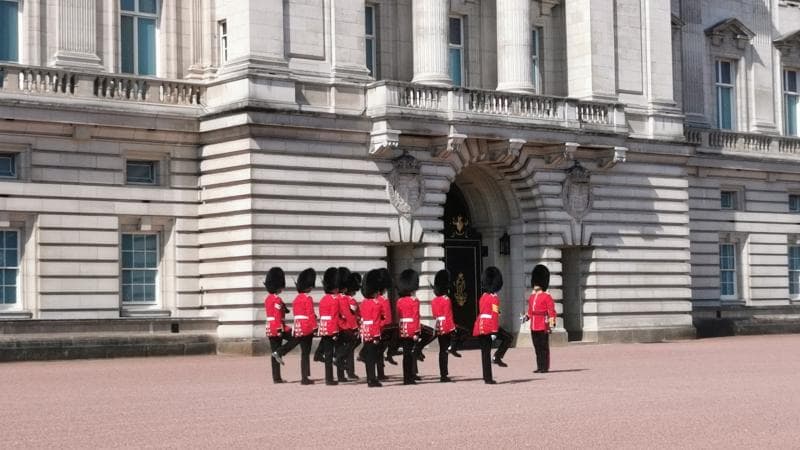
Witness the iconic Changing of the Guard at Buckingham Palace, London, UK. Discover its rich history, cultural significance, and unique details.
Overview
The Changing of the Guard, also known as Guard Mounting, is a deeply symbolic and highly anticipated ceremonial event that takes place at Buckingham Palace in London, United Kingdom. It represents the formal handover of responsibility from one group of soldiers, the Old Guard, to a new group, the New Guard, for protecting the monarch's official residence. This iconic spectacle combines military precision, vibrant uniforms, and rousing musical performances, drawing millions of visitors annually to witness a living piece of British tradition.
While the most famous ceremony unfolds in front of Buckingham Palace, the tradition involves movements between three key locations: Buckingham Palace itself, St James's Palace, and Wellington Barracks. The King's Guard, identifiable by their distinctive red tunics and bearskin hats, are active-duty soldiers from the Foot Guards of the Household Division, not merely ceremonial figures. The ceremony typically takes place on Mondays, Wednesdays, and Fridays, and on Sundays at 11am, lasting about 45 minutes, although schedules can change, so it's always advisable to check the official timings in advance.
History & Cultural Background
The origins of the Changing of the Guard are steeped in over 500 years of British history, tracing back to the reign of King Henry VII. Faced with the need for enhanced royal security, Henry VII established the Royal Body Guard as a permanent institution in the late 1400s, transforming royal protection. Initially, this ritual occurred at the Palace of Whitehall, the sovereign's primary London residence until 1698.
When the Royal Court relocated to St James's Palace after Whitehall Palace was largely destroyed by fire, the ceremony moved with it. It was only after Queen Victoria moved into Buckingham Palace in 1837 that the main ceremonial focus gradually shifted to its current prominent location. However, a detachment of the King's Guard still maintains duty at St James's Palace as part of the overall guard mounting. The Foot Guards, who perform this duty today, have roots tracing back to the 17th century, serving with distinction in nearly every major conflict involving the British Army.
What Makes It Special
The Changing of the Guard is more than just a military routine; it's a grand display of British pageantry and national identity. The meticulous synchronization of the Foot Guards, their crisp movements, and the striking visual of their scarlet tunics and towering bearskin caps create an unforgettable spectacle. What truly elevates the experience is the accompanying military band, which performs a diverse repertoire. Beyond traditional marches, visitors are often delighted by renditions of popular songs, musical scores, and even chart-toppers, adding a contemporary twist to this ancient tradition.
The ceremony symbolizes the seamless transition of authority and the unwavering dedication of the British Armed Forces to protect the monarch and royal residences. It's a powerful reminder of the close relationship between the Armed Forces and the Head of State, embodying continuity, duty, and honor, values deeply ingrained in British culture.
Stories, Fun Facts & Local Details
One fascinating aspect is the regimental diversity within the Household Division. The King's Guard is typically provided by one of five Foot Guards regiments, each identifiable by subtle distinctions. You can often tell the regiment by the colour of the plume in their bearskin caps, or the unique arrangement of buttons on their tunics and symbols on their collars. For instance, the Welsh Guards feature a leek symbol and a white and green plume.
The music played during the ceremony is carefully selected by the Captain of the Guard from a list provided by the Director of Music. This allows for historically significant pieces, regimental anthems, and even modern pop songs to be included, sometimes reflecting current events or anniversaries. Surprisingly, the famous red tunics were not chosen for camouflage or to hide blood, but rather because red dye was historically inexpensive and allowed for uniform appearance across the newly formed army in the 17th century.
Occasionally, you might even spot an official regimental mascot participating. The Irish Guards, for example, have been known to feature an Irish Wolfhound named Seamus, while the Royal Regiment of Scotland has a Shetland pony named Cruachan. Also, on days when the monarch is in residence, the Royal Standard flag flies, and the number of guards on duty might be doubled.
Visitor Perspective
Witnessing the Changing of the Guard is a quintessential London experience, offering a glimpse into British ceremonial heritage. The event is free to attend, but due to its immense popularity, arriving early is crucial to secure a good viewing spot. The ceremony itself involves several movements: the Old Guard forming up, the New Guard marching from Wellington Barracks, and the formal handover in the Buckingham Palace forecourt.
Good vantage points include the gates of Buckingham Palace, the steps of the Victoria Memorial directly opposite, or along The Mall between Marlborough Road and the Palace. Be prepared for crowds and remember that these soldiers are active military personnel performing their duties. The precision, the music, and the sheer tradition of it all combine to create a memorable and truly British moment, connecting visitors to centuries of royal history and military service.
Coordinates: -0.142, 51.501
View on Google Maps💬 How Travelers Describe This Place
Based on community votes
Beautiful
996Unique
726Interesting
717Photogenic
335Must See
193
Traveler Stories
Discover memorable experiences shared by travelers who have visited this place.
No traveler stories yet.
Be the first traveler to share what made this place memorable.

Tour
By
Spot
Discover amazing places around the world. Your journey starts here.
Explore
© 2026 TourBySpot. All rights reserved.