Thai Hoc Courtyard
Hanoi, Vietnam
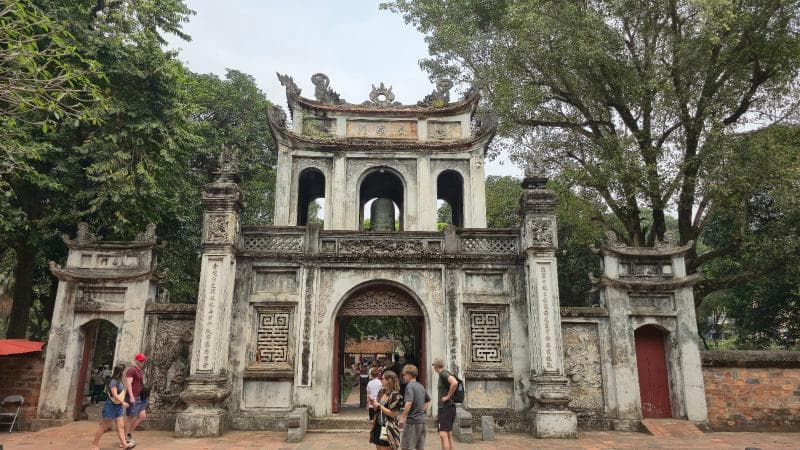
Explore Thai Hoc Courtyard, the Imperial Academy within Hanoi's Temple of Literature, Vietnam's first national university. Discover its rich history and cultural significance.
Overview
Nestled within the revered Temple of Literature in Hanoi, Vietnam, the Thai Hoc Courtyard stands as a vibrant testament to the nation's profound respect for education and scholarship. Often referred to as the 'Imperial Academy' (Quoc Tu Giam), this fifth and final courtyard of the complex is more than just a historical site; it's a living symbol of Vietnamese intellectual heritage. Although a reconstruction, its design faithfully mirrors the traditional architecture of the original academy, offering visitors a window into centuries of academic pursuit.
The courtyard spans a significant area, comprising various traditional buildings, including a front hall, a rear hall with two storeys, and left and right auxiliary houses, alongside a distinctive bell house and drum house. It serves today as a focal point for cultural and educational activities, continuing its legacy of fostering knowledge and celebrating scholarly achievements in a serene and historically rich setting.
History & Cultural Background
The origins of the site where the Thai Hoc Courtyard now stands are deeply entwined with the birth of Vietnamese education. The Temple of Literature itself was established in 1070 by Emperor Lý Thánh Tông to honor Confucius. Just six years later, in 1076, his son, Emperor Lý Nhân Tông, founded the Imperial Academy (Quoc Tu Giam) here, making it Vietnam's first national university. For centuries, this institution was the training ground for mandarins, royalty, and elite scholars, cultivating the brightest minds of the Đại Việt kingdom in Confucian philosophy, literature, and governance.
Tragically, the original Imperial Academy structures were largely destroyed in 1946 during the First Indochina War. However, Vietnam's enduring commitment to its educational roots led to the reconstruction of the Thai Hoc Courtyard between 1999 and 2000. This ambitious project was undertaken to commemorate the 990th anniversary of Thang Long – Hanoi, the ancient name of the capital, and to revive the space dedicated to national culture and education. The reconstruction carefully adhered to traditional architectural styles, ensuring harmony with the older parts of the Temple of Literature complex.
What Makes It Special
The Thai Hoc Courtyard is special not merely for its architectural beauty but for its profound symbolic resonance. It represents the unwavering Vietnamese tradition of valuing knowledge and scholarship. Unlike other parts of the Temple of Literature that focus primarily on worship, Thai Hoc Courtyard is explicitly dedicated to the living legacy of education.
The front building of the courtyard is regularly used for ceremonies honoring cultural scholars, as well as for various scientific and cultural events, making it a dynamic space for contemporary intellectual life. The rear, two-storeyed building houses significant exhibits: its ground floor displays a statue of Chu Van An, a revered rector of the Imperial Academy, and offers insights into the history of the Temple of Literature-Quoc Tu Giam and Confucian education in Vietnam. The upper floor is a tribute to the three pivotal emperors—Lý Thánh Tông, Lý Nhân Tông, and Lê Thánh Tông—who championed the establishment and development of this foundational educational institution.
Stories, Fun Facts & Local Details
The Thai Hoc Courtyard, as the spiritual successor to Vietnam's first university, holds a special place in the hearts of Vietnamese students. It's a common sight, especially during exam season, to see students visiting the Temple of Literature, and particularly this courtyard, to pray for academic success and good fortune in their studies. This practice highlights the continuity of reverence for education that has spanned nearly a millennium. The reconstruction in 2000 was a significant national effort, demonstrating how deeply ingrained the values of learning and heritage are in Vietnamese society. The choice of materials, such as ironwood, traditional tiles, and bricks, ensured that the newly built structures not only looked authentic but also contributed to the enduring atmosphere of the site.
Moreover, the Thai Hoc Courtyard, with its bell and drum houses, evokes the historical rhythms of academic life. These instruments traditionally marked the beginning and end of academic ceremonies, echoing the routines of ancient scholars who once walked these grounds. The surrounding serene gardens, like Giam Garden, were designed to provide a tranquil environment conducive to study and reflection, a tradition that continues to this day for visitors seeking peace amidst Hanoi's bustle.
Visitor Perspective
For a curious traveler, stepping into the Thai Hoc Courtyard offers a unique journey through Vietnam's intellectual past and present. It's a place where history feels tangible, and the whispers of ancient scholars seem to mingle with the aspirations of modern students. The meticulous reconstruction allows visitors to appreciate the grandeur and functionality of Vietnam's first national university, even though the current buildings are relatively new.
Visitors can explore the exhibits detailing Confucian education and the lives of influential educators like Chu Van An, gaining a deeper understanding of the philosophical underpinnings of Vietnamese society. The calm and thoughtful atmosphere provides a peaceful contrast to the lively streets of Hanoi, encouraging contemplation about the enduring power of knowledge. Experiencing the traditional architecture, observing cultural events, or simply reflecting in the courtyard, visitors leave with a profound appreciation for Vietnam's rich educational legacy and its continuous celebration of scholarly achievement.
Coordinates: 105.8356, 21.0286
View on Google Maps💬 How Travelers Describe This Place
Based on community votes
Beautiful
995Interesting
839Must See
603Unique
388Photogenic
289
Traveler Stories
Discover memorable experiences shared by travelers who have visited this place.
No traveler stories yet.
Be the first traveler to share what made this place memorable.

Tour
By
Spot
Discover amazing places around the world. Your journey starts here.
Explore
© 2026 TourBySpot. All rights reserved.