Terrace Views
Venice, Italy
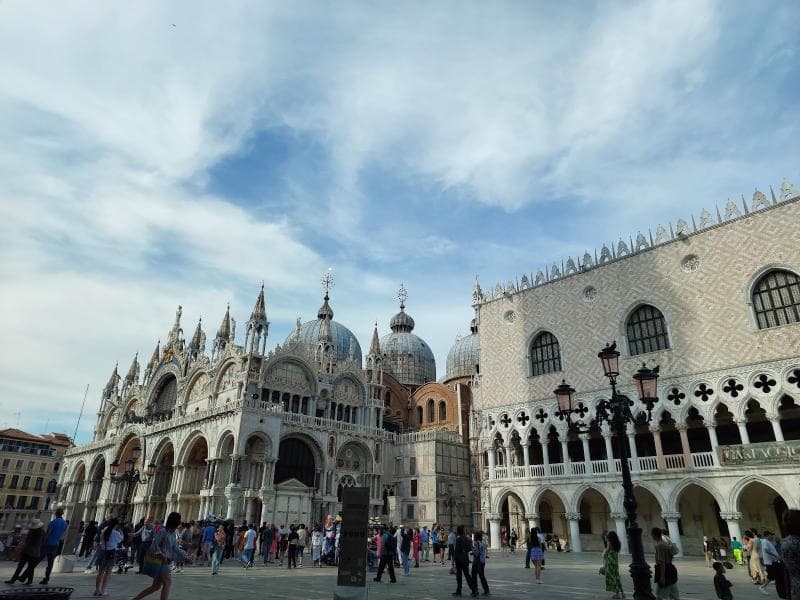
Discover the 'Terrace Views' of St. Mark's Basilica in Venice, Italy, offering panoramic vistas of Piazza San Marco and housing the historic Quadriga.
Overview
Perched high above the iconic Piazza San Marco, the 'Terrace Views' of St. Mark's Basilica in Venice, Italy, offer an unparalleled perspective of the city's heart. This elevated platform, formally known as the Loggia dei Cavalli, is more than just a viewpoint; it is an integral part of the basilica's historical and architectural narrative. From here, visitors are treated to sweeping panoramas of St. Mark's Square, the majestic Doge's Palace, the towering Campanile, and the sprawling rooftops of Venice, extending all the way to the shimmering Venetian Lagoon. It is a place where centuries of history unfold before your eyes, offering a unique blend of architectural grandeur and breathtaking vistas that define the spirit of Venice.
Access to the Terrace is typically granted through a visit to the Museo Marciano (St. Mark's Museum), located in the upper galleries of the basilica. This means the journey to the terrace is often a two-fold experience, first immersing you in the museum's treasures before stepping out into the open air. The ascent involves navigating a steep, narrow staircase, a small challenge that rewards travelers with an extraordinary vantage point.
History & Cultural Background
St. Mark's Basilica itself is a testament to Venice's rich history and its powerful ties to the East. Consecrated in 1094, the basilica evolved over centuries, blending Byzantine, Gothic, and Romanesque styles into a dazzling masterpiece. It was originally built to house the relics of St. Mark the Evangelist, becoming a symbol of Venetian independence and a showcase of the Republic's wealth and power.
The Terrace's most striking feature is the Quadriga, a set of four magnificent bronze horses. These are not the originals, but exquisitely crafted modern replicas. The genuine ancient Roman sculptures, known as the Triumphal Quadriga, were brought to Venice from Constantinople in 1204 after the Fourth Crusade, symbolizing a significant triumph for the Venetian Republic. Historically, they graced the basilica's facade for centuries. However, to protect these invaluable artifacts from environmental damage and pollution, the originals were moved indoors to a climate-controlled room within the St. Mark's Museum in the 1970s.
For centuries, the Loggia dei Cavalli served as a prominent stage where the city's rulers, the Doges, would address the Venetian people. This made the terrace not merely an architectural embellishment but a significant political and civic space, imbued with layers of historical and cultural meaning.
What Makes It Special
The 'Terrace Views' offer an experience that transcends a simple scenic overlook. It is a unique vantage point that allows visitors to appreciate the intricate details of the basilica's upper facade, which are often lost from ground level. You can admire the complex iconography of the stone carvings, marble veneering, and the dazzling mosaics up close. This elevated perspective provides an intimate connection to the architectural artistry that defines St. Mark's Basilica.
What truly sets this location apart is the profound shift in perspective it offers. Stepping onto the terrace allows you to bridge the gap between the basilica's opulent interior and the bustling urban landscape outside. It provides the definitive vantage point of Piazza San Marco, allowing you to grasp the sheer scale and layout of one of the world's most famous squares.
Stories, Fun Facts & Local Details
The Triumphal Quadriga has a fascinating and turbulent history. Believed to be of Greek origin, cast in the 4th century BC, these horses traveled from Rome to Constantinople before finally arriving in Venice. They were even taken by Napoleon Bonaparte in 1797 as spoils of war and adorned the Arc de Triomphe du Carrousel in Paris before being returned to Venice in 1815 after his downfall. Their journey across empires and through conflicts makes them a powerful symbol of endurance and conquest.
From the terrace, you also gain a closer look at the basilica's five domes, a characteristic feature of its Italo-Byzantine architecture. Before stepping outside, the museum pathway often guides you through internal upper galleries, where you can marvel at the basilica's vaulted ceilings and the millions of glittering gold glass tesserae that form its renowned mosaics, offering a 'bird's-eye view' of the church's interior.
Visitor Perspective
For many curious travelers, ascending to the 'Terrace Views' is considered an indispensable part of visiting St. Mark's Basilica. While the main floor dazzles with its golden mosaics and profound atmosphere, the terrace offers an entirely different, yet equally captivating, contextual layer. It provides a sense of connection to Venice's strategic importance as a maritime power, as you gaze out over the very square that was once the epicenter of its political and commercial life.
The climb, though steep, is widely regarded as well worth the effort, offering photo opportunities and memories that will last a lifetime. It is a chance to connect with Venice's history in a way that truly brings its stories to life, understanding how the basilica's architecture intricately ties into the city's urban plan and its glorious past.
Coordinates: 12.3396, 45.4345
View on Google Maps💬 How Travelers Describe This Place
Based on community votes
Interesting
879Photogenic
741Beautiful
482Unique
396Must See
274
Traveler Stories
Discover memorable experiences shared by travelers who have visited this place.
No traveler stories yet.
Be the first traveler to share what made this place memorable.

Tour
By
Spot
Discover amazing places around the world. Your journey starts here.
Explore
© 2026 TourBySpot. All rights reserved.