Temple Platform with Columns
Cancún, Mexico
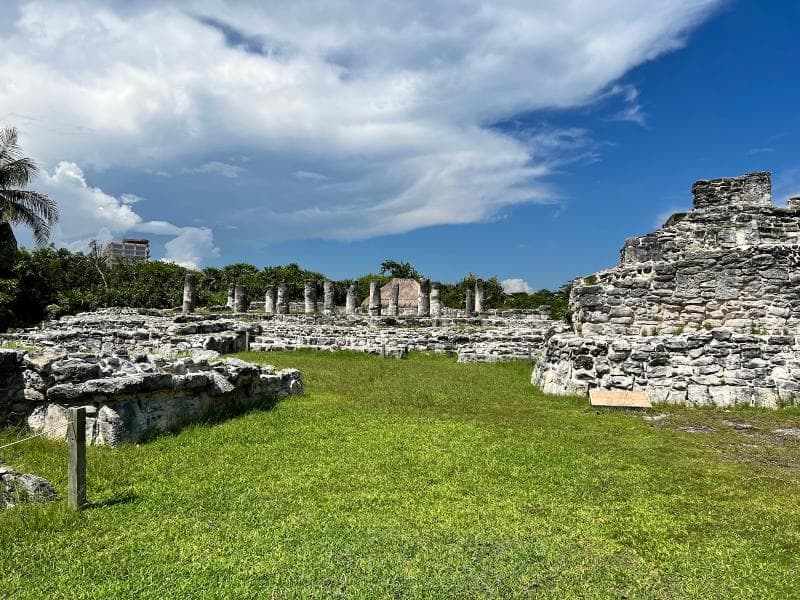
Explore the ancient Temple Platform with Columns at El Rey Ruins, Cancún, Mexico. Uncover Mayan history and culture at this accessible archaeological site.
Overview
Nestled amidst the vibrant energy of Cancún, Mexico, the El Rey Ruins offer a tranquil journey back in time to an ancient Mayan settlement. Among its many fascinating structures, the 'Temple Platform with Columns' stands out as a significant landmark within this archaeological zone. El Rey is a more intimate Mayan site, providing a captivating glimpse into a civilization that thrived on this coastal stretch. Its compact size makes it easily explorable, often allowing visitors to experience a sense of personal discovery, far removed from the larger, more frequented ruins in the Yucatán Peninsula.
History & Cultural Background
The origins of El Rey trace back to approximately 300 AD, when a small community of fishermen established a settlement here, building modest houses on stone platforms. The site flourished significantly between 1300 and 1550 AD, during the Late Postclassic period, becoming an important maritime trading port. Its strategic location between the Caribbean Sea and the Nichupté Lagoon facilitated its role in the extensive Mayan trade network, dealing primarily in salt and fish, which were vital commodities of the era. El Rey maintained connections with other prominent Mayan coastal communities such as Xel Ha, Tulum, and Xaman Ha (Playa del Carmen). The site's current name, 'El Rey,' meaning 'The King,' was bestowed upon it after the discovery of an anthropomorphic sculpture in 1909 by English travelers. This sculpture was believed to represent a monarch or noble person. Archaeological excavations have revealed 47 structures, including evidence of mural paintings and a notable burial site of a high-ranking individual, complete with a copper axe and ornaments of shell and bone, found during a temple excavation in 1975. The architecture visible today is characteristic of the 'East Coast Style,' known for its low-lying structures and single chambers.
What Makes It Special
The 'Temple Platform with Columns,' also referred to as Structure 22.1 or 22L-l, represents a distinctive architectural style found at El Rey. This structure, considered the largest and most complete of the palace-type buildings along the South Sacbe, originally featured two long galleries divided by twin rows of columns, totaling 18 pillars that once supported a substantial flat roof. A broad stairway leading up from its north side and a small altar at its center highlight its significance. Another columned temple within the site was likely used for ceremonies, with inner shrines where Mayans would burn incense in ceramic burners adorned with images of their gods. These columnar designs are a hallmark of the Late Postclassic period and provide valuable insights into Mayan construction techniques and the functional uses of their buildings, ranging from residential complexes to ceremonial spaces. The ability to walk among these ancient remains, juxtaposed against the modern Cancún skyline, offers a powerful and unique sense of continuity and change. The site's original position on a low sand barrier, near the Nichupté Lagoon, emphasizes the Mayan's astute understanding of their environment for protection and maritime access.
Stories, Fun Facts & Local Details
Perhaps one of the most engaging stories of El Rey concerns the sculpture that gave the site its name. While 'The King' statue is no longer at the ruins, its head is preserved and exhibited at the nearby Museo Maya de Cancún, allowing visitors to connect with the artifact that inspired the site's modern designation. The original Mayan name for this settlement remains a mystery, though suggestions like 'Kin Ich Ahau Bonil' (King of the Solar Countenance) or 'Cancuen' have been put forth. A delightful and memorable aspect of visiting El Rey is the prevalence of iguanas. These reptiles roam freely throughout the ruins, often basking on the ancient stones, providing charming photo opportunities and a lively natural element to the historical landscape. Archaeological findings at El Rey have also uncovered over 500 burials beneath residential platforms, shedding light on ancient Mayan funerary practices, where the dead were sometimes buried in a sitting position, believed to keep their spirits close to the family. Traces of mural paintings depicting deities have also been found, offering rare glimpses into the rich artistic and religious life of the ancient inhabitants.
Visitor Perspective
Visiting the Temple Platform with Columns and the broader El Rey Ruins offers a uniquely accessible and rewarding archaeological experience in Cancún. Located conveniently within the Hotel Zone, the site is easily reachable by public bus or taxi. Most visitors find that exploring the site takes about an hour, making it a perfect excursion to combine with a visit to the Mayan Museum or a relaxing afternoon at Playa Delfines, both located nearby. The terrain is relatively flat with natural, unpaved paths, making it suitable for a leisurely stroll. For the most comfortable experience, it's advisable to visit in the morning to avoid the midday heat and to wear comfortable walking shoes and sun protection. While smaller than some of the region's colossal Mayan cities, El Rey provides an intimate and profound connection to the past, offering a rich historical and cultural narrative without the crowds often found at larger archaeological sites.
Coordinates: -86.78111, 21.06083
View on Google Maps💬 How Travelers Describe This Place
Based on community votes
Unique
972Interesting
787Must See
726Beautiful
720Photogenic
85
Traveler Stories
Discover memorable experiences shared by travelers who have visited this place.
No traveler stories yet.
Be the first traveler to share what made this place memorable.

Tour
By
Spot
Discover amazing places around the world. Your journey starts here.
Explore
© 2026 TourBySpot. All rights reserved.