Temple Platform
Athens, Greece
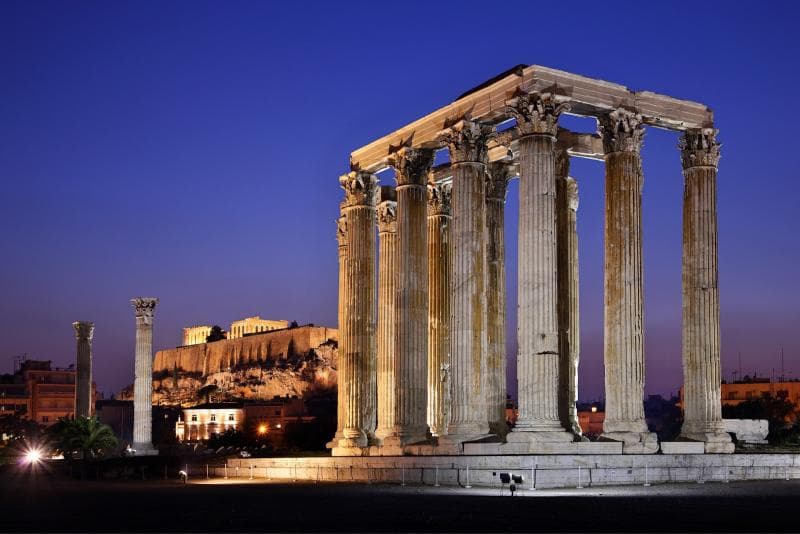
Explore the Temple of Olympian Zeus in Athens, Greece. Discover its colossal platform, rich history, and monumental Corinthian columns.
Overview
Stepping onto the grounds of the Temple of Olympian Zeus in Athens, Greece, one is immediately struck by the sheer scale of ambition that defined ancient builders. This monumental ruin, known locally as the Olympieion, was dedicated to Zeus, the king of the Olympian gods. What remains today – a handful of colossal Corinthian columns – hints at what was once the largest temple in Greece, a testament to enduring religious devotion and political aspiration. The site itself, encompassing the temple and its surrounding archaeological park, offers a profound journey through centuries of history, showcasing the layers of Greek and Roman influence on Athens's sacred landscape.
The impressive platform upon which the temple rests signifies the immense effort and vision that began its construction, though it took over 600 years to reach completion. While many ancient sites primarily present their foundations, here the foundational platform was itself a significant undertaking, laid down with the intent of supporting a structure of unprecedented grandeur.
History & Cultural Background
The history of the Temple of Olympian Zeus is as lengthy and complex as its construction. The site holds ancient significance, with evidence of habitation since the Neolithic period and claims that the mythical Deukalion built the first sanctuary to Zeus here after the great flood. The ambitious project of building a monumental temple began around 520 BC under the Athenian tyrant Peisistratus and his sons. Their vision was to create the grandest temple in the Greek world, with initial plans for a massive Doric-style temple of local limestone. However, construction ceased abruptly with the fall of the Peisistratid tyranny in 510 BC, leaving only the foundational platform and some column elements completed.
For centuries, the partially built temple remained untouched. It was not until 174 BC that Antiochus IV Epiphanes, the Hellenistic king of the Seleucid Empire, resumed construction, opting for a grander Corinthian style using Pentelic marble. His death in 164 BC again halted the work. The temple would only finally be completed by the Roman Emperor Hadrian in 132 AD, who, as a noted admirer of Greek culture, saw its completion as a tribute to Greek heritage and a symbol of Roman strength and patronage. This completion marked a significant moment, bridging Greek aspirations with Roman imperial power.
What Makes It Special
The Temple of Olympian Zeus stands out primarily for its sheer scale and architectural style. When completed under Hadrian, it boasted 104 colossal Corinthian columns, each standing over 17 meters tall and approximately 2 meters in diameter. This made it one of the largest temples in the ancient world and the largest in Greece. The Corinthian order, with its ornate acanthus leaf capitals, was a relatively unusual choice for Greek temples at that time, more commonly associated with Roman architecture, signifying a unique blend of Greek and Roman aesthetic and political influence.
Inside the cella (the inner sanctuary), the temple once housed an enormous chryselephantine (gold and ivory) statue of Zeus, and later, a statue of Emperor Hadrian himself, a testament to the emperor's ambition to associate himself with divine authority. The construction material, Pentelic marble, contributed to its grandeur, as its white surface would sparkle with a subtle golden sheen in the sunlight.
Stories, Fun Facts & Local Details
The long and interrupted construction of the Temple of Olympian Zeus has given rise to interesting historical anecdotes. Aristotle, the famous Greek philosopher, reportedly used the unfinished temple as an example of how tyrants kept their populace occupied with grand projects to prevent them from contemplating rebellion. Another fascinating detail is the ancient belief that a chasm several feet wide within the site was where the floodwaters from Deukalion's mythical deluge drained away, marking the spot as sacred from primordial times.
During the Roman era, after Sulla sacked Athens in 86 BC, he famously took several columns from the Olympieion back to Rome to be reused in the Temple of Jupiter on the Capitoline Hill. This act is believed to have significantly influenced the adoption of the Corinthian style in Roman architecture. Today, one of the most striking sights is a single column that fell during a storm in 1852, lying on the ground. Its broken segments offer a unique, up-close perspective on the scale and construction methods of these ancient marvels, allowing visitors to examine its 24 flutes and Corinthian capital with acanthus leaves.
Visitor Perspective
Visiting the Temple of Olympian Zeus today is an experience of awe and contemplation. The site, though in ruins with only 15 of its original 104 columns still standing (and one famously fallen), feels spacious and offers a sense of tranquility distinct from the bustling Acropolis. It's an open-air archaeological park, inviting visitors to wander among the remnants of a once-magnificent structure. The remaining columns, graphically spread across a large grassy terrace, still convey the immense scale and architectural ambition.
From within the park, visitors are treated to inspiring views of the Acropolis perched on its hill, offering a striking contrast between these two iconic Athenian landmarks. It is a place that rewards slow observation, encouraging reflection on the passage of time and the cyclical nature of human endeavor and decay. The immediate vicinity also includes Hadrian's Arch, which once marked the ceremonial boundary between the ancient Greek city and Hadrian's new Roman extension of Athens.
Coordinates: 23.73309, 37.96937
View on Google Maps💬 How Travelers Describe This Place
Based on community votes
Unique
886Interesting
564Must See
443Beautiful
233Photogenic
201
Traveler Stories
Discover memorable experiences shared by travelers who have visited this place.
No traveler stories yet.
Be the first traveler to share what made this place memorable.

Tour
By
Spot
Discover amazing places around the world. Your journey starts here.
Explore
© 2026 TourBySpot. All rights reserved.