Temple Of Jupiter
Split, Croatia
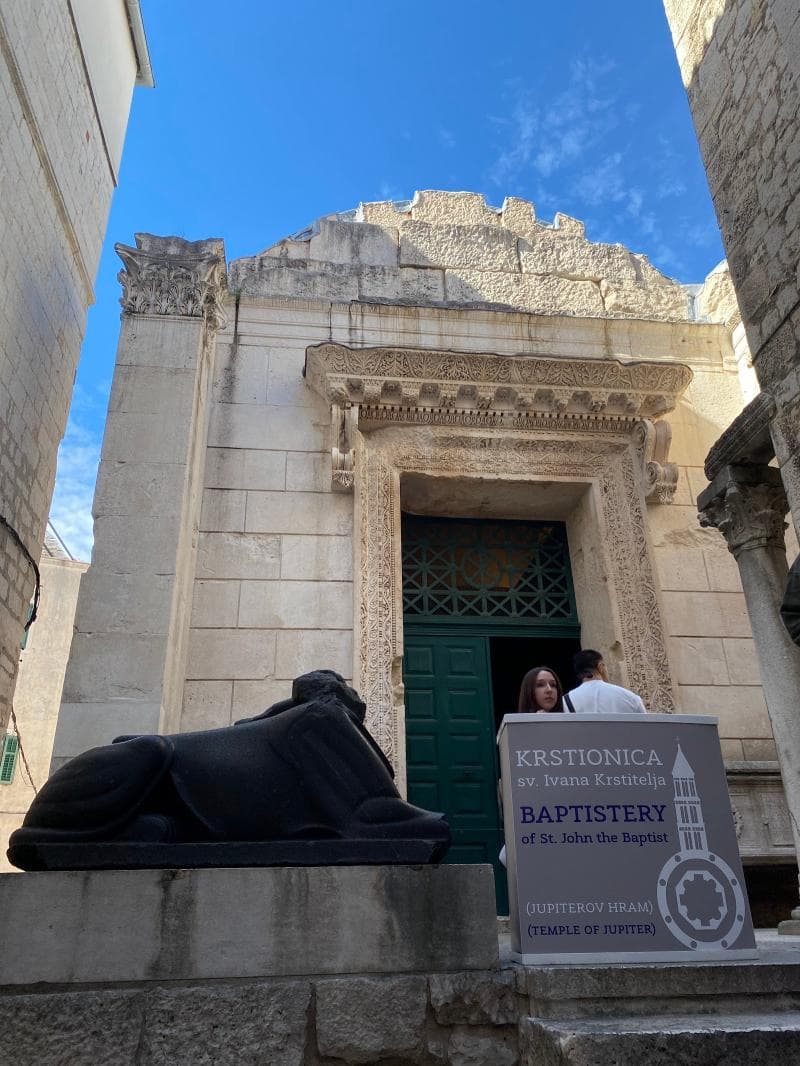
Explore the Temple of Jupiter, a remarkably preserved Roman temple and baptistery within Diocletian’s Palace in Split, Croatia. Discover its history and unique architecture.
Overview
Nestled within the ancient walls of Diocletian’s Palace in Split, Croatia, the Temple of Jupiter stands as a remarkable testament to Roman imperial grandeur and the subsequent transformations of history. Originally constructed as a shrine to the supreme Roman god Jupiter, to whom Emperor Diocletian attributed his divine lineage, this edifice later found new life as the Baptistery of St. John the Baptist. It is considered one of the best-preserved Roman temples in Europe and a vital part of Split's UNESCO World Heritage site. Its enduring presence offers visitors a unique journey through nearly two millennia of religious and architectural evolution.
History & Cultural Background
The Temple of Jupiter was built between 295 and 305 AD, forming an integral part of Emperor Diocletian's magnificent palace complex. Diocletian, who ruled as one of Rome's last emperors to persecute Christians, consciously identified himself as the 'son of Jupiter,' seeking to reinforce his imperial authority through divine association. The temple was intended as a sacred space for rituals dedicated to the chief deity of the Roman pantheon. However, Diocletian's unexpected abdication in 305 AD led to the premature halting of construction, leaving some parts of the temple unfinished.
A significant transformation occurred in the 6th century, during the early Christian period, when the temple was repurposed into the Baptistery of St. John the Baptist. This conversion reflected the shifting religious landscape of the region, symbolizing the triumph of Christianity over paganism. Concurrently, the crypt beneath the temple was dedicated to St. Thomas, adding another layer of spiritual significance to the site.
What Makes It Special
The Temple of Jupiter is an architectural marvel, showcasing the ingenuity of Roman engineering and artistry. As you approach, you'll notice a beautifully carved architrave above the entrance, adorned with intricate reliefs depicting a pantheon of gods and heroes, including Victoria, Triton, Helios, Hercules, Jupiter, and Apollo. The doorway itself is richly decorated, leading into the temple's interior where its most striking feature awaits: the barrel-vaulted ceiling. This coffered design, a masterpiece of Roman construction, not only provided structural stability but also created a sense of grandeur within the compact space. Its advanced technique significantly influenced Dalmatian early Renaissance art, evident in works like Andrea Alessi's baptistery in Trogir.
Before the temple's entrance stands one of the twelve Egyptian sphinxes brought to Split by Emperor Diocletian from Egypt. This headless sphinx, carved from black granite, is over 3,000 years old and is one of the few that survived intact, adding an exotic and mystical element to the Roman structure. The blend of ancient Roman pagan architecture with later Christian additions makes the temple a fascinating 'architectural hybrid' in Europe.
Stories, Fun Facts & Local Details
The sphinx guarding the temple entrance has witnessed centuries of change, from emperors to bishops and revolutionaries, silently observing the flow of history around Diocletian's Palace. Inside, the temple, now a baptistery, houses several remarkable artifacts that offer glimpses into the past. The baptismal font, assembled from parts of an 11th-century altar partition, features the oldest known representation of a Croatian king, either Peter Krešimir IV or Demetrius Zvonimir, surrounded by their subjects. This historical engraving provides valuable insight into the region's medieval history.
The interior also contains sarcophagi holding the remains of two Archbishops of Split, Ivan of Ravenna (died c. 1059) and Lovre (died c. 1099), providing a tangible link to the city's ecclesiastical past. A large bronze statue of St. John the Baptist, created by the renowned Croatian sculptor Ivan Meštrović, stands within the temple, further emphasizing its Christian identity. Interestingly, in the 11th century, a Romanesque-style bell tower was built above the temple's vault, though it was later demolished in the 19th century to 'purify' the ancient monument.
Visitor Perspective
Visiting the Temple of Jupiter offers a profound connection to the layered history of Split. Located in the western part of Diocletian's Palace, near the bustling Peristyle, it is easily accessible on foot. While it may be smaller than some other grand Roman structures, its significance lies in its incredible preservation and the compelling narrative it tells through its architectural elements and artifacts. Many visitors find it best appreciated as part of a combined ticket or a guided tour of Diocletian's Palace, allowing for a deeper understanding of its context within the broader imperial complex. Stepping inside, travelers can experience a rare moment of immersion in ancient history, standing within a nearly two-thousand-year-old structure that continues to echo the stories of emperors and saints.
Coordinates: 16.439568, 43.508341
View on Google Maps💬 How Travelers Describe This Place
Based on community votes
Interesting
915Must See
211Unique
123Beautiful
74Photogenic
53
Traveler Stories
Discover memorable experiences shared by travelers who have visited this place.
No traveler stories yet.
Be the first traveler to share what made this place memorable.

Tour
By
Spot
Discover amazing places around the world. Your journey starts here.
Explore
© 2026 TourBySpot. All rights reserved.