Temple Of Hephaestus
Athens, Greece
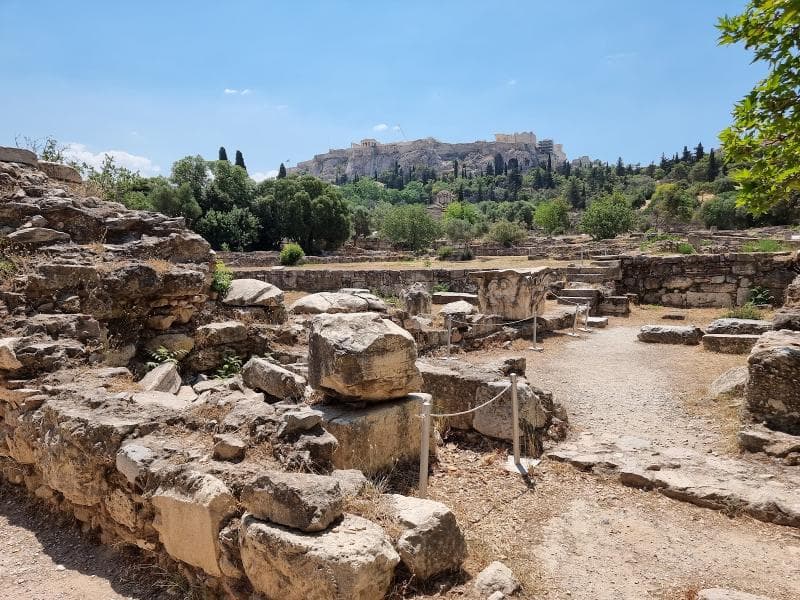
Explore the Temple of Hephaestus in Athens, Greece – the best-preserved ancient Greek temple dedicated to Hephaestus and Athena. Discover its history.
Overview
Nestled atop the Agoraios Kolonos hill on the western side of the Ancient Agora of Athens, the Temple of Hephaestus stands as the best-preserved ancient Greek temple in the world. This magnificent Doric peripteral temple, located in Athens, Greece, offers a tangible link to the classical past. It was dedicated to Hephaestus, the Olympian god of fire, metalworking, and craftsmanship, and to Athena Ergani, the goddess of potters and artisans. Constructed primarily from lustrous Pentelic marble, with its sculptures crafted from fine Parian marble, the temple's enduring presence is a testament to ancient Athenian architectural prowess.
History & Cultural Background
The construction of the Temple of Hephaestus began around 449 BC, during the 'golden age' of Classical Athens and Pericles' ambitious building program. Its completion spanned approximately 30 years, with funding occasionally diverted to other grand projects like the Parthenon. The design is often attributed to Iktinos, one of the architects behind the Parthenon, showcasing the refined Doric order.
Its location within the Ancient Agora, the bustling heart of Athenian public, political, and commercial life, underscored its significance. The temple served not only as a place of worship but also as a powerful civic symbol, reflecting the city's divine favor and celebrating the vital role of artisans and craftspeople in Athenian society.
A pivotal moment in its history, and key to its exceptional preservation, was its conversion into a Christian church. Around the 7th century AD, the temple was rededicated to Saint George Akamates, a change that saved it from the fate of many other ancient structures that were dismantled for their materials. It continued to function as a church until 1834, after which it briefly housed Athens' first archaeological museum before being restored to its status as an ancient monument. In the 19th century, it also served as a burial site for non-Orthodox Europeans, including notable philhellenes who supported Greece's War of Independence. The first king of Greece, Otto I, was officially welcomed here in 1834.
What Makes It Special
What truly sets the Temple of Hephaestus apart is its unparalleled state of preservation. Unlike many of its contemporaries, its full colonnade of 34 columns remains standing, sections of its ceiling are intact, and much of its intricate sculptural program is still visible after 2,450 years. This allows visitors to experience an ancient Greek Doric temple almost as it appeared in its original context.
The temple is a prime example of the mature Doric order, characterized by its elegant simplicity and robust strength. It features a hexastyle design with six columns on its shorter east and west ends, and thirteen columns along its longer north and south sides, creating a total of 34 columns surrounding the structure.
The decorative sculptures tell vivid stories from Greek mythology. The ten metopes on the eastern side depict the Labours of Heracles, while the four easternmost metopes on the north and south sides illustrate the Labours of Theseus. The western frieze portrays the battle between the Centaurs and Lapiths, and other sections depict Theseus's conflict with the Pallantides and scenes from the fall of Troy. These carvings not only adorn the temple but also reflect civic pride and the values of ancient Athens.
Stories, Fun Facts & Local Details
The dedication of the Temple of Hephaestus to Hephaestus and Athena Ergani highlights the profound respect for manual labor and craftsmanship in ancient Athens. Archaeological excavations in the surrounding area have indeed uncovered numerous metalworking and pottery workshops, affirming the temple's purpose. It is believed that a yearly festival called Chalkeia was held, during which blacksmiths and artisans paraded around the temple with their tools.
According to the ancient writer Pausanias, bronze statues of Hephaestus and Athena once graced the temple's interior. For a period, the temple was mistakenly known as the 'Theseum' because it was believed to be the burial site of the legendary Athenian hero, Theseus. This enduring misconception is still reflected in the name of the surrounding neighborhood, Thissio. Its construction using Pentelic marble from nearby Mount Penteli and Parian marble for sculptures was a mark of quality and prestige, similar to the Parthenon.
Visitor Perspective
The Temple of Hephaestus is not a standalone attraction but an integral part of the Ancient Agora archaeological site. Visitors gain entry through the Agora's entrances on Adrianou Street or Apostolou Pavlou Street, both just a short 5-10 minute walk from the temple. The site is conveniently located near the Monastiraki metro station, making it easily accessible.
Admission to the Ancient Agora, including the Temple of Hephaestus, is covered by the combined Athens archaeological sites ticket, or can be purchased individually. While visitors can walk around the exterior of the temple and admire its architectural grandeur, entry into the interior is generally not permitted. The surrounding area, with its leafy park, offers a peaceful respite and shade from the Athenian sun. Many visitors to Athens tend to focus solely on the Acropolis, often overlooking the profound experience offered by this remarkably preserved temple. From the Acropolis, one can also enjoy a panoramic view of the Temple of Hephaestus amidst the ancient Agora. Visiting this site provides a unique opportunity to connect with the past and appreciate the enduring legacy of classical Greek architecture and culture.
Coordinates: 23.7213917, 37.9756167
View on Google Maps💬 How Travelers Describe This Place
Based on community votes
Beautiful
996Interesting
673Must See
585Unique
143Photogenic
80
Traveler Stories
Discover memorable experiences shared by travelers who have visited this place.
No traveler stories yet.
Be the first traveler to share what made this place memorable.

Tour
By
Spot
Discover amazing places around the world. Your journey starts here.
Explore
© 2026 TourBySpot. All rights reserved.