Surrounding Square
Zagreb, Croatia
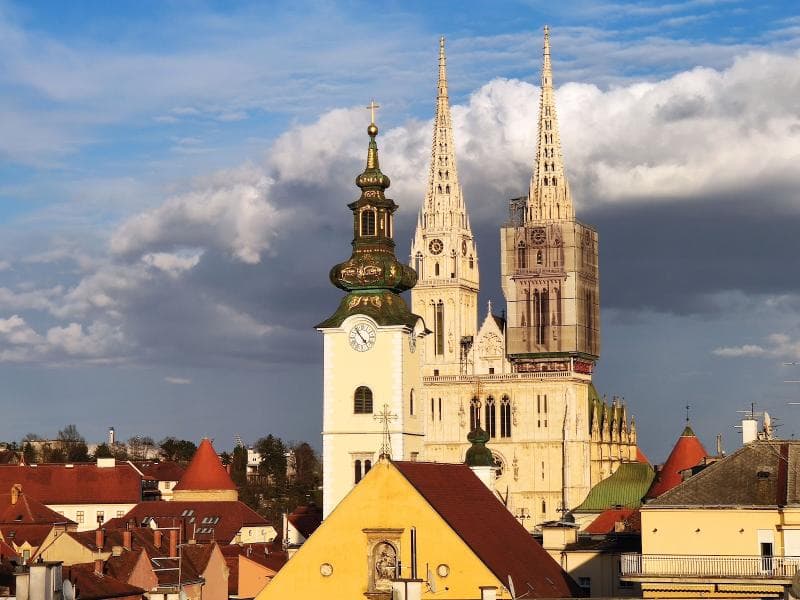
Explore the historic precinct surrounding Zagreb Cathedral in Croatia's Kaptol district, featuring Neo-Gothic spires and ancient fortifications.
Overview
Nestled within the historic Kaptol district of Zagreb, Croatia, the area surrounding Zagreb Cathedral offers a profound journey into the city's rich past and spiritual heart. While there isn't a formally named 'Surrounding Square', the immediate precinct around the Cathedral of the Assumption of the Blessed Virgin Mary and Saints Stephen and Ladislaus, including the Archbishop's Palace and remnants of ancient fortifications, creates a distinct and awe-inspiring atmosphere. This sacred space stands as a testament to centuries of Croatian history, resilience, and faith, dominating Zagreb's skyline with its soaring Neo-Gothic spires.
Visitors to this precinct are immediately struck by the grandeur of the cathedral itself, which is the tallest building in Croatia. The area serves as the ecclesiastical center of the Roman Catholic Archdiocese of Zagreb and holds immense cultural significance for the entire nation. A stroll here allows one to explore not just the magnificent church, but also the ancient walls and the stately Archbishop's Palace that have witnessed countless historical events.
History & Cultural Background
The history of this sacred ground dates back to 1094, when King Ladislaus I of Hungary established the Diocese of Zagreb and proclaimed an existing church in Kaptol as the cathedral. The original Romanesque cathedral, completed around 1217, faced an early challenge when it was severely damaged during the Tatar invasion in 1242. Rebuilt in Gothic style under Bishop Timothy, the cathedral and its surroundings became a focal point for the developing city.
The 15th and 16th centuries brought the threat of Ottoman invasions, leading to the construction of robust fortification walls and towers around the cathedral and the Bishop's residence. These Renaissance defenses are among the best-preserved in Europe and offer a tangible link to a turbulent past. The cathedral has endured numerous fires and conflicts over the centuries, but perhaps its most significant transformation followed the devastating 1880 earthquake. Austrian architect Hermann Bollé spearheaded a comprehensive Neo-Gothic reconstruction, giving the cathedral its iconic twin spires and current appearance between 1889 and 1906.
What Makes It Special
What truly sets this area apart is its seamless blend of monumental architecture, deep historical layers, and ongoing spiritual relevance. The Zagreb Cathedral's twin spires, reaching 108 meters, are a dominant feature of the city's skyline, visible from many parts of Zagreb and serving as a constant beacon. The architectural finesse of Bollé's Neo-Gothic design, which unified and idealized the older Gothic structure, is remarkable.
Beyond the cathedral itself, the immediate precinct is special for its well-preserved historical elements. The Archbishop's Palace, dating from 1729 in its current Baroque form, stands parallel to the cathedral and incorporates elements as old as a Romanesque-Gothic chapel from 1250. The remnants of the 16th-century fortifications, including round towers and walls, evoke a sense of the city's defensive past and its struggle for survival against formidable adversaries. This combination of a towering Gothic masterpiece and its ancient fortified ecclesiastical surroundings creates an unparalleled sense of history and grandeur.
Stories, Fun Facts & Local Details
The area surrounding Zagreb Cathedral is rich with stories. For instance, the original wooden fence around Kaptol was torn down in 1387 during a civil war, only to be reinforced later due to fears of Ottoman attacks. A poignant detail is the Marian column located in front of the cathedral, featuring a golden statue of the Virgin Mary and four angels, which adds to the spiritual ambiance of the square.
A fun fact for visitors is that the cathedral's organ is considered among the top ten finest in the world, with more than 6,000 pipes. The area also ties directly into daily life, as it's just a short walk from Dolac Market, connecting the sacred space with the vibrant pulse of local commerce. Another interesting detail from the 1880 earthquake's impact was a clock outside the cathedral that was said to have stopped at 7:03, the exact time the tremor hit.
Visitor Perspective
Visiting the area around Zagreb Cathedral is an immersive historical experience. As you approach, the sheer scale of the cathedral, with its twin spires reaching towards the sky, is truly humbling. The atmosphere is one of reverence and historical depth, inviting quiet contemplation. Walking among the ancient fortification walls, one can almost hear echoes of past struggles and triumphs. The Archbishop's Palace, though often only appreciated from the outside due to its active use, provides a majestic backdrop to the cathedral.
The interior of the cathedral, which is typically free to enter as it remains an active place of worship, offers a chance to see its soaring nave, Renaissance choir stalls, and the tomb of Cardinal Alojzije Stepinac, a deeply venerated figure in Croatian Catholicism. While the cathedral is currently undergoing extensive restoration work due to the 2020 earthquake, its spiritual significance and architectural beauty continue to draw visitors, offering a unique opportunity to witness its ongoing journey through time.
Coordinates: 15.97974, 45.81447
View on Google Maps💬 How Travelers Describe This Place
Based on community votes
Must See
680Interesting
653Beautiful
588Unique
566Photogenic
503
Traveler Stories
Discover memorable experiences shared by travelers who have visited this place.
No traveler stories yet.
Be the first traveler to share what made this place memorable.

Tour
By
Spot
Discover amazing places around the world. Your journey starts here.
Explore
© 2026 TourBySpot. All rights reserved.