Surrounding Park
Madrid, Spain
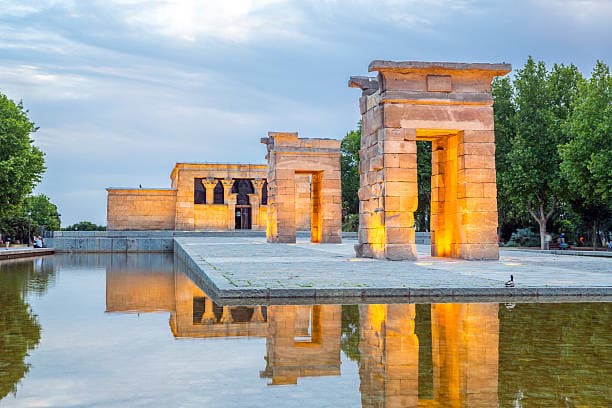
Explore the Jardines del Templo de Debod in Madrid, Spain—a unique park housing an ancient Egyptian temple and offering stunning city views, especially at sunset.
Overview
Nestled atop the former Príncipe Pío hill in Madrid, Spain, the park surrounding the Temple of Debod, officially known as the Jardines del Templo de Debod, offers an unexpected journey into ancient Egypt right in the heart of the Spanish capital. This unique green space, forming part of the larger Parque del Oeste, is not merely a garden but a historical tableau, presenting one of the few ancient Egyptian temples found outside of Egypt. It serves as a tranquil oasis for locals and visitors alike, renowned for its serene atmosphere, panoramic city views, and particularly spectacular sunsets. The park beautifully frames the temple, with reflective pools mirroring the ancient structure, creating a captivating scene that transports you across continents and millennia.
History & Cultural Background
The story of the Temple of Debod, and by extension its surrounding park, is one of international cooperation and profound historical layers. The temple itself dates back to the 2nd century BC, originating in Nubia, southern Egypt, close to the first cataract of the Nile. It was initially commissioned by King Adikhalamani of Meroë as a small chapel dedicated to the gods Amun and Isis. Over centuries, various Ptolemaic kings and later Roman emperors, including Augustus and Tiberius, expanded and adorned the temple, demonstrating its enduring religious significance.
Its journey to Madrid began in the 1960s when the construction of the Aswan High Dam threatened numerous ancient monuments with submersion. UNESCO launched an international appeal to save these invaluable archaeological treasures. Spain played a crucial role in aiding Egypt, notably assisting in the relocation of the Abu Simbel temples. As a gesture of profound gratitude, the Egyptian government gifted five temples to contributing nations, with the Temple of Debod bestowed upon Spain in 1968.
The temple was meticulously dismantled, transported stone by stone, and then painstakingly reassembled in Madrid between 1970 and 1972. The site chosen for its reconstruction is equally steeped in history. This elevated area, known as Príncipe Pío hill, was once home to the Cuartel de la Montaña (Mountain Barracks), built between 1860 and 1863. This location holds a poignant place in Spanish history, being the spot where Napoleon's French troops executed Spanish rebels during the 2nd of May 1808 uprising, a tragic event immortalized in Goya's famous painting. Decades later, it also witnessed pivotal events at the outset of the Spanish Civil War in July 1936, when the barracks were almost entirely destroyed.
The Jardines del Templo de Debod were inaugurated in 1970, designed by Manuel Herrero Palacios, to elegantly host the ancient temple. The park was conceived to frame the temple, respecting its original east-to-west orientation, which was vital for the solar cult of the ancient Egyptians.
What Makes It Special
What sets the Jardines del Templo de Debod apart is the sheer incongruity and beauty of an ancient Egyptian temple gracing a European capital. It's a powerful blend of cultures and histories, offering a moment of quiet contemplation amidst Madrid's bustling urban landscape. The temple's presence, reflected in the shallow rectangular pools that simulate the Nile, creates a mesmerizing optical effect, particularly magical at dusk.
The park also boasts some of the most breathtaking panoramic views in Madrid. From its vantage point, visitors can gaze upon the Royal Palace, the sprawling Casa de Campo, and the distant Guadarrama mountains, making it a favorite spot for photographers and romantics alike. Its status as one of the very few authentic ancient Egyptian monuments outside of its homeland further enhances its allure, offering a tangible link to a civilization thousands of years old.
Stories, Fun Facts & Local Details
The relocation of the Temple of Debod was an astonishing feat of engineering and international cooperation. Each stone was carefully numbered, dismantled, and packed into 1,350 boxes, then shipped across the Mediterranean before being transported by trucks to Madrid. The meticulous reconstruction ensured the temple retained its sacred east-to-west alignment.
Manuel Herrero Palacios, the landscape architect, consciously designed the gardens with semi-tropical, arid vegetation, including palm trees and yucca plants, to subtly evoke the temple's original Egyptian desert environment. The serene water features surrounding the temple were created to mimic the sacred waters of the Nile, adding another layer of authenticity to its new home.
The historical weight of the site itself, predating the temple's arrival, adds a compelling layer to a visit. Standing where the Cuartel de la Montaña once stood, one can reflect on centuries of human drama, from ancient Egyptian reverence to Napoleonic-era tragedy and the tumult of the Spanish Civil War. Today, a commemorative monument within the park also reminds visitors of the historical events that unfolded there.
Visitor Perspective
Visiting the Jardines del Templo de Debod is a deeply rewarding experience, freely accessible to all. While entry to the temple's interior is also free, it often involves timed visits or queues due to conservation efforts and limited capacity, making it advisable to check the official website for current visiting hours and potential reservation requirements.
Many agree that the best time to experience the park is during sunset. As the sun dips below the horizon, painting the sky with fiery hues, the temple glows, its reflection dancing in the water, creating an unforgettable spectacle. The park is perfect for leisurely strolls, quiet contemplation, or enjoying a picnic with a unique historical backdrop. Its central location near Plaza de España makes it easily reachable by metro and bus, offering a peaceful escape from the city's vibrant energy.
Coordinates: -3.71799, 40.42405
View on Google Maps💬 How Travelers Describe This Place
Based on community votes
Must See
951Beautiful
491Unique
414Photogenic
310Interesting
277
Traveler Stories
Discover memorable experiences shared by travelers who have visited this place.
No traveler stories yet.
Be the first traveler to share what made this place memorable.

Tour
By
Spot
Discover amazing places around the world. Your journey starts here.
Explore
© 2026 TourBySpot. All rights reserved.