Surrounding Park Area
Athens, Greece
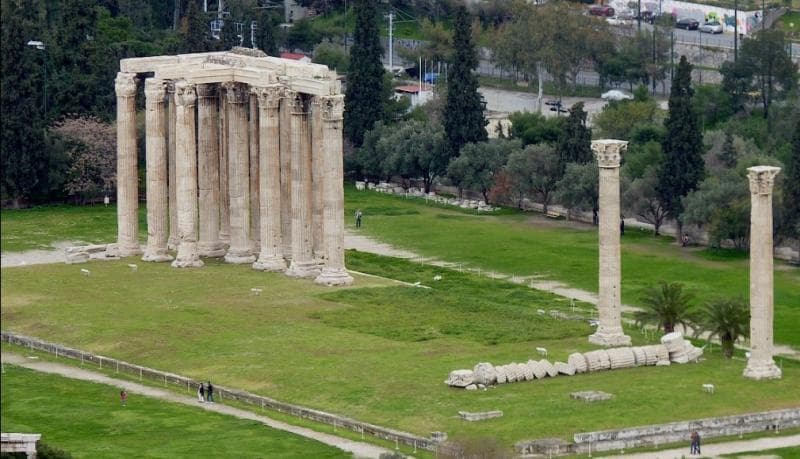
Explore the Surrounding Park Area of the Temple of Olympian Zeus in Athens, Greece, a historical park blending ancient ruins, Hadrian's Arch, and lush gardens.
Overview
The Surrounding Park Area of the Temple of Olympian Zeus in Athens, Greece, is far more than just green space; it is a sprawling archaeological precinct and a verdant urban oasis that beautifully intertwines ancient history with modern tranquility. Located southeast of the Acropolis and south of Syntagma Square, this expansive area encompasses the colossal ruins of the Temple of Olympian Zeus, the monumental Arch of Hadrian, and remnants of ancient Roman structures, all set amidst lush gardens. It serves as a vital historical bridge, connecting the ancient heart of Athens with the Roman-era additions and offering a serene escape within the bustling city.
Visitors can explore the archaeological site, which also includes the foundations of Classical-era houses, Roman baths, and portions of the ancient Themistoclean Wall. Adjacent to this historical core are the beautifully landscaped National Garden and the Zappeion Gardens, which contribute significantly to the area's park-like feel. This combination creates a unique environment where towering ancient columns stand proudly against a backdrop of mature trees and flowering plants, inviting contemplation of millennia of history.
History & Cultural Background
The history of the Surrounding Park Area is inextricably linked to the Temple of Olympian Zeus itself, a project that spanned over 600 years. The foundations for the temple were laid in the 6th century BC by the Athenian tyrant Peisistratos, who envisioned a temple of unprecedented scale. However, its construction was repeatedly halted due to political upheavals and lack of funds, remaining unfinished for centuries.
The area gained significant prominence under the Roman Emperor Hadrian, a known admirer of Greek culture, who finally completed the colossal temple in 132 AD. Hadrian's influence transformed the precinct into a central focus of the ancient city, creating a new affluent neighborhood known as Hadrianopolis. To mark the transition from the old city of Theseus to Hadrian's new city, the impressive Arch of Hadrian was erected near the temple. This arch symbolically divided the Greek Athens from the Roman Athens, bearing inscriptions on its two facades to highlight this distinction.
Later, in the 19th century, the adjacent Zappeion Hall and its surrounding gardens were developed. Commissioned by Evangelos Zappas with the vision of reviving the Olympic Games, the Zappeion became the world's first building explicitly constructed for the modern Olympics. It hosted fencing events in the 1896 Olympic Games and served as the first Olympic Village in the interim Olympics of 1906, further cementing the area's historical and cultural significance.
What Makes It Special
What truly makes the Surrounding Park Area special is its unparalleled ability to offer a tangible journey through diverse layers of Athenian history within a single, coherent landscape. It is here that the ambitions of ancient Greek tyrants, the grandeur of Roman emperors, and the revivalist spirit of modern Greece converge. The sheer scale of the Temple of Olympian Zeus, even in its ruined state with its 15 surviving colossal Corinthian columns, is breathtaking and evokes a sense of awe.
The site's strategic location provides iconic views, including dramatic perspectives of the Acropolis, making it a photographer's dream. The elegant Arch of Hadrian stands as a poignant reminder of Athens's complex relationship with its various rulers and cultural influences. Furthermore, the harmonious integration of archaeological remains with the lush National and Zappeion Gardens offers a unique blend of history, architecture, and natural beauty, providing both intellectual stimulation and peaceful contemplation.
Stories, Fun Facts & Local Details
Legend has it that the Temple of Olympian Zeus, with its immense gold-and-ivory statue of Zeus, was so grand it was intended to rival the wonders of the ancient world. Emperor Hadrian also placed a statue of himself inside the temple, honored alongside the chief Olympian god. A poignant reminder of the temple's tumultuous history is the single fallen column, toppled by a gale-force wind in 1852, which still lies on the ground today, providing a stark visual of its eventual decay.
The Arch of Hadrian itself tells a fascinating story, with its dual inscriptions. On the side facing the Acropolis, it declared, 'This is Athens, the ancient city of Theseus,' while the side facing the temple proclaimed, 'This is the city of Hadrian, and not of Theseus.' This subtle architectural 'dialogue' perfectly encapsulates the shifting identities of Athens over centuries. The Zappeion, while a 19th-century addition, carries its own piece of modern history, having hosted major European Union accession treaties for Greece, reflecting its continued importance as a public venue.
Visitor Perspective
For the curious traveler, the Surrounding Park Area of the Temple of Olympian Zeus offers an enriching and accessible experience. The entire Olympieion archaeological site is well-maintained with crushed-gravel paths, making it easy to navigate and offering excellent views of the majestic temple ruins. It's conveniently located within walking distance of other major Athenian landmarks like the Acropolis, the Acropolis Museum, and Syntagma Square, making it an ideal stop on any Athens itinerary.
The area provides a wonderful opportunity for a leisurely stroll, combining historical exploration with the enjoyment of green spaces. Many visitors choose to combine a visit to the temple with a walk through the adjacent National Garden or Zappeion Gardens for a comprehensive experience. The site offers minimal shade, so planning visits during the cooler parts of the day, particularly sunrise or sunset, can enhance the experience and provide dramatic photographic opportunities with the Acropolis in the background. It is a place that invites you to pause, imagine, and connect with the enduring legacy of Athens.
Coordinates: 23.7337, 37.9694
View on Google Maps💬 How Travelers Describe This Place
Based on community votes
Unique
826Must See
800Beautiful
387Interesting
242Photogenic
82
Traveler Stories
Discover memorable experiences shared by travelers who have visited this place.
No traveler stories yet.
Be the first traveler to share what made this place memorable.

Tour
By
Spot
Discover amazing places around the world. Your journey starts here.
Explore
© 2026 TourBySpot. All rights reserved.