Summit Crater
Bali, Indonesia
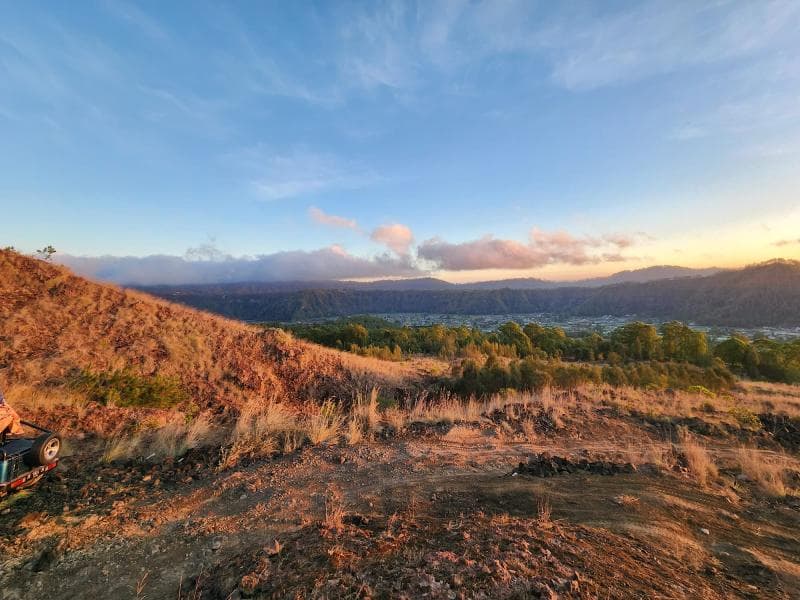
Discover the sacred Summit Crater of Mount Batur in Bali, Indonesia, an active volcano offering breathtaking sunrise views and rich cultural history.
Overview
Perched majestically in the Kintamani region of Bali, Indonesia, the Summit Crater of Mount Batur offers a captivating glimpse into the island's volcanic heart. This active stratovolcano rises to an elevation of 1,717 meters (5,633 feet) above sea level, making it a prominent feature of Bali's landscape. The Summit Crater is the highest point of Mount Batur, which itself is situated within a dramatic double caldera system, a geological rarity often described as 'a volcano within a volcano'. Recognized as part of the Batur UNESCO Global Geopark, the area is a testament to the powerful natural forces that have shaped Bali. While Batur has erupted frequently throughout history, with the most recent significant activity recorded in 2000, it remains a popular destination, particularly renowned for its breathtaking sunrise treks that draw visitors from around the globe.
History & Cultural Background
The geological story of Mount Batur began approximately 29,000 years ago with colossal eruptions that led to the formation of a massive outer caldera. Within this vast depression, a subsequent eruption around 20,000 years ago created a smaller inner caldera, from which the present-day Mount Batur peak, including its Summit Crater, gradually emerged. Its position along the Pacific Ring of Fire underscores its dynamic nature, which has profoundly influenced Bali's environment and its people. Documented volcanic activity dates back to 1804, with the mountain experiencing numerous eruptions since. Notable events in 1917 and 1926 had devastating impacts, destroying villages and the original Pura Ulun Danu Batur temple. Miraculously, a central shrine of the temple survived the 1917 lava flow, an event deeply ingrained in local lore. Lava fields visible today are remnants of eruptions in the 1960s and 1970s.
Culturally, Mount Batur holds immense spiritual significance for the Balinese Hindu community. It is revered as a sacred mountain, believed to be the dwelling place of the gods, particularly Brahma and Dewi Danu, the goddess of Lake Batur. The Balinese worldview, which intertwines nature and the divine, sees the volcano as embodying the balance between creation and destruction. Ceremonies and offerings are regularly performed to appease mountain spirits and maintain harmony. The Pura Ulun Danu Batur temple complex, rebuilt after the 1926 eruption and considered the second most important temple in Bali after Pura Besakih, plays a crucial role in the island's spiritual life. It is dedicated to Dewi Danu, who is believed to control the water essential for the subak irrigation system, a UNESCO-recognized cultural heritage practice that sustains Bali's vital rice fields.
What Makes It Special
The Summit Crater of Mount Batur offers a truly unique experience. Its most distinguishing feature is its geological setting: it's an active volcano rising from within a larger, ancient caldera, essentially creating 'a volcano inside another volcano'. This intricate formation, visible from the summit, provides a dramatic panoramic backdrop. The views from the top at dawn are particularly celebrated, encompassing the serene Lake Batur, the distant peaks of Mount Agung in Bali, and even Mount Rinjani on the neighboring island of Lombok, all bathed in the golden hues of sunrise.
Beyond the visual spectacle, the Summit Crater allows visitors to stand atop an active volcano, offering a tangible connection to Earth's powerful forces. The presence of steam vents and fumaroles at the summit hints at the geothermal activity beneath. The entire Mount Batur region's status as a UNESCO Global Geopark further highlights its special geological and cultural importance, ensuring its preservation and recognition on a global scale.
Stories, Fun Facts & Local Details
Mount Batur is rich with local legends and folklore. One popular myth tells of the giant Kebo Iwa, whose enormous appetite and strength were harnessed by villagers to dig a massive well. Upon his exhaustion, they tricked him, burying him with limestone, and the resulting pit filled with water to become Lake Batur, while the displaced earth formed Mount Batur. Another legend suggests that the gods transported a peak from the sacred Mount Mahameru in Java, splitting it to create Mount Agung and Mount Batur, thus anchoring the spiritual balance of Bali.
A fascinating detail relates to Pura Ulun Danu Batur. When Mount Batur erupted in 1917, the lava miraculously stopped just short of the temple's gates, an event interpreted by the Balinese as a divine sign of protection. Though the temple was later destroyed in the more powerful 1926 eruption, its central shrine notably survived, reinforcing its sacred status and the resilience of Balinese faith. Today, many local farmers in the area have transitioned into roles as trekking guides, a testament to the mountain's growing tourism and a way for locals to share their profound connection to this sacred land. As a fun fact for those reaching the summit, mischievous monkeys often appear after sunrise, eager to share in any breakfast provisions.
Visitor Perspective
For many, the journey to Mount Batur's Summit Crater is synonymous with the iconic sunrise trek. This popular adventure typically begins with a very early morning pickup, often between 1:00 AM and 3:00 AM, to ensure climbers reach the summit before dawn. The ascent is generally considered moderately challenging, taking between 1.5 to 2.5 hours, and is manageable for most individuals with a basic level of fitness. While the initial climb occurs in complete darkness, guided by flashlights often provided by local guides, the anticipation builds with each step.
The reward for the early start and the climb is an unparalleled view. As the sun ascends, it slowly illuminates the caldera, Lake Batur, and the surrounding peaks, creating a spectacle often described as 'worth it'. Essential items for the trek include wearing layers of clothing, as it can be quite cold at the summit before sunrise, and sturdy closed-toe hiking shoes for navigating the volcanic terrain, which can be rocky and slippery with loose gravel in places. Engaging a local guide is highly recommended, not just for safety on the well-trodden but sometimes challenging paths, but also for their invaluable insights into the mountain's history, geology, and cultural significance. The descent, often taken on a different, sometimes sandier route, offers fresh perspectives of the now fully illuminated landscape.
Coordinates: 115.3775, -8.23889
View on Google Maps💬 How Travelers Describe This Place
Based on community votes
Unique
934Must See
879Beautiful
741Interesting
276Photogenic
30
Traveler Stories
Discover memorable experiences shared by travelers who have visited this place.
No traveler stories yet.
Be the first traveler to share what made this place memorable.

Tour
By
Spot
Discover amazing places around the world. Your journey starts here.
Explore
© 2026 TourBySpot. All rights reserved.