Stone Reliefs
Split, Croatia
Explore the stone reliefs of the Temple of Jupiter in Split, Croatia. Discover ancient Roman carvings and the temple's transformation into a baptistery.
Overview
Nestled within the ancient walls of Diocletian's Palace in Split, Croatia, the Temple of Jupiter stands as a remarkably preserved testament to Roman architectural prowess and shifting cultural landscapes. Originally dedicated to Jupiter, the supreme Roman god and Emperor Diocletian's divine father, this edifice is a highlight for any traveler exploring Split's rich history. While often referred to as the Temple of Jupiter, it later underwent a significant transformation, becoming the Baptistery of St. John the Baptist in the 6th century.
The sub-spot known as 'Stone Reliefs' refers to the intricate carvings that adorn this historic structure, particularly above its entrance and within its celebrated barrel-vaulted ceiling. These detailed sculptural elements offer a fascinating glimpse into the artistic and religious beliefs of the Roman Empire and provide a tangible connection to the past, allowing visitors to walk in the footsteps of emperors and ancient worshippers.
History & Cultural Background
The Temple of Jupiter was constructed between 295 and 305 AD, concurrent with the building of Emperor Diocletian's magnificent palace in Split. Diocletian, who considered himself the living son of Jupiter, commissioned this temple as an essential part of the religious life within his imperial complex. The temple's location in the western, religious part of the palace, near the Peristyle, underscored its importance. Its construction was halted when Diocletian abdicated in 305 AD, leaving some parts unfinished.
With the advent of Christianity and the decline of the Roman Empire, the temple's purpose evolved dramatically. In the 6th century, it was converted into the Baptistery of St. John the Baptist, reflecting the profound religious changes in the region. This conversion saw the addition of a crypt beneath the temple, dedicated to St. Thomas. This layering of history – a Roman temple becoming a Christian baptistery – highlights Split's continuous cultural and religious evolution over centuries.
What Makes It Special
The Temple of Jupiter is celebrated for several distinctive features, most notably its remarkably well-preserved stone reliefs and unique architectural elements. As one approaches the temple, the façade reveals intricate carvings depicting a pantheon of Roman gods and heroes. These include figures such as Victoria, Triton, Helios, Hercules, Jupiter, and Apollo, each adding to the temple's mythological grandeur. The doorway itself is richly decorated with detailed carvings that tell stories of ancient devotion.
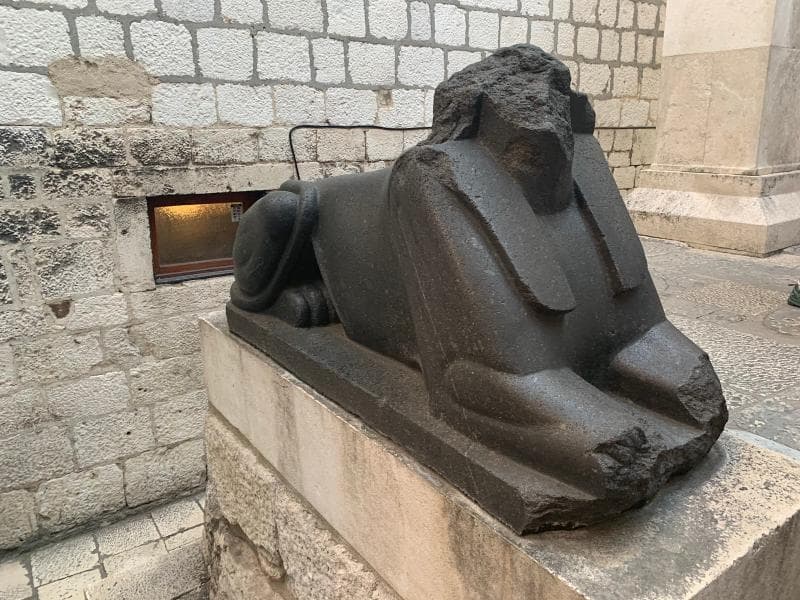
Inside, the temple boasts a magnificent barrel-vaulted ceiling, considered a masterpiece of Roman engineering. This coffered design is not only aesthetically pleasing but also showcases the advanced construction techniques of its era, influencing later Dalmatian early Renaissance art, particularly seen in the works of Andrea Alessi in Trogir. Another striking feature is the headless black granite Egyptian sphinx, one of several brought from Egypt by Emperor Diocletian, which stands guard outside the entrance. This ancient artifact, already ancient when it arrived in Split, adds an exotic and mysterious layer to the temple's presence.
Stories, Fun Facts & Local Details
One fascinating aspect of the Temple of Jupiter is its connection to Emperor Diocletian's self-proclaimed divine lineage; he believed himself to be a reincarnation of Jupiter, making the temple a very personal tribute. When it became a baptistery, significant Christian elements were introduced. Inside, visitors can find the sarcophagi of two Archbishops of Split, Ivan of Ravenna and Lovre, dating back to the 11th century.
A particularly intriguing detail is the baptismal font within the baptistery, which features carvings that include the oldest representation of a Croatian king, either Peter Krešimir IV or Demetrius Zvonimir, alongside his subjects. This historical artwork, carved on marble rood screens from the 11th century, provides a rare glimpse into early Croatian royal iconography. The Temple's barrel-vaulted ceiling, with its sixty-four panels, each said to display a different human emotion, remains a point of intrigue, as the exact meaning behind these faces is still debated. Additionally, a notable bronze statue of St. John the Baptist, created by the renowned Croatian sculptor Ivan Meštrović, stands inside, adding a 20th-century artistic layer to this ancient site.
Visitor Perspective
Visiting the Stone Reliefs and the Temple of Jupiter is a journey through time, a unique opportunity to immerse oneself in millennia of history within Diocletian's Palace, a UNESCO World Heritage site. As you step through the richly decorated doorway, you'll feel the echoes of Roman worship and early Christian devotion. The sheer preservation of the barrel-vaulted ceiling and the intricate details of the reliefs are truly awe-inspiring, prompting contemplation on the skilled artisans who created them without modern tools.
The combination of pagan Roman deities on the exterior, an Egyptian sphinx guarding the entrance, and Christian artifacts within, creates a compelling narrative of cultural transition. It offers a sense of continuity, where different eras and beliefs have left their indelible marks, each adding to the site's profound significance. Scottish architect Robert Adam even considered this temple one of Europe's most beautiful monuments, a testament to its enduring appeal. Standing within these ancient stones, one truly appreciates the ingenuity of the Roman Empire and the deep historical layers that define Split today.
Coordinates: 16.4396, 43.5083
View on Google Maps💬 How Travelers Describe This Place
Based on community votes
Unique
799Must See
526Photogenic
424Beautiful
181Interesting
30
Traveler Stories
Discover memorable experiences shared by travelers who have visited this place.
No traveler stories yet.
Be the first traveler to share what made this place memorable.

Tour
By
Spot
Discover amazing places around the world. Your journey starts here.
Explore
© 2026 TourBySpot. All rights reserved.