Statue Of Alexander II
Helsinki, Finland
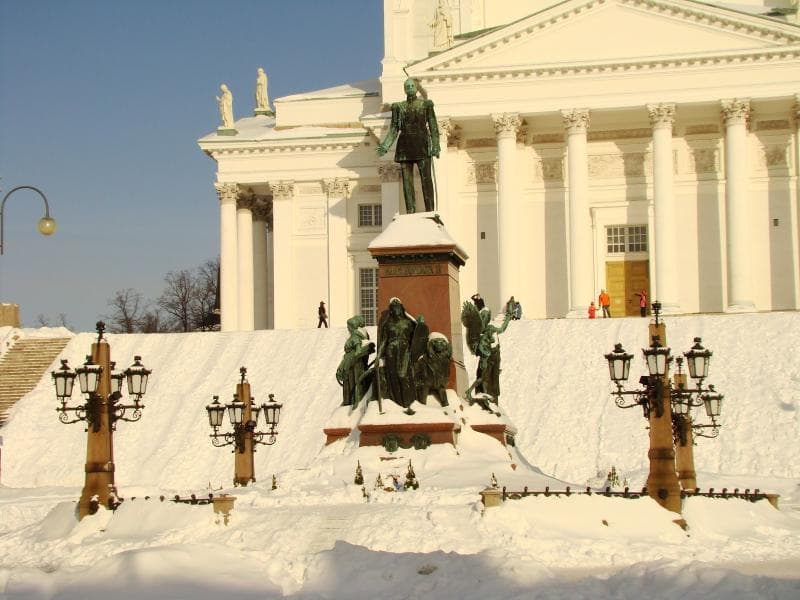
Explore the Statue of Alexander II in Helsinki's Senate Square, a monumental tribute to 'The Good Tsar' and his impact on Finnish autonomy and culture.
Overview
Nestled in the heart of Helsinki's magnificent Senate Square, the Statue of Alexander II stands as a commanding bronze monument, a central focal point amidst the grand Neoclassical architecture that defines this iconic space. It commemorates Russian Emperor Alexander II, who also held the title of Grand Duke of Finland. Erected in 1894, the statue is a significant landmark, drawing the eye upwards to its detailed figure and the symbolic sculptures at its base.
Surrounded by some of Helsinki's most prominent buildings – including the Helsinki Cathedral, the Government Palace, and the University of Helsinki – the statue is not merely a piece of art but an integral part of the city's historical and cultural tapestry. It offers visitors a tangible link to a pivotal era in Finnish history, where political reform and national identity began to flourish.
History & Cultural Background
The story of the Statue of Alexander II is deeply intertwined with Finland's journey toward nationhood. During the 19th century, Finland was an autonomous Grand Duchy under Russian rule. Alexander II, who reigned from 1855 until his assassination in 1881, is particularly revered in Finland as 'The Good Tsar' or 'Tsar Liberator'.
His reign brought about significant reforms that greatly benefited the Finnish people and fostered a stronger sense of national identity. He reconvened the Diet of Finland in 1863, which had been suspended for over half a century, allowing Finns to participate in their own governance. Furthermore, he elevated Finnish to an official language alongside Swedish and introduced Finland's own currency, the Markka. These actions laid much of the groundwork for an independent Finnish state.
The monument was unveiled on April 29, 1894, on the emperor's birthday, in a ceremony that became a widespread patriotic demonstration, highlighting the Finns' gratitude and respect for his contributions. Interestingly, during the later Russification period initiated by his grandson Nicholas II, the statue transformed into a site of passive resistance and anti-Russian demonstrations, as Finns would place flowers on it to remember the liberal emperor and quietly protest the oppressive policies.
What Makes It Special
What makes this statue truly special is its profound symbolism and artistic execution. The central bronze figure depicts Alexander II in the uniform of an officer of the Finnish Guards' Rifle Battalion, captured in the act of giving a speech at the 1863 Diet of Finland. This particular pose emphasizes his role in restoring Finnish legislative power.
The monument's red granite pedestal is adorned with four allegorical sculptures, meticulously crafted to represent the virtues Alexander II promoted: Law (Lex), Work (Labor), Peace (Pax), and Light (Lux). These figures add layers of meaning to the statue, illustrating the foundations of a flourishing society. For instance, the figure representing 'Law' is often interpreted as the Finnish Maiden, wearing a bearskin and accompanied by a lion, symbolizing the protection of the Finnish constitution.
Designed by sculptors Johannes Takanen and Walter Runeberg, the monument stands over 10 meters tall, with Alexander's figure alone measuring 3.23 meters. Its placement in Senate Square, surrounded by Carl Ludvig Engel's harmonious Neoclassical buildings, creates a powerful and cohesive architectural ensemble, making it one of the best examples of Empire-style urban planning.
Stories, Fun Facts & Local Details
One fascinating aspect of the statue's history is the collaborative effort behind its creation. While Johannes Takanen won the initial competition for the memorial, Walter Runeberg, who came in second, was also commissioned to work on it due to the high quality of both entries. Takanen tragically passed away in 1885, leaving Runeberg to complete the work, integrating Takanen's original ideas with his own, particularly regarding the allegorical figures on the pedestal.
The statue's enduring presence in Helsinki is also a testament to its unique significance. Unlike many monuments of Russian rulers in former territories, the Statue of Alexander II remained standing even after Finland gained independence in 1917. This decision reflects the deep respect Finns held for Alexander II, recognizing his role in laying the administrative and cultural groundwork for their independent state, rather than viewing him merely as an imperial oppressor.
Locally, the statue serves as a gathering point and a stage for various events. The patterned pavement surrounding the statue invites visitors to stroll and admire the surrounding historical buildings. The entire Senate Square occasionally hosts concerts, art exhibitions, and even Christmas markets, with the statue silently overseeing the city's vibrant life.
Visitor Perspective
For any traveler exploring Helsinki, the Statue of Alexander II is an unmissable sight, offering both historical depth and aesthetic pleasure. It's often the first stop on many walking tours of the city, providing an excellent introduction to Finland's past. Standing in front of the Helsinki Cathedral, the statue provides a perfect photo opportunity, capturing the grandeur of the square.
Visitors can take their time to observe the intricate details of the bronze figures and contemplate the allegories represented. The serene yet imposing presence of the statue, set against the backdrop of the luminous white cathedral, creates a powerful visual experience. It's a place for quiet reflection on the complexities of history and the enduring legacy of a ruler who, despite his imperial title, fostered the national awakening of Finland. The benches and open space around the monument encourage visitors to pause, soak in the atmosphere, and appreciate the unique blend of history, art, and urban design that defines Helsinki's Senate Square.
Coordinates: 24.952222, 60.169444
View on Google Maps💬 How Travelers Describe This Place
Based on community votes
Unique
826Must See
800Beautiful
387Interesting
242Photogenic
82
Traveler Stories
Discover memorable experiences shared by travelers who have visited this place.
No traveler stories yet.
Be the first traveler to share what made this place memorable.

Tour
By
Spot
Discover amazing places around the world. Your journey starts here.
Explore
© 2026 TourBySpot. All rights reserved.