Statue Colonnades
Budapest, Hungary
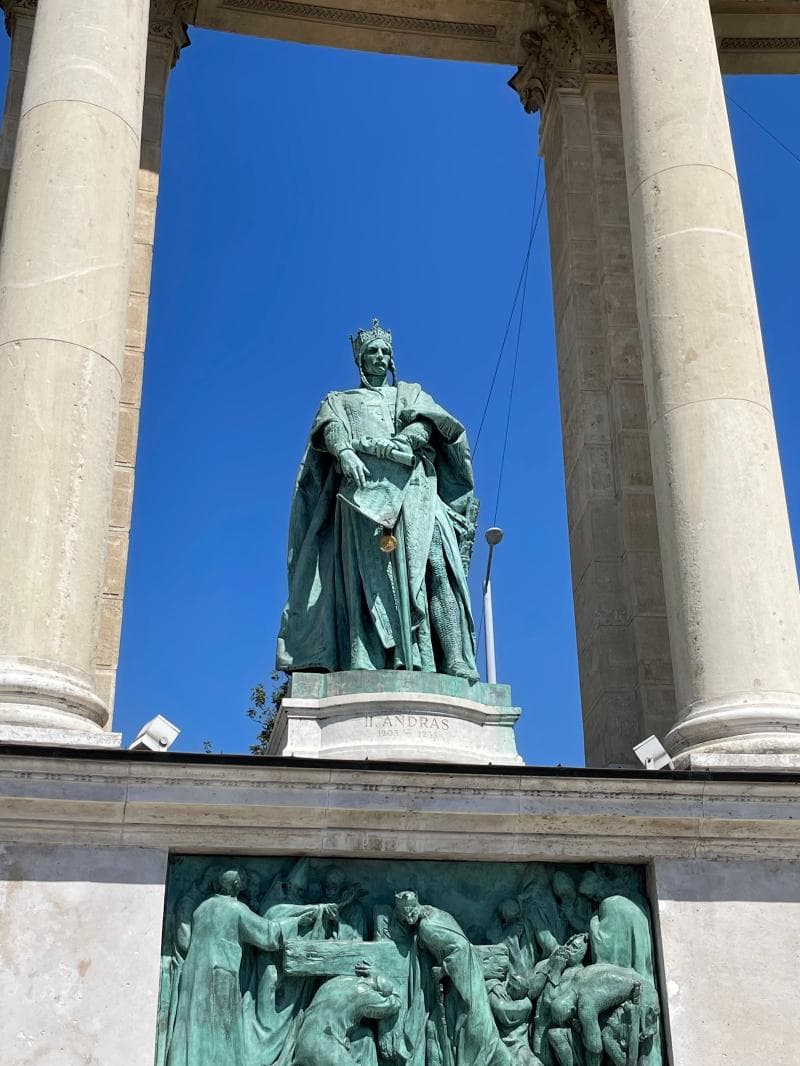
Explore the majestic Statue Colonnades at Heroes’ Square in Budapest, Hungary. Discover Hungary's history through 14 iconic statues and allegorical sculptures.
Overview
At the heart of Budapest's grand Heroes’ Square (Hősök tere) stand the magnificent Statue Colonnades, a central feature of the Millennium Monument. This iconic landmark, a designated UNESCO World Heritage Site since 2002, forms a sweeping embrace around the square's towering central column. It serves as a profound visual narrative of Hungary's rich and often dramatic thousand-year history, presenting a captivating gallery of national heroes and pivotal moments in stone and bronze. The Colonnades, along with the entire monument, were erected to commemorate the millennium of the Hungarian conquest of the Carpathian Basin, making them not merely decorative, but deeply symbolic of the nation's enduring spirit and identity.
Flanking the central column, two symmetrical semicircular colonnades rise majestically, each adorned with seven imposing bronze statues of Hungarian kings, statesmen, and military leaders. These figures, positioned between stately Corinthian columns, tell tales of nation-building, struggles for independence, and cultural flourishing. Above the colonnades, allegorical sculptures depict fundamental human concepts such as War, Peace, Work and Wealth, and Knowledge and Glory, adding layers of universal meaning to this distinctly Hungarian tribute.
History & Cultural Background
The genesis of the Statue Colonnades and the broader Millennium Monument dates back to 1895, as Hungary prepared to celebrate its 1,000th anniversary in 1896. Conceived as a grand national memorial, the monument was designed by the acclaimed architect Albert Schickedanz, with the intricate sculptural work entrusted to György Zala. While the square was largely completed and named by 1900, and officially inaugurated in 1906, the sculptural composition, including the full array of statues within the colonnades, was not entirely finished until 1929.
The cultural significance of the Colonnades is rooted in their purpose: to honor the heroes who shaped Hungary. Initially, some spaces within the left colonnade were reserved for statues of Habsburg rulers, reflecting Hungary's position within the Austro-Hungarian Empire at the time. However, after World War II, as Hungary embarked on a new chapter, these Habsburg figures were replaced with Hungarian national heroes, showcasing a deliberate re-telling of the nation's story through its most revered figures. This alteration highlights the monument's dynamic role as a reflection of Hungary's shifting historical consciousness.
What Makes It Special
What truly distinguishes the Statue Colonnades is their comprehensive portrayal of Hungarian history through a carefully curated selection of its most influential figures. Each of the fourteen nine-foot bronze statues within the colonnades represents a prominent personality, from the very first King of Hungary, Saint Stephen, who established Christianity, to leaders like Lajos Kossuth, a key figure in the 1848 revolution. Below each statue, a bronze relief meticulously illustrates a significant event or characteristic moment from that individual's life, offering visitors a deeper, contextualized understanding of their contributions.
Beyond the individual heroes, the overarching design of the Colonnades, combined with the central column, creates a powerful architectural ensemble. The column itself is crowned by a striking statue of the Archangel Gabriel, holding the Hungarian Holy Crown and the apostolic double cross. At its base, seven mounted bronze statues depict the Magyar chieftains, led by Prince Árpád, who are credited with settling the Hungarian people in the Carpathian Basin. This arrangement offers a symbolic journey from the nation's origins to its pivotal historical epochs, encapsulated within a single, majestic setting.
Stories, Fun Facts & Local Details
One of the most captivating stories associated with the central monument involves the Archangel Gabriel. Legend has it that Gabriel appeared in a dream to Pope Sylvester II, prompting him to grant the Holy Crown to Stephen, thus cementing his status as Hungary's first king. This very statue of Archangel Gabriel was awarded the grand prize at the 1900 Paris World Exhibition, a testament to its artistic merit and national pride.
Another interesting detail is the Memorial Stone of Heroes, often mistakenly referred to as the 'Tomb of the Unknown Soldier.' While it is a solemn cenotaph honoring those who gave their lives for Hungary, no human remains are interred beneath it. It serves as a symbolic tribute, frequently used for wreath-laying ceremonies on national holidays, and its presence underscores the profound respect for historical sacrifice embedded within the square's design.
The square itself has witnessed numerous critical junctures in Hungarian history, serving as a powerful backdrop for both celebratory events and profound political statements. Notably, in 1989, a quarter of a million people gathered here for the historic reburial of Imre Nagy, the prime minister executed after the 1956 uprising, an event that became a significant milestone in Hungary's transition to democracy.
Visitor Perspective
Visiting the Statue Colonnades in Heroes’ Square offers a uniquely immersive journey through Hungarian history. The sheer scale and intricate detail of the monuments are impressive, encouraging visitors to pause and contemplate the stories etched in stone. Whether you're a history enthusiast or simply a curious traveler, the visual impact of the fourteen colossal statues, each accompanied by its narrative relief, provides an accessible and engaging lesson in the nation's past.
The square is easily accessible, located at the end of the iconic Andrássy Avenue and served by the M1 (yellow) metro line, with the Hősök tere station opening directly onto the plaza. Its strategic position also makes it a gateway to City Park (Városliget), home to attractions like Vajdahunyad Castle, the Budapest Zoo, and the famous Széchenyi Thermal Baths, allowing for a multifaceted exploration of Budapest's cultural and recreational offerings. The Colonnades are particularly stunning during the evening, when strategic lighting illuminates the figures, casting a dramatic and memorable glow on these guardians of Hungarian heritage.
Coordinates: 19.07777777777778, 47.515
View on Google Maps💬 How Travelers Describe This Place
Based on community votes
Photogenic
996Must See
953Beautiful
658Interesting
585Unique
69
Traveler Stories
Discover memorable experiences shared by travelers who have visited this place.
No traveler stories yet.
Be the first traveler to share what made this place memorable.

Tour
By
Spot
Discover amazing places around the world. Your journey starts here.
Explore
© 2026 TourBySpot. All rights reserved.